

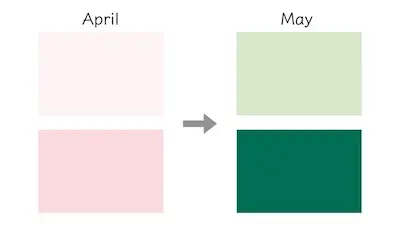
When the cherry blossoms fall, the world changes.
Pink fades, and green slowly appears.
In May, the colors around us shift from pink to green.
Trees grow new leaves. Mountains and parks become full of bright green.
In this way, we can feel the change of seasons through “color” in Japan.
From 桜色 (Sakura-iro, Cherry Blossom Pink) to green.
Nature quietly changes its appearance.
When you notice this change, you can see the flow of the seasons more clearly.
Note: I also introduced traditional Japanese colors like Sakura-iro,Matcha-iro and Ai-iro in my article.
[Why Japanese Colors and i-Adjectives Matter: Master 6 Key Hues].
Seasonal Changes and 萌葱色 (Moegiiro)
-
萌葱色
(Moegi-iro, dark green)
In May, nature becomes full of energy.
Let’s start with the word that best represents this season.
What is 新緑 (Shinryoku)?
Have you ever heard the word 新緑 (Shinryoku, Fresh Greenery)?
This word refers to young, soft green leaves.
They appear from spring to early summer.
In winter, trees lose their leaves. In spring, new leaves appear.
This beautiful scene is called 新緑 (Shinryoku).
You can feel the vitality and energy of growth from these lush, young leaves.
It makes us feel motivated to say, “I’ll do my best!” or “I want to start something new!”
The color that represents this season is 萌葱色 (Moegiiro, Sprouted Onion Green).
I will introduce it next.
What is 萌葱色 (Moegiiro)?
萌葱色 (Moegiiro) is one of Japan’s traditional colors.
It is a bright green with a hint of yellow.
It is similar to the color of newly sprouted leaves.
It is a color where you can truly feel the energy of 新緑 (Shinryoku).
Even within “green,” there are many differences in Japan.
Some greens are deep, some are dark, and others are close to blue.
Among them, 萌葱色 (Moegiiro) evokes a sense of youth and freshness.
As you can see, Japanese has many color names.
They describe subtle differences in nature.
Discover the significance behind Japan’s iconic color.
[Why Is Vermilion (朱) Important in Japan?]
Comparing Similar Colors: 萌葱色 (Moegiiro) vs. 白緑 (Byakuroku)
-
萌葱色
(Moegi-iro, dark green)白緑色
(Byakuroku, light green)
Besides 萌葱色 (Moegiiro), there are other famous traditional green colors in Japan.
Each one has its own image and feeling.
One of them is 白緑 (Byakuroku, Pale Green).
Let’s compare these two colors.
- 萌葱色 (Moegiiro):
A bright, strong green with a yellow tint.
It represents the energy of new sprouts.
They grow quickly under the sun. - 白緑 (Byakuroku): A very pale and quiet green.
It almost looks as if white has been mixed into it.
Originally, this color came from paint made from natural stones.
The stones were finely ground into powder.
Different Impressions of Green
萌葱色 (Moegiiro) gives a feeling of active energy.
In contrast, 白緑 (Byakuroku) evokes quiet and cool air.
Even the same green can feel different in Japanese.
A different name creates a completely different impression.
The History of 萌葱色 (Moegiiro)
萌葱色 (Moegiiro)is a traditional Japanese color.
It has been cherished since ancient times.
Its roots go back to the Heian period (794–1185).
Back then, it was used as a color for clothing.
In the Heian period, every color had its own specific meaning and role.
萌葱色 (Moegiiro) was enjoyed by many people, from nobles to commoners.
It was especially popular among young noblemen.
They used it for clothing linings or accessories like Obi (sashes).
It was a stylish way to create a youthful image.
A Symbol of Kabuki Culture
Later, in the Edo period (1803-1868), it became even more famous.
It was chosen as one of the three iconic colors of the 定式幕 (Jōshiki-maku, Kabuki stage curtain).
This is the traditional curtain used in Kabuki theaters.
The curtain features three distinct stripes.
These are black, 柿色 (Kaki-iro, Persimmon orange), and 萌葱色 (Moegiiro).
In this way, 萌葱色 (Moegiiro) has been part of traditional Japanese scenes.
It remains a beloved color throughout history.
Note: Dive Deeper into Japan’s Palette.
[Traditional Japanese Colors: History, Culture, and Modern Influence]
Breaking Down the Kanji for 萌葱色 (Moegiiro)
The word 萌葱色 (Moegiiro) consists of two Kanji.
- 萌 (Moe): To sprout. It represents a young and new state.
- 葱 (Negi): Green onion. It has a soft and bright green color.
These meanings come together in one color.
It reminds us of fresh sprouts and the bright color of green onions.
When you look at each Kanji, the image of the word becomes clearer.
Also, the word 萌える (Moeru) is used in anime culture today.
It is famous for expressing a feeling of “I love it!”
The original meaning is “plants sprouting.”
However, both meanings share the idea of energy rising from within.
Learning how meanings expand is part of the fun of Japanese.
Conclusion
In Japan, seasons and colors are deeply connected.
萌葱色 (Moegiiro) is a traditional Japanese color.
It represents fresh greenery and new beginnings.
What kind of green do you like?
Do you prefer bright 萌葱色 (Moegiiro) or deep green?
Discover more about Japanese culture in the Japan & Culture category.
Related Posts

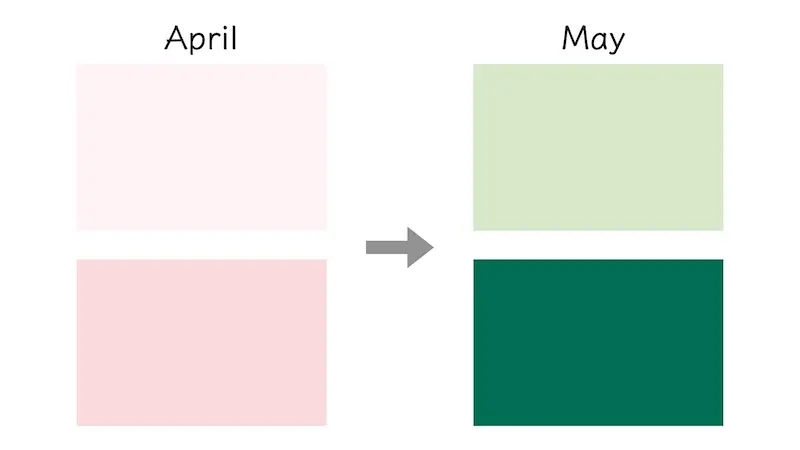
桜が散るころ、景色は少しずつ変わり始めます。
やがて、やわらかな緑が広がり、季節は静かに次へと移っていきます。
5月になると、目に入る色はピンクから緑へと移ります。
木々は新しい葉をつけます。
そして、山や公園は明るい緑でいっぱいになります。
このように、日本では季節の変化を「色」で感じることができます。
桜色から緑へ。自然は静かに姿を変えます。
その変化に気づくと、季節の流れがよりはっきりと見えてきます。
Note: 桜色や抹茶色、藍色など、日本の色についてはこちらです。
[Why Japanese Colors and i-Adjectives Matter: Master 6 Key Hues]
季節の移り変わりと「萌葱色」
5月は、自然がエネルギーでいっぱいになります。
まずは、この季節を象徴する言葉から見ていきましょう。
新緑(しんりょく)とは何か?
「新緑(しんりょく)」という言葉を聞いたことがありますか。
この言葉は、春から初夏にかけて見られる、若くやわらかい葉の緑のことです。
冬の間、木々は葉を落としています。
春になると、新しい葉が出てきます。
このような様子を「新緑」といいます。
青々と茂る若葉から、生命力や成長のエネルギーを感じます。
そして、自分も「頑張ろう」「何か新しいことを始めよう」という活力が湧いてきます。
この「新緑」の季節を代表する色が、次に紹介する「萌葱色」です。
萌葱色(もえぎいろ)とは?
萌葱色は、日本の伝統的な色の一つです。
明るく、少し黄色みのある緑を指します。
新しく芽を出した葉の色に近い色です。
まさに「新緑」のエネルギーを感じる色です。
「緑」といっても、その中には多くの違いがあります。
深い緑もあれば、暗い緑もあります。青に近い緑もあります。
その中で、萌葱色は若さや新鮮さを感じさせる色です。
このように、日本語には自然の細かな違いを表す色の名前が多くあります。
似ている色との比較:萌葱色 vs 白緑(びゃくろく)
「緑」の中には、萌葱色のほかにも有名な伝統色があります。
その一つが「白緑(びゃくろく)」です。
この二つの色を比べてみましょう。
- 萌葱色(もえぎいろ)
黄色が混ざった、明るく強い緑です。
太陽の光を浴びて、ぐんぐん伸びる「新芽」のようなエネルギーがあります。 - 白緑(びゃくろく)
白が混ざったような、とても淡くて静かな緑です。
もともとは、岩石(天然の石)を細かく削って作られた絵具の色です。
萌葱色は「動くエネルギー」を感じさせ、白緑は「静かで涼しい空気」を感じさせます。
同じ緑でも、名前が違うと、受ける印象(イメージ)が全く違います。
萌葱色の歴史
萌葱色は、古くから使われてきた日本の色です。
起源は平安時代にさかのぼります。
当時は、衣装の色の一つとして用いられていました。
平安時代には、色にはそれぞれ意味や役割がありました。
萌葱色は、身分が高い人から庶民まで多くの人が使える色でした。
特に貴族や若い男性に好まれ、着物の裏地(うらじ)や、帯などの小物にもよく使われました。
若々しさをアピールするおしゃれな色だったのですね。
その後、江戸時代になると、歌舞伎の定式幕(じょうしきまく)に使われる三色の一つとして用いられました。
黒、柿色、そして萌葱色です。
このように、萌葱色は時代とともに、日本の伝統的なシーンで親しまれてきました。
*日本の伝統色についてはこちらです。
[Traditional Japanese Colors: History, Culture, and Modern Influence]
「萌葱色」の漢字を分けてみる
「萌葱色」という言葉は、二つの漢字からできています。
- 萌(もえ): 芽が出ること。若く新しい様子を表す。
- 葱(ねぎ): 野菜のねぎ。やわらかく明るい緑色を持つ。
この二つの意味が合わさっています。
芽が出たばかりの緑を思わせ、ねぎのような明るい色も思い出します。
漢字の意味を分けて考えると、言葉のイメージが見えやすくなりますね。
また、「萌える」という言葉は、アニメなどの文化でも使われています。
今では、「好き!」という気持ちを表す言葉としても有名です。
本来の意味は「草木の芽が出ること」です。
どちらも「内側からエネルギーがわき出してくる」という点は共通しています。
こうした言葉の意味の広がりも、日本語の面白さの一つです。
まとめ
日本では、季節と色が深く結びついています。
桜色と聞くと、春を思い浮かべる人が多いでしょう。
萌葱色と聞くと、新緑の季節が思い浮かびます。
「新緑」は、若い葉の色とともに、夏の始まりを伝える言葉です。
そして萌葱色は「伝統的な」色ですが、「新しい」エネルギーを表しています。
1,000年以上もの間、日本人はこの「古い」名前を使って、「新しい」始まりを感じてきました。
5月、あなたも何か新しいことを始めてみませんか。
あなたはどのような「緑」が好きですか。
明るい「萌葱色」ですか。それとも深い緑ですか。
日本の風景を彩る「朱色」に隠された深い意味とは?
[Why Is Vermilion (朱) Important in Japan?]
日本文化についてもっと知りたい方は、Japan & Culture カテゴリをご覧ください。