

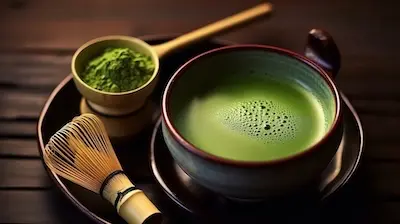
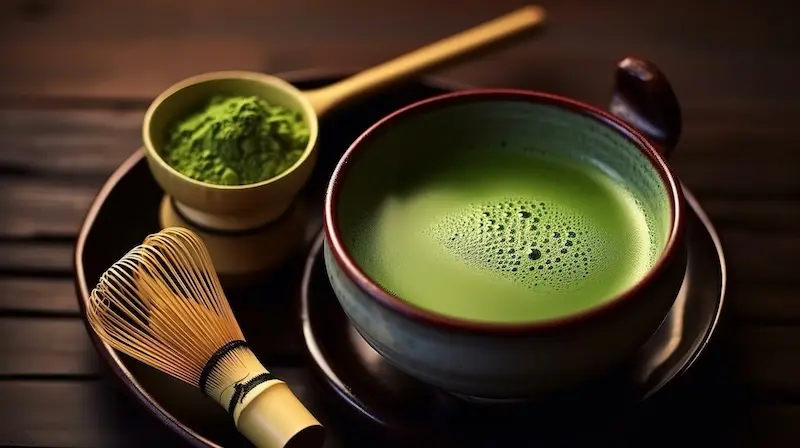
Do you know the word for making 抹茶 (matcha)?
In Japanese, we say 点てる (tateru / to whisk).
We don’t say 淹れる (ireru / to brew).
Actually, this one verb shows a deep culture.
However, matcha is more than just a sweet flavor.
Sweets only show a part of its true charm.
So, what is the difference from regular green tea?
And why is the language for matcha so unique?
Therefore, let’s explore the basics and the culture together.
We will learn about it step by step.
Matcha vs. Green Tea: The Real Secret
Matcha and 緑茶 (ryokucha / green tea) come from the same plant.
However, the growing and processing methods are very different.
What is 碾茶 (tencha / tea for grinding)?
Matcha is made from tea leaves called tencha.
Actually, farmers cover the fields with black cloth before harvest.
They start about 20 days before picking the leaves.
Blocking the sunlight reduces カテキン (katekin / catechin).
The component causes the bitter taste in tea.
Instead, the leaves become rich in テアニン (teanin / theanine).
That nutrient provides a deep and savory flavor.
Finally, the leaves are steamed and dried.
Then, a stone mill grinds them into powder.
The result is the fine powder of matcha.
Comparison: Matcha vs. Green tea
Here are the two main differences summarized.
Actually, the growing and brewing styles are completely unique.
| Item | Matcha | Ggreen tea |
| Cultivation Method | Grown in the shade | Grown in full sun |
| Processing Method | Ground without rolling | Rolled while drying |
| Preparation Method | 点てる ( tateru / whisking) | 淹れる ( ireru / brewing) |
| Nutritional Intake | Consuming the whole leaf | Drinking only the extract |
History of Matcha: From Medicine to Culture
matcha’s history began in the 鎌倉時代 (Kamakura-jidai / Kamakura period).
In 1191, the monk 栄西 (Eisai / a famous monk) brought tea seeds from China.
Initially, the powder served as a form of medicine.
Actually, people used it to stay awake. It also acted as a health tonic.
After the 室町時代 (Muromachi-jidai / Muromachi period), it became a social tool for samurai.
Finally, 千利休 (Sen no Rikyu / the tea master) established 茶道 (sado / tea ceremony).
He perfected the tradition during the 安土桃山時代 (Azuchi-Momoyama-jidai / Azuchi-Momoyama period).
Why We Say 点てる (tateru / to whisk) for Matcha
Japanese verbs often reflect deep cultural backgrounds.
We use specific expressions and tools when making matcha.
The Meaning of the Verb 点てる (tateru / to whisk)
For regular tea or coffee, we use the word 淹れる (ireru / to brew).
However, for matcha, we always say 点てる (tateru / to whisk).
- 淹れる
The act of pouring hot water and waiting for the flavor to extract. - 点てる
The act of mixing powder and hot water vigorously with a 茶筅 (chasen / bamboo whisk).
The character “点” can mean “lighting a fire” or “dropping liquid.”
The action also includes “creating fine foam” with the whisk.
Preparing matcha is more than just making a drink.
The verb implies an active process to complete a perfect bowl.
Essential Tools for Making Matcha
Traditional tools are necessary to whisk matcha correctly.
- 茶筅 (chasen / bamboo whisk)
A bamboo tool that mixes water and matcha powder evenly. - 茶碗 (chawan / tea bowl)
A pottery bowl shaped for easy whisking and drinking. - 茶杓 (chashaku / tea scoop)
A bamboo tool used to scoop the matcha powder.
The role of the whisk is particularly important.
Bamboo flexibility adds air to the tea.
The process creates a mellow and smooth texture.
Using the correct tools truly brings out the quality of the matcha.
The Spirit of Japanese Matcha Culture
Matcha is deeply connected to Japanese language and culture.
Learning the origins of words deepens your understanding of Japan.
Hospitality: 和敬静寂 (wakei seijaku / harmony and respect)
Matcha developed within 茶道 (sado / tea ceremony).
Actually, the ceremony is more than just tea manners.
The culture values space, time, and human relationships.
- 和 (wa / harmony): Valuing balance with others and nature.
- 敬 (kei / respect): Honoring others with a caring heart.
- 清 (sei / purity): Keeping the heart and surroundings clean.
- 寂 (jaku / tranquility): Finding beauty in silence and calm.
These values apply to daily life even today.
Eventually, the spirit created the foundation of modern Japanese おもてなし (omotenashi / hospitality).
One Moment: 一期一会 (ichigo ichie / once in a lifetime)
Whisking matcha follows the spirit of the tea ceremony.
A representative phrase is 一期一会 (Ichigo Ichie).
The expression means “this moment happens only once in a lifetime.”
Therefore, the host does their absolute best for the guest.
The guest then shows deep gratitude for that effort.
Japanese Tea Idioms in Daily Life
Many Japanese expressions come from tea culture.
- お茶を濁す (ocha o nigosu / to make tea cloudy):
The origin comes from people who did not know the rules.
They mixed the tea randomly to hide their ignorance.
Today, it means “to give a vague excuse.” - お茶の子さいさい (ochanoko saisai / easy as tea snacks):
お茶の子 refers to light snacks served with tea.
Because snacks are easy to eat, the phrase means “something is very easy.”
Why Matcha is a Global Success
Today, matcha is a superstar in the world of sweets. There are three key reasons for its global popularity.
- Flavor Pairing
Bitterness balances sweetness perfectly.
It leaves a refreshing aftertaste. Also, it adds richness to dairy products. - Visual Appeal
The vibrant green looks elegant. That natural shade feels safe.
No artificial dyes are needed for a beautiful look. - Health Benefits
You consume the entire leaf in powder form.
Therefore, no nutrients are wasted.
People value these high health effects.
How to Enjoy Authentic Matcha at Home
Matcha is not just a flavor for desserts.
Actually, you can enjoy authentic tea easily at home.
High-quality powder is now available in small amounts.
Therefore, a special tea room is unnecessary.
A mug and one 茶筅 (chasen / bamboo whisk) are enough.
By knowing the authentic taste, you will appreciate commercial matcha sweets even more.
Conclusion: The Beauty of Matcha
Matcha has about 800 years of history in Japan.
Initially, it arrived as a form of medicine.
Later, through samurai culture, it became a global favorite.
The verb 点てる (tateru / to whisk) shows a unique Japanese sensitivity.
The tool 茶筅 (chasen / bamboo whisk) also reflects the cultural spirit.
When you eat matcha sweets next time, remember the roots.
Enjoy the tradition of matcha in your daily life.
Explore the heart of Japanese beauty.
What Is Wabi-Sabi? Understanding Japanese Beauty
Discover more about Japanese culture in the Japan & Culture category.
Related Posts
抹茶を作るとき、なぜ「入れる」ではなく「点てる(たてる)」と言うのでしょうか。
日本語の動詞一つにも、実は深い文化が隠されています。
スイーツとして楽しむだけでは、抹茶の魅力の半分も分かりません。
「緑茶との違いは何?」
「なぜ特別な言葉を使うの?」
その答えを、抹茶の基本から文化的な背景まで、順を追って紐解いていきましょう。
【抹茶と緑茶の違い】原料や製法の秘密
抹茶と一般的な緑茶(煎茶)は、同じ茶葉から作られます。
しかし、栽培方法と加工プロセスが大きく異なります。
抹茶の正体は「碾茶(てんちゃ)」にあり
抹茶の原料は「碾茶(てんちゃ)」という茶葉です。
収穫の約20日前から、茶園を黒い布で覆います。
日光を遮ると、渋みの原因であるカテキンが減ります。
その代わりに、旨味成分のテアニンが豊富になります。
この茶葉を蒸して乾燥させ、石臼で粉末にしたものが抹茶です。
抹茶と緑茶の決定的な差
2つの主な違いをまとめました。
| 抹茶 | 緑茶 | |
| 栽培方法 | 日光を遮る(被覆栽培) | 太陽をたっぷり浴びせる |
| 加工方法 | 揉まずに粉末にする | 揉みながら乾燥させる |
| 調理法 | 点てる(混ぜる) | 淹れる(抽出する) |
| 栄養摂取 | 茶葉を丸ごと摂取する | 水に溶ける成分のみ摂取する |
始まりは「薬」だった?抹茶の意外な歴史
抹茶の歴史は鎌倉時代に始まります。
1191年、僧侶の栄西(えいさい)が中国から種を持ち帰りました。
当初、抹茶は「薬」として利用されていました。
眠気覚ましや滋養強壮に効果があるためです。
室町時代以降、武士の社交道具として普及しました。
安土桃山時代には、千利休が「茶道」を確立しました。
なぜ抹茶だけ「淹れる」ではなく「点てる」?
日本語の動詞には、文化の背景が現れます。
抹茶を作る際には、特有の表現と道具を使います。
動詞「点てる(たてる)」に隠されたもの
一般的なお茶やコーヒーには「淹れる(入れる)」を使います。
しかし、抹茶には必ず「点てる(たてる)」 が使われます。
- 淹れる: 熱湯を注ぎ、時間を置いて成分を抽出する動作。
- 点てる: 茶筅(ちゃせん)で粉とお湯を激しく混ぜる動作。
「点」という字には、火を灯す、あるいは液体を落とす意味があります。
茶筅を振って「細かい泡を立てる」動作も含まれます。
ただ飲み物を作るだけではありません。
そこには、一碗を完成させるという、能動的な意味が込められています。
茶筅(ちゃせん)が命!
抹茶を正しく点てるには、伝統的な道具が必要です。
- 茶筅(ちゃせん): 竹製の道具。お湯と抹茶を均一に混ぜる。
- 茶碗(ちゃわん): 抹茶を点てやすく、飲みやすい形状の器。陶器。
- 茶杓(ちゃしゃく): 竹製で、抹茶をすくうための道具。
特に茶筅の役割は重要です。
竹のしなりで空気を含ませ、口当たりをまろやかにします。
道具を正しく使うことで、抹茶の品質が引き出されます。
抹茶が教える「和の心」
抹茶は日本の言語文化に深く関わっています。
語源を知ることで、日本語への理解が深まります。
おもてなしの根幹「和敬静寂(わけいせいじゃく)」
抹茶は、茶道(さどう)の中で発展してきました。
茶道はお茶を点てる作法だけではありません。
それは、空間や時間、人との関係を大切にする文化です。
- 和(わ):人や自然との調和を大切にすること。
- 敬(けい):相手を思いやり、敬う心。
- 清(せい):心と空間を清らかに保つこと。
- 寂(じゃく):静けさの中にある落ち着きや美しさ。
これらは日常生活にも通じます。
そして、この精神は、現代の日本の「おもてなし」につながっています。
言葉の由来を知る「一期一会」
抹茶を点てる行為は、茶道の精神に基づいています。
代表的な言葉が「一期一会(いちごいちえ)」です。
これは、「この機会は一生に一度きりである」という意味です。
主人は客人のために最善を尽くします。そして、客人はそれに感謝します。
語源から見る「お茶」の慣用句
お茶に関する言葉が、日常的な慣用句になっています。
- お茶を濁す(おちゃをにごす)
作法を知らない人が、適当にかき混ぜて濁らせたことが由来です。
現代では「一時しのぎで誤魔化す」という意味で使われます。 - お茶の子さいさい
「お茶の子」はお茶に添えられるお菓子のことです。
すぐに食べられることから、「非常に簡単であること」です。
抹茶が世界中で愛される3つの理由
現在、抹茶がスイーツとして広く愛されている3つの理由があります。
- 味わいの相性
苦みが甘さを引き立てます。 後味をさっぱりさせます。
乳製品とも合い、コクが深まります。 - 見た目の美しさ
鮮やかな緑色が上品です。
天然の色なので安心感があります。
着色料なしできれいに仕上がります。 - 豊富な栄養成分
茶葉を丸ごと粉末にしています。
栄養を無駄なくとることができます。
健康効果も高く評価されています。
本物の抹茶を日常に取り入れる
抹茶は、スイーツとして楽しむだけではありません。
本来の抹茶を自宅で味わうこともできます。
最近では、質の高い抹茶が少量から購入できます。
特別な茶室は必要ありません。
マグカップと、茶筅(ちゃせん)が一本あれば十分です。
本物の抹茶の味を知ることで、市販の抹茶スイーツの良さもより深く理解できます。
まとめ
抹茶は日本で約800年の歴史を持つ飲み物です。
当初は薬として伝わりました。
そして、武士の文化を経て、現在は世界的な嗜好品となりました。
「点てる」という言葉や、茶筅という道具には、日本独自の感性が含まれています。
次に抹茶スイーツを食べる際は、その原料や原点に触れてみてください。
抹茶という伝統を、ぜひ日常の視点から楽しんでください。
日本の美しさの「心」に触れてみませんか: What Is Wabi-Sabi? Understanding Japanese Beauty
日本文化についてもっと知りたい方は、Japan & Culture カテゴリをご覧ください。