

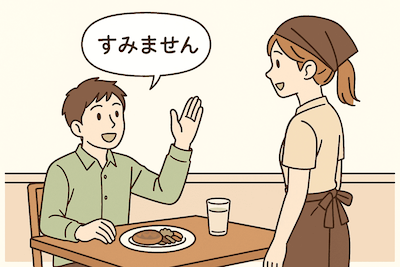

“Sumimasen (すみません)” is a very common and useful word in Japanese.
It’s short, but its meaning changes depending on the situation.
In this article, we’ll look at three main ways to use “sumimasen.”
① Saying Sorry
Use “sumimasen” when you cause trouble for someone or do something impolite.
It has a similar meaning to “gomen nasai” (I’m sorry), but it sounds a little more polite.
Common examples:
- When you bump into someone on a train:
→あっ、すみません!
(a, sumimasen! —“Oh, sorry!”) - When you are late for an appointment:
→すみません、おそく なりました。
(sumimasen, osoku narimashita. — “I’m sorry I’m late.”)
In Japan, being polite is important, so this type of “sumimasen” is used often.
The difference between “sumimasen” and “gomen nasai”
“Sumimasen (すみません)” is more polite than “gomen nasai (ごめんなさい, I’m sorry).”
“Gomen nasai” is often used with close friends or family.
On the other hand, “sumimasen” is more natural when speaking to someone older.
It is also used with people you are not very close to.
This is because, in Japan, it is important to show respect to others.
Not only the words, but also the feeling behind them matters.
② Getting Someone’s Attention
You can also use “sumimasen” when calling someone, like a waiter at a restaurant.
It means something like “Excuse me.” You are not apologizing, but trying to speak politely.
Common examples:
- At a restaurant, when calling the staff:
→ すみません、ちゅうもん おねがいします。
(sumimasen, chuumon onegaishimasu. — “Excuse me, I’d like to order.”) - When you’re lost and ask a stranger:
→ すみません、このへんに えき は ありますか?
(sumimasen, kono hen ni eki wa arimasu ka? — “Excuse me, is there a station around here?”)
This kind of “sumimasen” is often the first thing you say.
You use it when speaking to a stranger, someone older, or a person in a higher position.
③ Saying Thank You
Sometimes, “sumimasen” is used instead of “thank you.”
You say it when someone does something kind for you.
Common examples:
- When someone holds a door open for you:
→ すみません、ありがとうございました。
(sumimasen, arigatou gozaimashita. — “Thank you very much.”) - When someone picks up something you dropped:
→ あっ、すみません!
(a, sumimasen! — “Oh, sorry!”)
This “sumimasen” shows both gratitude and a little apology for causing trouble.
In Japanese, people often use it instead of just saying “thank you.”
A phrase that makes your speech softer
You can use “sumimasen” before making a request or asking a question.
In this case, it is used like this:
- すみませんが、〜
(sumimasen ga, … — “Excuse me, but …”) - すみません、〜してもいいですか?
(sumimasen, … shite mo ii desu ka? — “Excuse me, may I …?”)
When you say this, your request sounds softer.
It also helps the other person prepare for what you are going to say.
So, it is not only for apologizing.
It is also used as a phrase before speaking to make the conversation smoother.
This kind of expression is called a “cushion word.”
In this way, Japanese uses these phrases to show politeness and consideration for others.
Pronunciation change: “sumimasen” → “suimasen”
In everyday conversation, “sumimasen (すみません)” may sound like “suimasen (すいません).”
This happens because the “m” sound in “mi” becomes weak or disappears.
It is a natural change when people speak quickly or casually.
The meaning does not change.
However, in formal situations or when speaking to someone older, it is better to say “sumimasen.”
Summary
“Sumimasen” has three main meanings:
- ① to say sorry,
- ② to get someone’s attention, and
- ③ to say thank you.
It’s an important word in Japanese.
Try using it in real situations, and it will help your Japanese sound more natural.
Japanese has many expressions that reflect its culture. One of them is mottainai:
[Mottainai(もったいない): The Japanese Concept That Teaches Us Not to Waste]
Explore more Japanese expressions in the Japanese Words category.
Related Posts


日本語の「すみません」は、とてもよく使われる便利な言葉です。
短い言葉ですが、使う場面によって意味が変わります。
この記事では、「すみません」の主な3つの使い方を紹介します。
① あやまるときの「すみません」
だれかに迷惑をかけたときや、失礼なことをしたとき。
「ごめんなさい」と同じように「すみません」を使います。
よく使う場面の例:
- 電車の中で人にぶつかってしまったとき
→「あっ、すみません!」 - 約束の時間に遅れてしまったとき
→「すみません、遅くなりました」
日本では、ていねいな態度が大切にされます。
そのため、あやまりの「すみません」はよく使われます。
「すみません」と「ごめんなさい」の違い
「すみません」は「ごめんなさい」より、丁寧な謝罪の言葉です。
親しい友達や家族には「ごめんなさい」を使うことが多いです。
また、目上の人やあまり親しくない人には「すみません」が自然です。
これは日本では、相手に敬意を表す習慣があるからです。
言葉の形だけでなく、気持ちも伝わることが大切です。
② 呼びかけの「すみません」
レストランやお店で店員さんを呼ぶときなど。
「ちょっといいですか?」という気持ちで使います。
あやまっているわけではありません。
ていねいに話しかけたいときに使います。
よく使う場面の例:
- レストランで店員さんを呼ぶとき
→「すみません、注文お願いします」 - 道に迷って、知らない人に聞きたいとき
→「すみません、このへんに駅はありますか?」
この「すみません」は、話しかけるときの第一声として使います。
上司や年上の人、知らない人に話すときに使います。
③ お礼の「すみません」
だれかが自分のために何かしてくれたとき。
「ありがとうございます」の代わりに「すみません」と言うことがあります。
よく使う場面の例:
- ドアを開けてくれた人に
→「すみません、ありがとうございました」 - 落とした物をひろってくれた人に
→「あっ、すみません!」
この「すみません」は、「申しわけない」と「ありがとう」の両方の気持ちが入っています。
とくに日本人は、「ありがとう」だけでなく、「すみません」もお礼としてよく使います。
会話をやわらかくする前置きの言葉
お願いや質問の前に「すみません」を使うことがあります。
このときは次のような形になります。
- 「すみませんが、〜」
- 「すみません、〜してもいいですか?」
このように言うと、相手にやわらかくお願いできます。
さらに、相手にこれから言うことに心の準備をしてもらう役割もあります。
つまり、謝るときだけでなく、会話をスムーズにする前置きの言葉です。
これを「クッション言葉」といいます。
このように、日本語では前置きで相手への配慮や丁寧さを示すことができます。
すみません → すいません の発音変化
日常会話では、「すみません」が「すいません」と聞こえることがあります。
これは「み」の子音(m)が落ちるからです。
口を早く動かすときや話しやすいときに自然に起こります。意味は変わりません。
ただし、フォーマルな場面や目上の人には、「すみません」と言う方が丁寧です。
まとめ
「すみません」は、
- ①あやまるとき
- ②呼びかけるとき
- ③お礼を言うとき
の3つの意味があります。
日本語ではとても大切な言葉です。
いろいろな場面でよく使われるので、会話の中で少しずつ使って、自然に覚えていきましょう。
「すみません」という表現に加えて、日本語には「もったいない」という面白い表現もあります。
→Mottainai(もったいない): The Japanese Concept That Teaches Us Not to Waste
日本語表現についてもっと知りたい方は、Japanese Words カテゴリをご覧ください。