

Japanese Retro Buildings: What Makes Them Unique?
When you see a beautiful building, do you ever think, “That looks lovely”?
But how much can you actually explain about it?
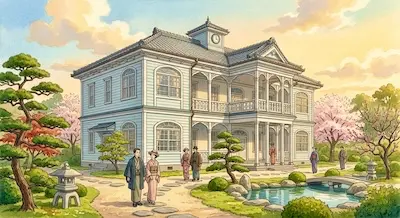
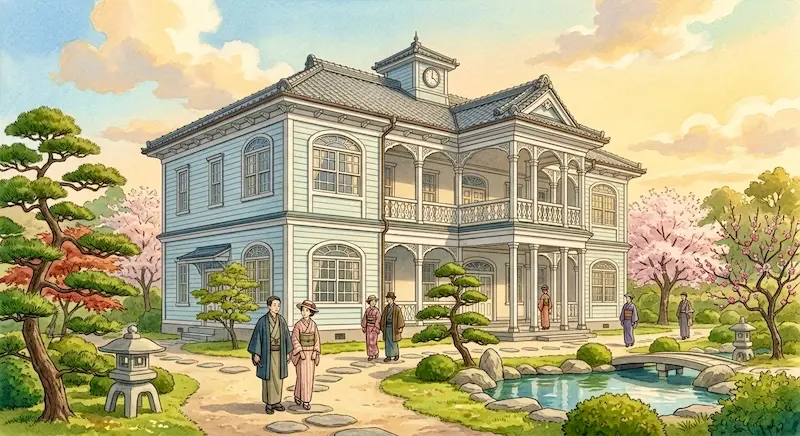
In Japan, there are retro buildings that mix Japanese and Western styles.
Let’s look at one example.
And let’s think about how to express your ideas in your own words.
Background and Features of Retro Buildings
First, we will look at the background of how these buildings were created.
Next, we will explore their main features.
Why Were These Buildings Created?
Japan has retro buildings that combine Japanese and Western styles.
These buildings were constructed from the Meiji period (1868–1912).
They were also built through the early Showa period (1926–early 1930s).
At that time, Japan had just ended a long period of national isolation.
Then, the country began full-scale interaction with foreign nations.
The Meiji government aimed to build a modern nation.
So it actively adopted Western culture and technology.
Architecture was one of the key areas of this transformation.
Buildings Where Japan and the West Are Mixed
As a result, many of these buildings have Western-style exterior walls.
And in some cases, they also include traditional Japanese-style rooms inside.
In this way, you can see two different styles within a single building.
This is one of the key features of Japanese retro architecture.
Knowing Is Not Enough
Next, let’s think about why speaking is necessary.
A Common Situation
Many people know about Japanese culture as knowledge.
However, not many can explain it in their own words.
They know grammar and vocabulary.
But still, some people struggle to express what they really want to say.
What You Will Be Able to Do
My culture course is designed for A2-level Japanese learners.
In the lessons, I ask questions to guide your thinking.
You answer the questions and organize your own ideas.
Then, you gradually build the ability to express them.
You also compare Japanese culture with your own culture and notice the differences.
In this way, you improve your Japanese so you can explain both cultures.
You may also like this article on retro buildings:
[Visit the “Godzilla Minus One” Set: Discover Showa Retro Architecture]
Try a Part of the Lesson
Now, let’s try thinking a little together.
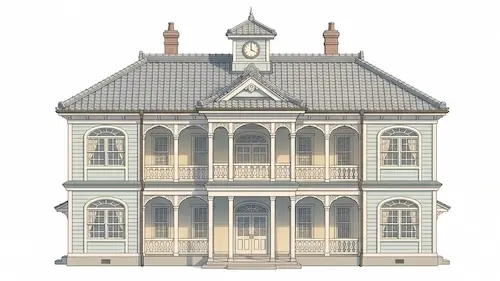
- この建物を見て、何を思いますか?
(What do you think when you see this building?) - どこが日本らしいですか?どこが西洋らしいですか?
(What parts feel Japanese? What parts feel Western?) - あなたの国にも、ちがう文化がまざった建物はありますか?
(Are there buildings in your country that mix different cultures?)
Answering these kinds of questions is speaking practice.
It’s okay if you cannot express everything perfectly.
I will help you so you can say it step by step.
When You Can Speak, Your Perspective Changes
Finally, let’s summarize the key points.
Retro buildings are unique structures that mix Japanese and Western styles.
First, you think about how you feel when you see them.
Then, you put those thoughts into words.
By doing this, your way of seeing things changes.
The same is true when you travel in Japan.
You can observe buildings and towns more deeply.
You are not just listening to a guide’s explanation.
You can also share what you feel in your own words.
You also think about your own culture.
And you become able to explain it more clearly.
About the Lessons
This article introduced one of the themes from my lessons: retro buildings in Japan.
The course, The 10-Theme Journey: Japanese Culture, is based on 9 cultural themes.
The 9 cultural themes are introduced in the pre-lesson. You can start from around A2 level.
In the final lesson, you will review everything you have learned.
You will also share your thoughts in your own words.
After completing the course, you will receive a certificate of completion.
Before starting the main course, there is a pre-lesson.
In this lesson, you can explore the learning style through a short practice lesson with a different theme.
If you are interested, you can find more details about the lessons here.
See available times and lesson details.
Try a Lesson