

- Discover the History Behind Demon Slayer: The Taisho Era
- Key Vocabulary to Understand the Taisho Era
- Understanding Taisho Roman: Culture and Style
- Natsume Soseki and the Spirit of the Taisho Era
- Conclusion: Why Taisho Roman Matters Today
- 大正時代と鬼滅の刃:物語の背景にある歴史
- 知っておきたい大切な日本語キーワード
- 文化・スタイル・精神で見る大正ロマン
- 夏目漱石と大正時代の心
- まとめ:なぜ大正ロマンは今も大切なのか
Discover the History Behind Demon Slayer: The Taisho Era
The world of Demon Slayer (『鬼滅の刃』) has a mysterious charm.
Characters wear traditional kimonos (着物) and carry swords (Katana, 刀).
Meanwhile, trains run through streets lit by electric lamps.
For Japanese people, this mix feels like a nostalgic past.
However, it may look unique and strange to international fans.
Here, “the old” and “the new” exist at the same time.
This aesthetic is based on the Taisho era (大正時代, 1912–1926).
How Historically Accurate is Demon Slayer?
The world of Demon Slayer differs slightly from the real Taisho era.
For example, look at the swords.
In reality, the 1876 Act banned swords.
This law happened in the Meiji era.
Therefore, people did not carry them daily.
Yet, in the anime, swords and modern life coexist.
The series is not a perfect historical replica, but a cultural expression.
This “slightly unreal but convincing feeling” is what we call Taisho Roman (大正ロマン).
Have you ever felt that the outfits or streets in the anime were stylish?
That feeling is your first step into the world of Taisho Roman.
Key Vocabulary to Understand the Taisho Era
In this section, I introduce essential terms to help you understand this period.
- Wayou Secchu (和洋折衷)
Mixing Japanese and Western cultures.
Example: Wearing boots with a hakama (袴).
Western furniture in Japanese rooms. - Haikara (ハイカラ)
A trend admiring Western fashion.
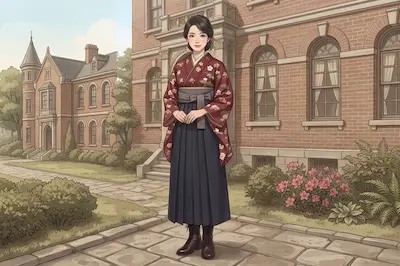
Young people began wearing hats and Western clothes. - Hakama (袴)
A traditional Japanese garment worn over a kimono (着物).
It is a skirt-like piece of clothing.
A symbol of “Wa (和)” (Japanese style). - Bungo (文豪)
Great literary masters.
They wrote about changing emotions in society.
Understanding Taisho Roman: Culture and Style
Taisho Roman refers to the vibrant culture of the Taisho era (1912–1926).
During this time, Japan embraced Western culture.
Also, people continued to value their own traditions.
In addition, this unique blend created the background of Taisho Roman.
Taisho Roman in Architecture, Fashion, and Art
Taisho Roman is visible in buildings, clothing, and art.
Here are the key elements:
- Architecture
Western designs were introduced.
Japanese decorations were used at the same time. - Fashion
Men in suits (Modern Boys) became popular.
Also, more women wore Western dresses (Modern Girls).
Moreover, hairstyles shifted to Western styles.
Hairstyles also shifted to Western styles. - Art
Romantic works appeared on paintings and magazine covers.
Western design elements were widely adopted.
The Origin of the Word “Roman”
“Roman“refers to a mindset that values ideals and emotions.
First, it entered Japanese under the influence of Romanticism.
Next, writers like Natsume Soseki chose the kanji “浪漫”.
Later, this term became a permanent part of the language.
Natsume Soseki and the Spirit of the Taisho Era
Natsume Soseki (夏目漱石) deeply observed the inner lives of people during this era.
Before his literary career, he taught English during the Meiji era.
He also studied in England.
In addition, this gave him a global perspective.
At the same time, he valued traditional Japanese beliefs.
During this period, people felt torn between Western values and traditions.
Soseki captured this psychological struggle in his famous works.
Tradition vs. Modernization: Conflict in Taisho Literature
- Soseki’s works focus on modernization stress.
- He explored conflicts between freedom and tradition.
- Thus, his stories show the changing hearts of that era.
Changes in Japanese: What is Genbun Itchi?
Until the Meiji era, written and spoken Japanese were very different.
Written text followed strict traditions, far from daily conversation.
During the Taisho era, a movement called “Genbun Itchi” progressed.
This changed written language.
Specifically, written Japanese became closer to spoken speech.
Therefore, the writing style became more natural.
Newspapers and novels quickly adopted this new style.
Japanese evolved into a new form.
It began to match real-life conversation.
My ancestor crafted the personal seal (hanko) for Natsume Soseki.
I introduce this story in the following article.
[Discovering My Roots: My Ancestor’s Secret Connection to Natsume Soseki]
Conclusion: Why Taisho Roman Matters Today
Taisho Roman blends Japanese and Western styles.
It shines in fashion, language, and art.
People honored traditions while embracing new ideas.
This free spirit still fascinates us today.
Understanding this history connects you deeply to the stories.
Discover more about Japanese culture in the Japan & Culture category.
Related Posts
大正時代と鬼滅の刃:物語の背景にある歴史
『鬼滅の刃』の世界は、不思議な魅力があります。
登場人物は着物を着て、登場人物は着物を着て、刀を手にしています。
その一方で、街には電車が走り、電灯が灯っています。
こうした組み合わせは、日本人にとっては昔の話だなと思う程度です。
しかし、海外の人にとっては少し不思議に見えるかもしれません。
ここには、「古いもの」と「新しいもの」が同時に存在しています。
その背景にあるのが、大正という時代 (1912〜1926) のイメージです。
鬼滅の刃はどこまで史実に忠実か?
ただし、この鬼滅の世界は、現実の大正時代と少し違うところがあります。
たとえば、「刀」です。
すでに明治時代の廃刀令(1876年)によって、日常では使われていませんでした。
それでも『鬼滅の刃』では、刀と近代的な生活が共存しています。
このアニメは、歴史の正確な再現ではなく、文化的なイメージの表現です。
この「現実とは少し違うけど、どこか納得できる感覚」。
それを理解する手がかりが、「大正ロマン」にあります。
『鬼滅の刃』を見て、「この服や街並み、おしゃれだな」と思ったシーンはありますか?
その感覚こそが、実は「大正ロマン」の入り口かもしれません。
知っておきたい大切な日本語キーワード
このパートでは、大正時代を理解するための言葉をご紹介します。
- 和洋折衷
日本と西洋の文化が混ざり合うこと。
たとえば、袴にブーツを合わせることがあります。
また、和風建築の中に洋風家具を置くこともあります。 - ハイカラ
西洋の新しい文化やファッションへの、憧れを表す言葉。
当時の都市では、帽子や洋服を取り入れた若者が増えました。 - 袴
伝統的な服装の一つ。
着物の上にまとい、スカート型のもの。
特に女学生の制服として着られ、和の要素を象徴しています。 - 文豪
当時を代表する作家たちのこと。
社会の変化の中で、人々の心の揺れや価値観を作品に描きました。
文化・スタイル・精神で見る大正ロマン
「大正ロマン」は、大正時代 (1912〜1926) の華やかな文化のことです。
この時代、日本は伝統を大切にしながら、西洋文化も積極的に取り入れていました。
街や暮らしは、日本文化と西洋から入ってきた新しいものが混ざっていました。
それが、大正ロマンと呼ばれる文化の背景です。
建築・ファッション・アートに見る大正ロマン
大正ロマンは、建物や服装、アートに現れています。
主な要素は次の通りです。
- 建築
洋風のデザインが取り入れられました。
和の装飾も同時に使われています。 - ファッション
スーツを着る男性(モダンボーイ)や洋装の女性(モダンガール)も増えました。
また、ヘアスタイルも洋風になりました。 - アート
絵画や雑誌の表紙に、浪漫的な作品が描かれました。
西洋風のデザインも取り入れられています。
「ロマン」という言葉の由来
「ロマン」とは理想や感情を大切にする心の動きのことです。
西洋のロマン主義の影響を受けて、日本語に取り入れられました。
また、「浪漫」という言葉は、夏目漱石らが当て字として用いました。
その後、文学や文化の中で使われ続け、日本語として定着しました。
そして「大正ロマン」という言葉は、1960年代末から1970年代前半に広まりました。
夏目漱石と大正時代の心
夏目漱石は、この時代の内面を深く見つめた作家です。
彼は明治期に英語の教師としても活躍していました。
またイギリス留学も経験しています。
同時に、日本の伝統的な価値観も大切にしていました。
この時代、人々は新しい価値観と伝統の間で揺れていました。
夏目漱石はその心理を作品に描きました。
伝統と近代化:大正文学に描かれた葛藤
- 漱石の作品は、人々が近代化の中で感じる違和感がテーマになっています。
- 個人の自由や理想と、伝統的価値観との葛藤が描かれています。
- これを通して、大正時代の心の動きや文化の変化が見えてきます。
大正時代の日本語の変化:言文一致とは
明治時代まで、書き言葉と話し言葉は大きく異なっていました。
文章は伝統的な形式に縛られ、日常会話とはかけ離れていました。
大正時代になると、「言文一致」が進みました。
書き言葉が話し言葉に近づき、自然な文章が増えていきます。
そして、新聞や小説にもこの傾向が現れました。
これにより、日本語はより現実の会話に沿った形に変わりました。
私の先祖は、夏目漱石の印章を制作しました。
こちらの記事で紹介しています。
[Discovering My Roots: My Ancestor’s Secret Connection to Natsume Soseki]
まとめ:なぜ大正ロマンは今も大切なのか
大正ロマンは、和と洋が混ざり合ったエネルギッシュな文化です。
ファッションや言葉など、いろいろな場面でその魅力が見られます。
当時の人々は、新しいものを取り入れつつ、日本の伝統も大切にしました。
その自由な精神が、現代の私たちの心も惹きつけるのでしょう。
時代背景を知ることで、物語の世界がもっと身近に感じられるようになります。
日本文化についてもっと知りたい方は、Japan & Culture カテゴリをご覧ください。