

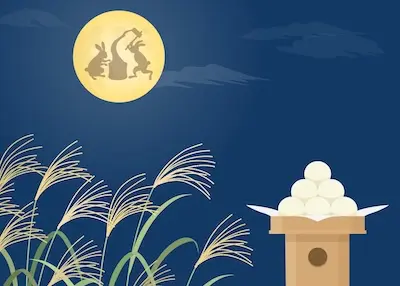
What is Otsukimi?
Tsukimi Japanese Moon Viewing is a beautiful tradition.
It is also known as Otsukimi (お月見).
The main event is Jyugoya (十五夜).
It refers to the night of August 15th in the old lunar calendar.
On the modern calendar, this usually falls in September or October.
People view the moon in autumn.
It is the most beautiful time of year.
The air becomes crisp, and the humidity drops.
As a result, the moon looks very bright and clear.
In Japan, this full moon is known as Chushu no Meigetsu (中秋の名月).
It means the “Mid-Autumn Moon.”
The History of Otsukimi
Otsukimi came from China during the Heian period.
At that time, nobles did not look directly at the moon.
Instead, they looked at the moon’s reflection on the water or in sakazuki (盃, sake cups).
This is the origin of the Japanese aesthetic called furyu (風流).
During the Edo period, Otsukimi spread to common people.
First, it was an event to enjoy the moon.
Second, it was a time to give thanks for the harvest.
This season is the harvest time for satoimo (里芋, taro roots).
Therefore, Jyugoya is also known by another name, Imo-meigetsu (芋名月).
Why is There a Rabbit on the Moon?
In Japan, people have traditionally told stories about a rabbit living on the moon.
This comes from an ancient Buddhist legend.
Long ago, a monkey, a fox, and a rabbit met an old man.
He was very hungry.
The monkey and fox found food.
However, the rabbit found nothing.
The rabbit said, “Please eat me.” Then, he jumped into a fire.
Actually, the old man was a god in disguise.
The god was deeply moved by the rabbit’s kind heart.
To honor the rabbit forever, the god took him to the moon.
In Japanese, the full moon is called Mochizuki (望月).
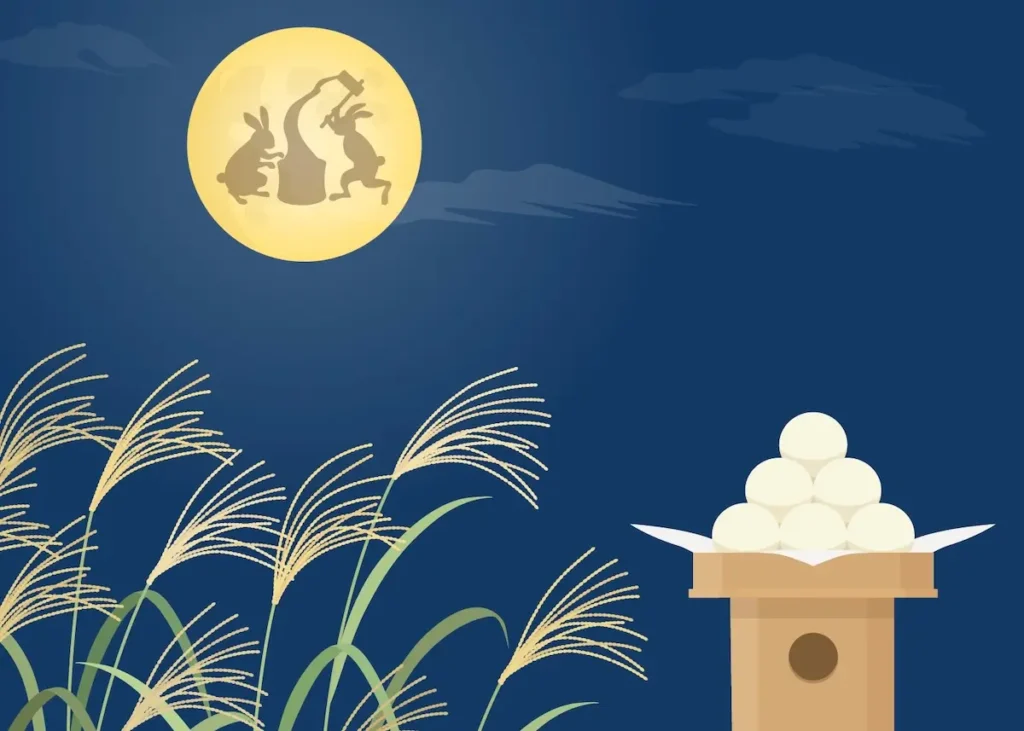
People say the rabbit is making rice cakes (Mochitsuki, 餅つき) on the moon.
These two words sound very similar.
What People See in the Moon Around the World
People all over the world look at the same moon.
However, how we see the patterns is different depending on the culture.
- Japan, Korea, and China: A rabbit making rice cakes.
- USA and Europe: A human face.
- Northern Europe: Two children carrying a bucket.
- Southern Europe: A large crab.
- Middle East: A roaring lion.
What is said to be visible in the moon in your country?
Items to Enjoy Otsukimi
Decorations for Otsukimi express gratitude toward nature.
- Tsukimi Dango:
People stack 15 rice dumplings into a pyramid.
Their round shape represents the full moon.
People offer these dumplings first.
Then, they eat them to pray for health and happiness. - Susuki (Silver Grass):
People display Susuki because it looks like ears of rice.
It is an offering to show thanks for the harvest.
Also, people believe its sharp edges act as a charm to ward off evil.
Modern Style: Tsukimi Burgers
In modern Japan, there is a popular autumn tradition called the “Tsukimi Burger.“
In September, many fast-food chains release special burgers.
These burgers contain a fried egg inside.
The round yellow yolk is meant to look like the full moon.
This is a new way to enjoy Otsukimi that fits today’s lifestyle.
The Unique “Jusanya”: Japan’s Own Moon Viewing
Japan has another important moon-viewing night.
It is called Jusanya (十三夜).
This culture is unique to Japan.
The moon on this night is not perfectly round.
However, Japanese people appreciate its “incomplete beauty.”
This is a very traditional Japanese sensibility.
Viewing the moon on only one night is called Kata-tsukimi (片月見).
This is a special term in Japan.
In the past, this was considered bad luck.
Therefore, it was proper manner to enjoy the moon on both nights.
Soseki’s Translation: “The Moon is Beautiful, Isn’t It?”
The novelist Soseki Natsume translated “I love you” in a unique way.
This story is very famous in Japan.
He translated it as “Tsuki ga kirei desu ne“.(月がきれいですね。)
This means, “The moon is beautiful, isn’t it?”
This expression does not convey feelings directly.
Instead, it entrusts the message to the scenery.
This phrase captures the modest and delicate sensibility of the Japanese people.
The custom of Otsukimi still reflects this spirit today.
*Note: Soseki deeply loved Hanko (personal seals).
In fact, my ancestor had the special honor of carving seals for him.
Please explore the artistic side of this literary legend here.
[Natsume Soseki and His Hanko: Literary and Artistic Legacy]
Conclusion
Otsukimi is an important event filled with gratitude and prayers for nature.
This custom has continued since the Heian period.
Although its form has changed over time, it is still cherished today.
The Japanese love for the beautiful moon remains the same.
This spirit has not changed since the past.
Tonight, please look up at the night sky.
I hope you enjoy a peaceful moment with the moon.
Discover more about Japanese culture in the Japan & Culture category.
Related Posts
 Washi (和紙) in Japan: Learn Japanese Words and Culture
 Discover Japan Through Washoku (和食)
「お月見」とは?
日本には、秋の美しい月を眺める「お月見(おつきみ)」という習慣があります。
中心となるのが「十五夜(じゅうごや)」です。
旧暦の8月15日の夜を指します。
現在の暦では、毎年9月か10月ごろになります。
秋にお月見をするのは、一年で最も月が美しいからです。
秋は空気が澄み、 湿度が下がります。
そのため、月がとても明るく、はっきりと見えます。
この時期の満月を、日本では「中秋の名月(ちゅうしゅうのめいげつ)」と呼びます。
お月見の歴史
お月見は平安時代に中国から伝わりました。
当時の貴族は、月を直接見ませんでした。
池の水面や、盃(さかずき)に映る月を眺めて楽しみました。
これは日本人の美意識「風流(ふうりゅう)」の原点と言えます。
江戸時代になると、お月見は庶民にも広がりました。
庶民にとって、お月見は「収穫に感謝する行事」でした。
この時期は里芋(さといも)の収穫期です。
そのため、十五夜は別名「芋名月(いもめいげつ)」とも呼ばれます。
なぜ月にウサギがいるのか?
日本では昔から、「月にウサギがいる」と言い伝えられています。
これには、仏教の古い伝説が関係しています。
昔、サル、キツネ、ウサギが、空腹の老人に会いました。
サルとキツネは食べ物を見つけましたが、ウサギは何も見つけられませんでした。
悩んだウサギは「私を食べてください」と言い、自ら火の中に飛び込みました。
老人は神様の化身(けしん)でした。
神様はウサギの優しい心に感動しました。
そして、その姿を永遠に残すために、ウサギを月へと連れて行ったのです。
満月を意味する「望月(もちづき)」という言葉があります。
月で餅をついているのは、「望月」と「餅つき」の音が似ているからだと言われています。
世界の人たちが月の中に何を見ているか
世界中で同じ月を見ていますが、模様の捉え方は文化によって異なります。
- 日本・韓国・中国: 餅をつくウサギ
- アメリカ・ヨーロッパ: 人の顔。
- 北欧: 桶を運ぶ二人の子供。
- 南欧(カニ): 大きなカニ。
- 中東(ライオン): 吠えているライオン
あなたの国では、月の中に何が見えると言われていますか?
お月見を楽しむために
お月見の飾りには、自然への感謝が込められています。
- 月見団子:
15個の団子を積み上げます。
丸い形は満月を表しています。
お供えした後に食べることで、健康と幸せを願います。 - ススキ:
お米の稲穂(いなほ)に似ているため、収穫への感謝として飾ります。
また、鋭い切り口が「魔除け」になるとも信じられています。
現代のスタイル:月見バーガー
現代の日本には「月見バーガー」という秋の恒例メニューがあります。
9月になると、多くのハンバーガーチェーンで目玉焼き入りのバーガーが販売されます。
黄身を満月に見立てたメニューです。
今のライフスタイルに合った、新しいお月見の形ですね。
日本独自の「十三夜」と美しい表現
日本には「十三夜(じゅうさんや)」という、もう一つのお月見があります。
これは日本独自の文化です。
少し欠けた月に「未完成の美」を感じる、日本らしい感性です。
十五夜だけを見るのは「片月見(かたつきみ)」と呼ばれます。
昔は、縁起が悪いとされ、両方の月を愛でるのがマナーでした。
漱石の訳「月が綺麗ですね」
文豪・夏目漱石は「I love you」を「月が綺麗ですね」と訳したそうです。
想いを直接伝えず、風景に託す表現です。
日本らしい奥ゆかしい感性が、この言葉には込められています。
お月見の習慣には、こうした日本人の心が今も息づいています。
*漱石は「印章」をこよなく愛していました。
私の先祖が彼の印を彫ったという特別な縁もあります。
文豪の芸術的な一面をぜひご覧ください。
[Natsume Soseki and His Hanko: Literary and Artistic Legacy]
まとめ
お月見は、自然への感謝や祈りが込められた大切な行事です。
平安時代から続くこの習慣は、形を変えながら今も大切にされています。
月を愛でる日本人の心は、昔も今も変わりません。
今夜はぜひ夜空を見上げて、お月様との静かな時間を楽しんでみてください。
日本文化についてもっと知りたい方は、Japan & Culture カテゴリをご覧ください。