

Discover Japanese Colors: Sakura Pink to Matcha Green
あかいの はな (Akai no hana, red flower).
This is a common mistake among Chinese learners.
They tend to replace the Chinese particle 的 (de) with the Japanese の (no).
In contrast, English speakers naturally say あかい はな (Akai hana, red flower).
It matches the “red flower” structure in English.
However, they sometimes say ピンク はな (Pinku hana, pink flower) by omitting the の (no).
Even a single color expression reveals unique Japanese rules and culture.
Why Japanese Colors Are Special
Japanese colors link deeply to nature and culture. Many names originate from the environment.
Examples:
- 桜色 (Sakura-iro, cherry blossom pink)
- 藍色 (Ai-iro, indigo blue)
- 抹茶色 (Matcha-iro, powdered green tea green)
Hues reflect landscapes and daily life. Such names evoke specific scenes and seasons.
This imagery marks a distinct linguistic feature.
Moreover, colors tie strongly to seasons.
桜色 (Sakura-iro, cherry blossom pink) symbolizes spring.
紅葉 (Momiji, autumn leaves) red represents autumn. Shifting colors reflect the passage of time.
Finally, colors are embedded in culture. They appear in kimono, crafts, and food. In Japan, colors play a vital role.
The Structure of Japanese Colors
Japanese color grammar reveals intriguing patterns.
Forms shift between nouns and i-adjectives. Usage dictates these changes.
あお (Ao, blue) functions as a noun. In contrast, あおい (Aoi, blue) serves as an i-adjective.
The noun あお (Ao) names the color itself. The adjective あおい (Aoi) describes an object’s property.
Examples:
- このクレヨンは あおです。 (Kono kureyon wa ao desu, This crayon is blue).
(Crayon equals blue) - あおい クレヨンで、そらを かきます。 (Aoi kureyon de, sora o kakimasu, I draw the sky with a blue crayon).
(Describing the crayon)
Even the same color adapts its form to its grammatical role.
The Rules for “-i” Adjective Colors
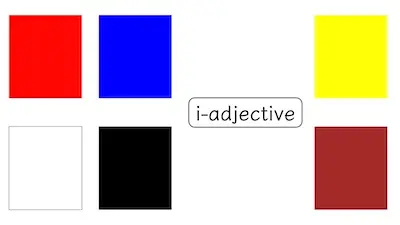
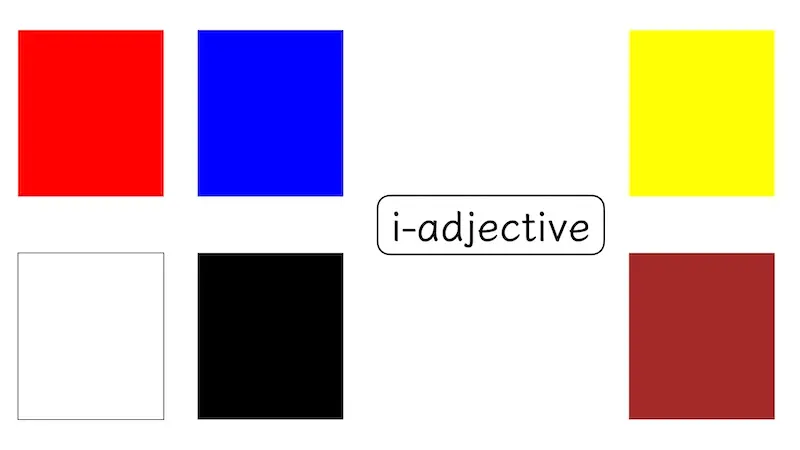
Only four colors function as direct i-adjectives.
- あか (Aka, red), あお (Ao, blue), しろ (Shiro, white), くろ (Kuro, black): Add い (i).
-
あか
(Aka, red)あお
(Ao, blue)しろ
(Shiro, white)くろ
(Kuro, black)
- きいろ (Kiiro, yellow),ちゃいろ (Chairo, brown): Add いろ (iro) + い (i).
-
きいろ
(Kiiro, yellow)ちゃいろ
(Chairo, brown)
The Four Fundamental Colors
History explains this grammatical split.
あか (Aka), あお (Ao), しろ (Shiro), and くろ (Kuro) represent Japan’s most ancient, fundamental hues.
Consequently, they evolved into adjectives early on.
These are あかい (Akai), あおい (Aoi), しろい (Shiroi), and くろい (Kuroi).
Yellow and Brown Colors
Meanwhile, きいろ (Kiiro) and ちゃいろ (Chairo) originally functioned as nouns.
Thus, their adjective forms require いろ (iro, color) before adding い (i).
This creates きいろい (Kiiroi) and ちゃいろい (Chairoi).
No other colors follow the 〜い (-i) rule. Others require the particle の (no). Examples:
- ピンクいろの はな (Pinku-iro no hana, pink flower)
- むらさきいろの きもの (Murasaki-iro no kimono, purple kimono)
Master the four colors: あかい, あおい, しろい, and くろい. Also remember きいろい and ちゃいろい.
Learning these six colors prevents the error mentioned earlier.
The Broad Meaning of Blue in Japanese
In Japanese, あお (ao) aooriginally covered both blue and green.
It was also used for the bright green of plants.
Because of this history, あお is still used today.It can describe things that are fresh or not fully mature.
Ao in Everyday Life — Apples as an Example
In Japan, apples are usually red.So when people say りんご(ringo, apple), they often mean:
あかい りんご (akai ringo, red apple)
However, green apples are called: あお りんご (ao ringo, green apple)
In contrast, English uses “green apple” based on visual appearance.It describes the color as it is seen.
Interestingly, Japanese does not say: みどりりんご (midori ringo, green apple)
Instead, it retains the historical use of: あお
In addition, あお extends beyond color terms.
For example: 青二才 (ao nisai, greenhorn). This refers to someone who is inexperienced.
In this way, Japanese color terms convey more than visual information. They also reflect states and imagery.
Colors That Tell a Story
Each color has unique meanings and backgrounds in Japan.
Sakura-iro (さくらいろ, cherry blossom pink) — Spring and Ephemeral Beauty
-
さくらいろ
(Sakurairo, cherry pink)
さくらいろ (Sakura-iro, cherry blossom pink) is a soft pink color. It looks like cherry blossoms.
It is gentle and does not stand out. Even fully bloomed cherry blossoms are soft and delicate.
In Japan, people appreciate not only the full bloom. They also admire the moment when petals fall.
The beauty comes from its fleeting nature.
Therefore, sakura-iro represents the beginning of spring. It also conveys a sense of transience and gentle sadness.
Sakura pink is a special color that represents spring in Japan:Why Are Cherry Blossoms So Special in Japan?
Ai-iro (あいいろ, indigo blue) — Daily Life and Tradition
-
あいいろ
(Aiiro, traditional indigo)
あいいろ (Ai-iro, indigo blue) is a deep, calm blue. It has been used in everyday life for centuries.
Indigo dye was common in clothing. Ordinary people wore it too.
Ai-iro also had practical benefits. It could prevent insects and odors.
It is a color rooted in daily life. Its natural beauty is valued.
Indigo is a traditional color often used in yukata: What Is Yukata? Meaning, History, and Summer Culture
Matcha-iro (まっちゃいろ, matcha green) — Food and Aesthetic Sense
-
まっちゃいろ
(Macchairo, matcha green)
まっちゃいろ (Matcha-iro, matcha green) comes from the color of matcha tea.
It is a soft, calm green. It is closely associated with tea ceremonies and Japanese sweets.
In tea ceremonies, calmness and harmony are more important than flashiness.
Matcha-iro reflects this aesthetic sense.
Additionally, matcha-iro connects not only to appearance but also to taste and aroma.
Its color extends across the senses. This is a defining feature.
Matcha green is a calm color that reflects traditional Japanese culture: Why Do We Whisk (tateru) Matcha?
Japanese Way of Seeing Colors
The way Japanese use colors reflects their way of thinking.
Perception by Feeling, Not Classification
In English, colors are clearly classified. For example: red, blue, green.
In Japanese, colors are used more by feeling.Exact distinctions are less important than natural use and tradition.
This is why あお (ao, blue) can include green.Such expressions are widely accepted in Japanese.
Colors Express Emotion and Time
Japanese colors are also linked to emotions and time.
さくらいろ (Sakura-iro, cherry blossom pink) represents spring.
It also conveys a fleeting beauty, since cherry blossoms quickly fall.
Through colors, people can feel seasonal changes and brief moments of beauty.
In other words, colors are connected not only to what you see, but also to time and memory.
In Japanese, colors relate to how we feel.
Conclusion
Japanese colors are closely connected to nature, culture, and emotions.
They also have unique grammatical features.
For example, あおい (aoi, blue) can change form, and あお (ao, blue) has a broad meaning.
Knowing this background deepens your understanding of Japanese.
Colors are easier to remember when you associate them with images.
Pay attention to the colors you see every day. Try describing them in Japanese and enjoy the process!
Explore the world of traditional colors that paint Japanese seasons:
Traditional Japanese Colors: History, Culture, and Modern Influence
Japanese of the Day / 今日の日本語
- Word: きれいな (kirei na) – beautiful / clean
- Meaning: Describes something beautiful or clean. It is a na-adjective.
- Example: この いろは きれいな いろです。 (Kono iro wa kirei na iro desu.)
(This is a beautiful color.) - Fun Fact: Na-adjectives need “na” before a noun (e.g., kirei na iro).
◆ Would you like to talk about Japanese culture? ◆
In the Culture Course, you can learn to speak about Japanese culture with me.
「赤いの花」
中国語話者の学習者がよくする間違いです。「的」を「の」と置き換えてしまうためです。
そして、英語話者は「red flower」から、「赤い花」は自然に出てきます。
一方で「ピンク花」のように「の」を抜くこともあります。
色の表現ひとつにも、日本語ならではのルールや文化が隠れています。
日本の色はなぜ特別なのか
日本の色は、自然や文化と深く結びついています。
多くの色の名前は、自然から生まれています。桜色、藍色、抹茶色など、どれも風景や生活の中にあるものです。
そのため、色の名前を聞くだけで、情景や季節が思い浮かびます。これは、日本語の大きな特徴の一つです。
また、日本では色は季節とも強く結びついています。桜色は春、紅葉の赤は秋の象徴です。
季節が変わると、見える色も変わります。そのため、色は時間の流れも感じさせます。
さらに、色は文化の中にも深く入り込んでいます。着物や工芸品、料理の見た目など、さまざまな場面で使われています。
日本では、色が重要な役割を持っています。
日本語の色のしくみ
日本語の色には、文法や意味の面でも興味深い特徴があります。
色は形を変える(名詞とイ形容詞)
日本語では、色は使い方によって形が変わります。
「青(あお)」は名詞です。しかし、「青い(あおい)」になるとイ形容詞になります。
これは、「青」は、色をそのまま言います。そして、「青い」は物の特徴として説明する場合の違いです。
- この クレヨンは 青です。(このクレヨン=青)
- 青い クレヨンで、空を かきます。(クレヨンの説明)
同じ色でも、文の中での役割によって形が変わります。
「〜い」になる色のルール
イ形容詞になる色は、全部で4つあります。
- 「赤」「青」「白」「黒」: 「い」をつける
- 「黄色」「茶色」: 「色+い」をつける
これは、赤や青、白、黒が昔から使われてきた基本的な色だからです。
そのため、早い段階から形容詞としても使われてきました。
「赤い」「青い」「白い」「黒い」です。
一方で、黄や茶はもともと名詞として使われていました。
そのため、イ形容詞として使うときは「色+い」を付ける形になりました。
「黄色い」「茶色い」です。
それ以外の色は「〜い」にはなりません。
たとえば、「ピンク(色)の花」「紫(色)の着物」のように「の」を使います。
「赤い」「青い」「白い」「黒い」の4つと、「黄色い」「茶色い」の2つ。
この6つのルールを覚えると、記事冒頭の間違いをなくすことができます。
「青」が持つ広い意味
日本語の「青(あお)」は、もともと今の「青」と「緑」の両方を含む言葉でした。
そして、植物のような鮮やかな緑色を「あお」と呼んでいました。
その名残で、今でも新鮮なものや未熟なものをいうときに「青」が使われます。
また、日本ではりんごは「赤い」ものが多いです。りんごといえば「赤いりんご」のことを指します。
そして、日本語では緑色のりんごのことを「青りんご」といいます。
一方、英語では緑色のりんごのことをGreen appleといいます。見た色そのままです。
面白いのは、日本語では「みどりりんご」と言わないことです。日本語では昔の名残である「青」を使います。
さらに、「青」は色だけでなく言葉にも広がります。「青二才(あおにさい)」は、未熟な人を表す言葉です。
このように、日本語の色は見た目だけでなく、状態やイメージも含んでいます。
ストーリーを持つ色
それぞれの色には、日本ならではの意味や背景があります。
桜色(さくらいろ)— 春と儚さ
「桜色」は、桜の花のような淡いピンク色です。
この色は強く主張しません。満開の桜でさえ、やわらかく、やさしい色合いをしています。
日本では、満開の瞬間だけでなく、花びらが散る瞬間にも美しさを見出します。
すぐに消えてしまうからこそ、美しいと感じるのです。
そのため桜色には、春の始まりとともに、さびしさや儚さも含まれています。
桜色は日本の春を象徴する特別な色です:Why Are Cherry Blossoms So Special in Japan?
藍色(あいいろ)— 生活と伝統
「藍色」は、深く落ち着いた青色です。
この色は、昔から人々の生活の中で使われてきました。染物として広く使われ、庶民の衣服にも取り入れられていました。
藍には、防虫や防臭の効果があるとも言われています。そのため、実用的な色でもありました。
日常の中で使われてきた色であり、自然な美しさが特徴です。
藍色は浴衣によく使われる伝統色です: What Is Yukata? Meaning, History, and Summer Culture
抹茶色(まっちゃいろ)— 食と美意識
「抹茶色」は、抹茶というお茶の色から生まれた、やわらかく落ち着いた緑色です。
この色は、茶道や和菓子と深く結びついています。
茶道では、派手さよりも静けさや調和が大切にされます。抹茶の色も、そのような美意識を表しています。
また、抹茶色は見た目だけでなく、味や香りのイメージともつながっています。
色が感覚全体に広がっているのが特徴です。
抹茶色は日本の伝統文化を感じさせる落ち着いた色です: Why Do We Whisk (tateru) Matcha?
日本人の色のとらえ方
日本語の色の使い方には、日本人の考え方が表れています。
分類ではなく感覚でとらえる
英語では、色ははっきりと分類されます。red、blue、green のように明確に分けられています。
一方で、日本語では色はより感覚的に使われます。
厳密に区別するよりも、自然な使い方や伝統が大切にされます。そのため、「青」が緑を含むような表現も受け入れられています。
色は感情や時間を表す
日本語の色は、感情や時間とも結びついています。
桜色は春を表すだけでなく、すぐに消えてしまうはかなさも含んでいます。
色を通して、季節の移り変わりや一瞬の美しさを感じることができます。
つまり、色は視覚だけでなく、時間や記憶とも結びついています。日本語では、色は感じ方にも関係しています。
まとめ
日本語の色は、自然や文化、感情と深く結びついています。
また、文法の面でも特徴があります。「青い」のように形が変わったり、「青」が広い意味を持ったりします。
こうした背景を知ることで、日本語の理解はさらに深まります。
色は、イメージと一緒に覚えると記憶に残りやすくなります。
ぜひ、身の回りの色を、日本語で感じてみてください。そこから、日本語の見え方が少し変わるかもしれません。
日本の四季を彩る「伝統色」の世界をのぞいてみませんか:
Traditional Japanese Colors: History, Culture, and Modern Influence