


Cherry Blossoms and the Feeling of Spring
The season for Fukujuso and plum blossoms is over.
I feel nostalgic for the scenery in my previous post.
[Beyond Sakura: Early Spring Flowers in Japan].
Now, cherry blossom season is finally here.
Sakura (さくら) signals the end of winter.
It marks the true start of spring.
My favorite view is the Sakura trees along my local river.
The rows of pale pink blossoms make me happy.
They tell me that spring has arrived.
A Season of New Beginnings in Japan
In Japan, the cherry blossom season overlaps with school graduations.
It also coincides with entrance ceremonies.
Therefore, Sakura is a symbol of “new beginnings.”
Looking up at the trees in full bloom fills me with hope for the future.
Even if your life doesn’t change, Sakura makes you feel positive.
It is a special flower. It brings excitement for what is next.
Hanami: Enjoying Cherry Blossoms in Japan
When the flowers bloom, people naturally gather outside.
This is the Japanese tradition of Ohanami(お花見).
Ohanami has a very long history.
In ancient times, people predicted the harvest by looking at the flowers.
They believed the gods of Sakura told them when to plant rice.
Therefore, gathering under the trees was a ritual of gratitude.
Today, people still gather when the Sakura bloom.
Families and friends look up at the same flowers together.
They share the season together.
They enjoy a peaceful time with good food and laughter.
In our busy lives, we stop for a moment to admire nature.
The custom of Ohanami is a beautiful tradition.
It is a “culture of the heart” that Japanese people still cherish today.
Yozakura: The Magic of Night Sakura
Ohanami is not only for the daytime.
We call the illuminated flowers at night Yozakura(夜桜).
- A Magical Atmosphere:
The flowers glow in the dark.
This beauty is different from the daytime.
It feels like a dream world. - Water Reflections:
You can see “upside-down Sakura” reflected in rivers or moats.
The mirror image is truly breathtaking. - Quiet Appreciation:
It is more peaceful than the busy daytime.
You can enjoy a calm and sophisticated atmosphere.
Why Do Cherry Blossoms Fall So Soon?
The peak of Sakura lasts only about one week.
The flowers bloom quickly and fall gracefully.
Japanese people find a special beauty in this spirit.
It is called “hakanasa (はかなさ),” or the beauty of fleeting things.
In Japan, people value moments that disappear quickly.
This is often more precious than something that lasts forever.
In fact, some feel that cherry blossoms are most beautiful when they fall.
Petals dancing in the wind look like magical snow.
Since their life is short, every moment is admired with all our hearts.
There is a touch of sadness as the petals scatter.
Yet, there is also the hope of seeing them again next spring.
This bittersweet feeling is the true essence of Ohanami.
Japanese Words Inspired by Sakura
The Japanese language has many words to describe the beauty of Sakura.
Knowing these words will make the scenery feel even deeper.
- Hira-hira (ひらひら):
The light and rhythmic way petals dance in the wind. - Mai-chiru (舞い散る / まいちる):
The graceful sight of petals falling like they are dancing. - Hakanai (はかない):
A delicate, fragile beauty that disappears quickly. - Mankai (満開 / まんかい):
Full bloom.
The stage where every flower is open and at its peak. - Hanabira (花びら / はなびら):
The noun for a single flower petal. - These expressions naturally come to mind.
- Japanese people use them when they look at the flowers.
- Each word captures the true essence and atmosphere of spring.
“Sakura Saku” and “Sakura Chiru”
Sakura is often used as a metaphor for life’s milestones.
In the past, Japanese university entrance exam results were sent by telegram.
The character count was limited.
Therefore, Sakura was chosen to convey the outcome.
This tradition started at Waseda University in the 1950s.
- Sakura Saku (桜咲く):
“The cherry blossoms bloom.”
This meant the student passed. - Sakura Chiru (桜散る):
“The cherry blossoms fall.”
This meant the student failed.
These short phrases held a lot of emotion for students.
Even today, “Sakura Saku” remains a beloved expression.
It is a warm way to share good news and celebrate a new beginning.
Iconic Sakura Melodies in Japan
In Japan, there are countless songs themed around Sakura.
Many people connect these songs to the major milestones in their lives.
Ikimonogakari (いきものがたり) is a popular band.
They are famous for their theme songs in the anime NARUTO Shippuden.
They also have a beautiful song titled “SAKURA.”
“Sakura hira-hira mai-orite ochite…”
This phrase is perfect for learning the sound of the Japanese word “hira-hira.“
Another long-time favorite song in Japan is “Sakura (さくら) “ by Ketsumeishi (ケツメイシ).
It has been loved by many people for years.
“Sakura mai-chiru naka ni wasureta kioku to...”
This song beautifully captures the scene of “mai-chiru.”
It is a sight that Japanese people love.
Why not try to find your own favorite Sakura song?
Popular Types of Sakura: Somei-yoshino and Yaezakura
There are many types of Sakura in Japan.
Let’s look at the two most famous varieties.
Each has its own charm and interesting secrets.
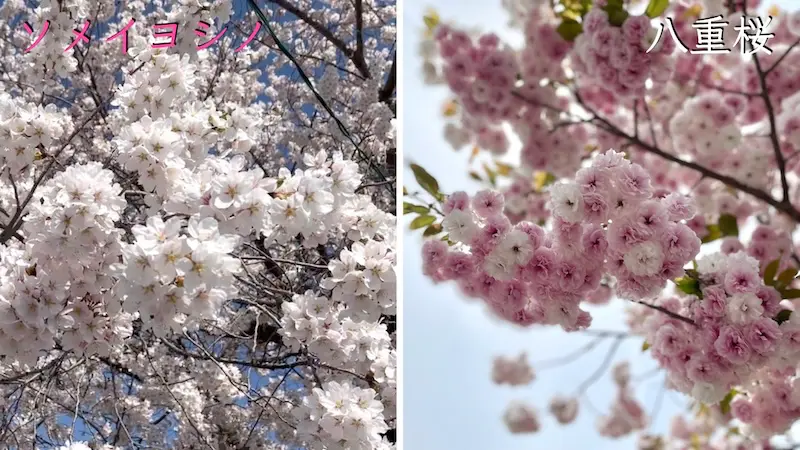
Somei-yoshino (ソメイヨシノ):Yoshino cherry
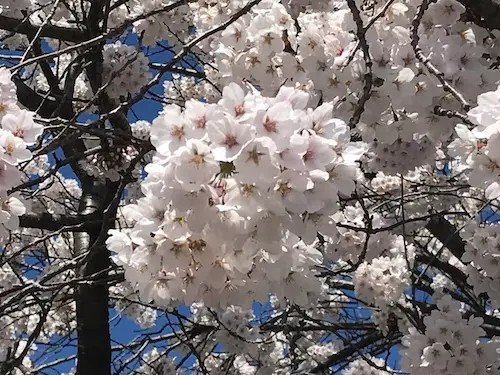
This is the most famous type, making up about 80% of Japan’s Sakura.
Actually, everySomei-yoshino(ソメイヨシノ) tree is a “clone” with the same DNA.
They were all grown from a single original tree using a grafting technique.
Because of this, trees in the same area bloom and fall all at once.
Yaezakura (八重桜):Double-flowered cherry blossoms
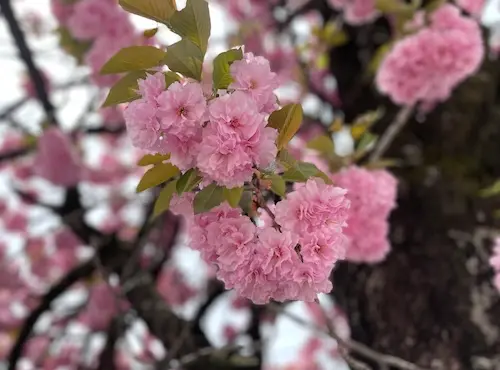
These flowers bloom a bit later than Somei-yoshino and last for a longer period.
The petals overlap in many layers, making them look like small bouquets.
Depending on the region, you can enjoy them until mid-May.
Interesting Differences Between the Two
You can notice some fascinating differences.
You will see them when you compare the photos.
- Flowers and Leaves
- Somei-yoshino:
The flowers bloom first.
The leaves appear only after the petals fall. - Yaezakura:
The flowers and leaves appear at the same time.
- Somei-yoshino:
- Color and Shade
- Somei-yoshino:
A delicate, translucent pale pink. - Yaezakura:
A bold and vibrant deep pink.
- Somei-yoshino:
- Blooming Timing
- Somei-yoshino:
They share the same DNA.
Therefore, they bloom and fall simultaneously in each area. - Yaezakura:
They bloom after Somei-yoshino and can be enjoyed for a longer time.
- Somei-yoshino:
Which of these Sakura captures your heart more?
Conclusion
Sakura is a special flower deeply rooted in the hearts of Japanese people.
It marks times of meetings, farewells, and new challenges.
Sakura gently accompanies us through every milestone.
May the Japanese spring be a wonderful new beginning for you.
Enjoyed the beauty of spring, please check out our other post.
It introduces traditional Japanese colors for Kimono here.
[Traditional Japanese Colors: History, Culture, and Modern Influence]
Discover more about Japanese culture in the Japan & Culture category.
Related Posts
桜と春の始まり
福寿草や梅の花の季節が終わりました。
以前、[Beyond Sakura: Early Spring Flowers in Japan] を書きました。
その景色がとても懐かしいです。
そして、いよいよ桜の季節が幕を開けます。
桜は、冬の終わりと春の始まりを知らせる花です。
私の原風景は、近所の川沿いに咲くソメイヨシノです。
淡いピンク色の並木を目にすると、「ああ、春だな」と嬉しくなります。
日本では、桜の時期に入学や進級が重なります。
そのため、桜は「始まり」を象徴する存在です。
満開の桜の木を見上げれば、新生活への期待感で胸が高鳴ります。
生活が変わらなくても、前向きで明るい気持ちになります。
桜は、未来へのワクワクする気持ちを運んでくれる、特別な花です。
花見という文化
桜が咲くと、人々は自然と外へ集まります。これが日本の「お花見」です。
日本の「お花見」には、とても長い歴史があります。
古くは、桜の咲き方でその年の豊作を占っていたそうです。
桜の神様が、田植えの時期を教えてくれると信じられていました。
そのため、日本人にとって桜の下で集まることは、感謝の儀式でもありました。
現代でも、桜が咲くと自然に人々が集まります。
家族や友人と集まり、同じ花を見上げて季節を分かち合う。
そこには、美味しいものを食べながら笑い合う、穏やかな時間が流れています。
忙しい日々の中で、一度立ち止まって自然を愛でる。
このお花見という習慣は、日本人が今も大切に守り続けている心の文化です。
夜桜(Yozakura):幻想的な夜の姿
お花見は昼間だけではありません。
夜にライトアップされた桜を「夜桜」と呼びます。
- 幻想的な雰囲気
暗闇の中に浮かび上がる桜は、昼間とは違う美しさです。 - 水面の反射
お城の堀や川沿いでは、水面に映る「逆さ桜」を楽しめます。 - 静かな鑑賞
賑やかな昼のお花見に比べ、落ち着いた大人の時間を過ごせます。
なぜ桜はすぐ散るのか
桜の見頃は、わずか一週間ほどです。
あっという間に咲き、潔く散っていきます。
日本人はその姿に「はかなさ」という美意識を見出しました。
永遠より、今しか見られないものに価値を置く感性です。
「桜は満開のときよりも、散るときが美しい」 そう感じる人も少なくありません。
風に舞う花びらは、雪のように幻想的です。
短い命だからこそ、その一瞬を全力で愛でる。
散りゆく姿を惜しみ、また来春の再会を願う。
その切なさこそが、お花見の醍醐味(だいごみ)です。
桜と日本語の表現
日本語には、桜の情景を捉えた言葉がたくさんあります。
言葉を知ることで、目の前の景色はより深くなります。
- ひらひら:花びらが風に舞う軽やかな様子
- 舞い散る:踊るように空を舞いながら落ちる姿
- はかない:消えやすく、脆くて繊細な美しさ
- 満開:すべての花が開き、一番美しい状態
- 花びら:花全体ではなく、一枚ずつの「花弁」のこと
これらの表現は、日本人にとって桜をみると自然に出てくる言葉です。
一文字ずつに、春の空気感が凝縮されています。
「桜咲く」と「桜散る」
桜は、人生の節目を彩る言葉としても使われます。
かつて、大学入試の合否は「電報」で伝えられました。
限られた文字数で結果を届けるため、桜が比喩に選ばれたのです。
この「サクラサク」という表現は、早稲田大学の合否電報がきっかけでした。
- 合格なら、「サクラサク(桜咲く)」
- 不合格なら、「サクラチル(桜散る)」
1950年代の大学入試から始まったとされる、この表現。
わずか数文字の中に、切実なドラマがありました。
今でも「桜咲く」は、吉報を意味する温かい言葉として愛されています。
歌い継がれる桜のメロディ
日本では、「桜」をテーマにした曲が驚くほどたくさんあります。
日本人は、自分の人生の節目を桜の歌に重ねてきました。
アニメ『NARUTO -ナルト- 疾風伝』の主題歌でお馴染みのいきものがかり。
彼らもまた、美しい桜の曲を歌っています。
代表曲の一つ「SAKURA」の歌詞を見てみましょう。
「さくら ひらひら 舞い降りて落ちて……」
このフレーズは、日本語の「ひらひら」という響きを覚えるのにぴったりです。
また、日本で長く愛されている名曲に、ケツメイシの「さくら」があります。
「さくら 舞い散る中に 忘れた 記憶と……」
ここには、日本人が愛する「舞い散る」情景が美しく表現されています。
あなたもぜひ、お気に入りの「桜ソング」を見つけてみてください。
桜の種類(ソメイヨシノと八重桜)
日本には多くの桜がありますが、代表的な2つの種類を紹介します。
それぞれに違った魅力と、興味深い秘密があります。
ソメイヨシノ(Somei-yoshino)
日本の桜の約8割を占める、最も有名な種類です。
実は、すべてのソメイヨシノは同じ遺伝子を持つ「クローン」です。
一本の原木から接ぎ木(つぎき)で増やされました。
そのため、同じ地域の桜は一斉に咲き、一斉に散ります。
八重桜(Yaezakura)
ソメイヨシノより少し遅れて咲き始め、長い期間楽しめるのが特徴です。
花びらが何枚も重なり、まるで小さなブーケのように見えます。
地域によっては、5月中旬ごろまでその姿を愛でることができます。
2つの桜の面白い特徴
ソメイヨシノと八重桜には、興味深い違いがあります。
写真で見比べる際に、ぜひチェックしてみてください。
- 花と葉の順番
- ソメイヨシノ:花が散った後に葉が出る
- 八重桜:花と葉が同時に現れる
- 色の濃淡
- ソメイヨシノ:透き通るような淡いピンク
- 八重桜:存在感のある濃いピンク
- 咲くタイミング
- ソメイヨシノ:ソメイヨシノは同じ遺伝子を持つ。地域ごとに一斉に咲き、一斉に散る
- 八重桜:ソメイヨシノより遅れて咲き、長く楽しめる
あなたは、どちらの桜に心が惹かれますか?
まとめ
桜は、日本人の心に深く根付いている特別な花です。
出会いと別れ、そして新しい挑戦。
そのすべての瞬間に、桜は優しく寄り添ってくれます。
日本の春が、あなたにとって素晴らしい始まりになりますように。
桜の色に興味がある方は、ぜひ着物の伝統色もあわせてご覧ください。:
[Traditional Japanese Colors: History, Culture, and Modern Influence]
日本文化についてもっと知りたい方は、Japan & Culture カテゴリをご覧ください。