


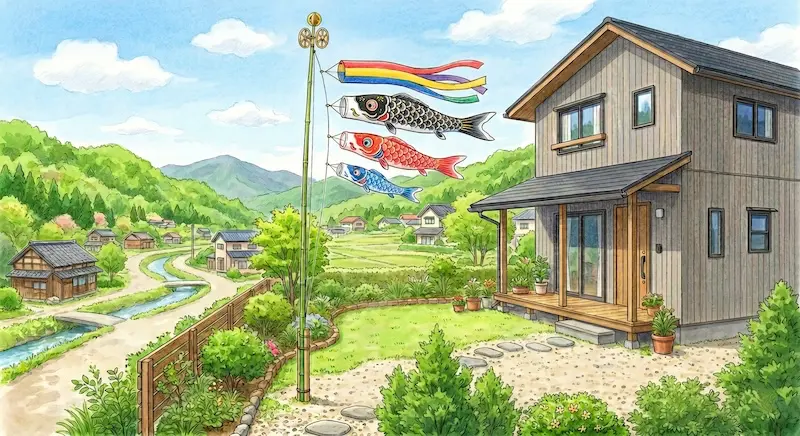
5月5日 (May 5th).
Why do people fly 鯉のぼり (Koinobori) in Japan on this day?
Today, it is known as こどもの日 (kodomo no hi, Children’s Day).
However, the tradition has a long history.
The Origins of “Tango no Sekku”
How did this traditional event begin? Let’s look at its history.
The Meaning of “Tango no Sekku”
節句 (sekku, seasonal festival day) refers to special seasonal days.
These days are used to pray for health and protection from evil spirits.
In ancient China, seasonal changes were believed to bring misfortune.
This idea influenced many customs.
The word 端午 (tango) uses the character 端 (tan, beginning).
It originally referred to the first horse day of the fifth lunar month.
Gradually, the sounds of 午 (go, horse) and 五 (go, five) came to overlap.
As a result, the date became fixed on May 5.
Thus, 端午の節句 (tango no sekku) spread as a festival held on May 5.
Introduction to Japan and Two Origins
Tango no Sekku was introduced to Japan from China during the Nara period ().
It later merged with an older Japanese tradition.
In Japan, there was a custom called 五月忌み (satsuki-imi).
It was a ritual to purify oneself before rice planting.
Women performed this ritual to welcome the rice field deities.
It was considered a sacred ceremony.
This Japanese custom merged with the Chinese practice of using 菖蒲 (shōbu, iris) to drive away evil spirits.
As a result, a tradition of praying for health and protection on May 5 became established.
The Heian Court Ritual “Tango no Sekku”
During the Heian period (), the imperial court officially adopted this ritual.
It became a formal court ceremony called 端午の節句 (ango no sekku).
Aristocrats followed Chinese customs.
They wore 菖蒲 (shōbu, iris plant) in their hair to ward off evil spirits.
They also decorated pillars with 薬玉 (kusudama, herbal charm ball).
These were filled with herbs and fragrances for protection.
At this time, it was not yet a celebration for boys.
It was a seasonal ritual for health and protection from disasters.
From the Warrior Era to a Boys’ Festival
From the Kamakura period () onward, the influence of the samurai class became stronger.
Iris and the Spirit of Martial Strength
During the Kamakura period, the meaning of Tango no Sekku changed significantly.
The focus shifted from aristocrats to the samurai class.
One key factor was the word 菖蒲 (shōbu, iris).
It shares the same pronunciation as 尚武 (shōbu, respect for martial arts).
In addition, the leaves of iris were said to resemble a sword.
This symbolism also supported its connection to warriors.
As a result, the festival came to represent wishes for boys to grow up strong and healthy.
Carp Streamers in the Edo Period
During the Edo period (), Tango no Sekku became an official holiday of the shogunate.
First, samurai families began placing banners called 幟 (nobori, banners) with their family crests in their yards.
Town merchants saw this practice.
In response, they created carp streamers called 鯉のぼり (koinobori, carp-shaped streamers).
They were inspired by a Chinese legend called 登竜門 (tōryūmon, “Dragon Gate”).
It tells the story of a carp that swims upstream and becomes a dragon.
This carp became a symbol of success and social advancement.
In this way, samurai banners and town merchant carp streamers developed.
They became the modern form we see today.
Armor and Helmets as Protection
In samurai households, a new custom developed beyond banners.
They began displaying armor and helmets called 鎧 (yoroi, armor) and 兜 (kabuto, helmet).
These were originally tools for battle.
At the same time, they were also seen as symbols of protection.
Parents wished to protect their children from illness and accidents.
Because of this hope, these items began to be displayed inside the home.
Also, kabuto helmets are made from origami.
Modern Tango no Sekku and Children’s Day
Tango no Sekku celebrates the health and growth of boys.
Below are some of its representative decorations and foods.
Carp Streamers and Samurai Dolls
Carp streamers called 鯉のぼり (koinobori, carp-shaped streamers) are displayed outside the home.
They symbolize overcoming life’s challenges and achieving success.
Inside the home, families display May dolls called 五月人形 (gogatsu ningyō, traditional May dolls).
Armor and helmets are believed to protect children by taking on misfortune in their place.
Both traditions express a wish for children to grow up healthy.
They are forms of family prayers for a safe and strong future.
Rice Cakes and Rice Dumplings
柏餅 (kashiwa mochi, oak leaf rice cake) and ちまき (chimaki, rice dumpling) are essential foods for this festival.
The leaves of the oak tree, 柏 (ashiwa, oak), do not fall until new leaves grow.
Because of this, it is seen as a symbol of family continuity.
Chimaki comes from a Chinese legend and is a food used to ward off evil spirits.
In Japan, kashiwa-mochi is common in the east, while chimaki is more common in the west.
Is It Only for Boys?
In 1948, May 5 was established as a national holiday called 子どもの日 (kodomo no hi, Children’s Day).
It is a day to wish for the happiness of all children.
It also includes a meaning of gratitude toward mothers.
There is also the Peach Festival, known as ひな祭り(hinamatsuri), which celebrates the health and growth of girls.
Conclusion
Tango no Sekku began with Chinese purification rituals.
It also combined with Japanese agricultural traditions.
Over time, its form changed.
First, it shifted from protection against evil spirits.
Then, it became a celebration for boys.
Later, it developed into a day for all children.
However, the wish for children’s healthy growth has remained unchanged.
Families continue this wish today.
In this way, the tradition helps us understand Japanese seasonal festivals.
Tango no Sekku is one clear example.
What celebrations for children exist in your country?
Discover more about Japanese culture in the Japan & Culture category.
Related Posts

 Is “Green” Different in Japan? Meaning and Culture
 Why Are “Satsuki” and “Mei” Connected to May?
5月5日。
なぜ日本では、この日に鯉のぼりを飾るのでしょうか?
今では「こどもの日」として知られています。
しかし、その背景には長い歴史があります。
「端午の節句」のルーツ
この伝統的な行事がどのようにして始まったのか。その歴史を紐解いていきましょう。
「端午の節句」という言葉
「節句」とは、季節の節目に健康や厄除けを願う行事のことです。
古代中国では、季節の変わり目は災いが多い時期と考えられていました。
「端午」の「端」は「はじまり」を意味します。
もともとは、5月最初の「午(うま)の日」を指す言葉でした。
やがて「午」と「五」の音が重なることから、5月5日に定着します。
こうして、端午は5月5日の節句として広まりました。
日本への伝来と2つのルーツ
端午の節句は、奈良時代に中国から伝わりました。
そこに、日本に古くからあった習慣が結びつきます。
もともと日本には、田植え前に身を清める「五月忌み」がありました。
これは女性たちが、田の神様を迎えるための神聖な儀式です。
この風習と、中国の「菖蒲で厄を払う文化」が合体しました。
こうして、5月5日に無病息災を祈る形が定着したのです。
平安時代の宮中行事「端午の節会」
平安時代、宮中ではこの中国流の厄除けを公式に取り入れました。
これが、公式行事である「端午の節会(たんごのせちえ)」です。
当時の貴族たちは、中国にならって菖蒲を髪に飾り、邪気を払いました。
柱には、香料や薬草を詰めた魔除けの「薬玉」を飾ったといいます。
この頃はまだ、男の子のためのお祝いではありませんでした。
国を挙げて災いを避け、健康を祈るための大切な節目だったのです。
武士の時代から「男の子の節句」へ
鎌倉時代以降、武士社会の影響が強まります。
菖蒲と尚武
鎌倉時代になると、端午の節句の意味合いが大きく変わります。
主役は貴族から武士へと移り変わりました。
きっかけは、厄除けに使う「菖蒲(しょうぶ)」という言葉です。
これが「尚武(武道を重んじる)」と同じ読み方だったのです。
さらに、菖蒲の葉の形が「剣」に似ていたことも理由の一つです。
こうして、男の子のたくましい成長を願う行事へと変化しました。
江戸時代に広まった「鯉のぼり」
江戸時代、端午の節句は幕府の公式な祝祭日になります。
まずは武家が、家紋を入れた「幟(のぼり)」を庭に立て始めました。
これを見た町人たちが、対抗して生み出したのが「鯉のぼり」です。
町人たちは、中国の「登竜門」という伝説をヒントにしました。
「激流を登りきった鯉は龍になる」という立身出世の象徴です。
こうして、武士の幟(のぼり)と町人の鯉のぼりが、現代の形に繋がりました。
身を守るための「鎧・兜」
武家では、幟だけでなく「鎧や兜」を飾る習慣も生まれました。
これらは戦いの道具ですが、同時に「身を守るもの」でもあります。
子供を病気や事故などの厄災から守ってほしい。
そんな親の願いを込めて、家の中に飾られるようになりました。
また、兜は折り紙でも作られています。
現代の端午の節句とこどもの日
「端午の節句」は男の子の健康や成長を祝います。
以下に、飾りや食べ物の代表的なものをご紹介します。
鯉のぼりと五月人形
家の外には「鯉のぼり」を飾ります。
これは人生の荒波を乗り越え、出世することを願うものです。
また、室内には「五月人形」を飾ります。
鎧や兜には、子供の身代わりとなって災いを防ぐ意味があります。
どちらも「健やかに育ってほしい」という家族の祈りの形です。
柏餅とちまき
端午の節句に欠かせないのが柏餅とちまきです。
柏の葉は、新芽が出るまで古い葉が落ちません。
そのため「子孫繁栄」の象徴とされています。
ちまきは、中国の故事に由来する厄除けの食べ物です。
関東では柏餅、関西ではちまきを食べる文化が定着しています。
男の子だけではない?
1948年、5月5日は「こどもの日」として祝日になりました。
すべての子どもの幸福を願う日です。
同時に、母に感謝する意味もあります。
また、女の子の健康や成長を祝う「桃の節句:ひな祭り」もあります。
まとめ
端午の節句は、中国の厄除けと日本の農耕儀礼が結びついて始まりました。
時代とともに「厄除け」から「男の子の祝い」へ変わりました。
そして「全ての子供の幸せ」を願う日へと変化してきました。
形は変わっても、子供の健やかな成長を願う家族の想いは変わりません。
そして現代では、「こどもの日」として受け継がれています。
あなたの国では、子どもの成長や幸せを祝うどんな行事がありますか?
日本文化についてもっと知りたい方は、Japan & Culture カテゴリをご覧ください。