

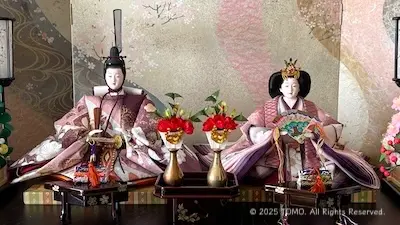
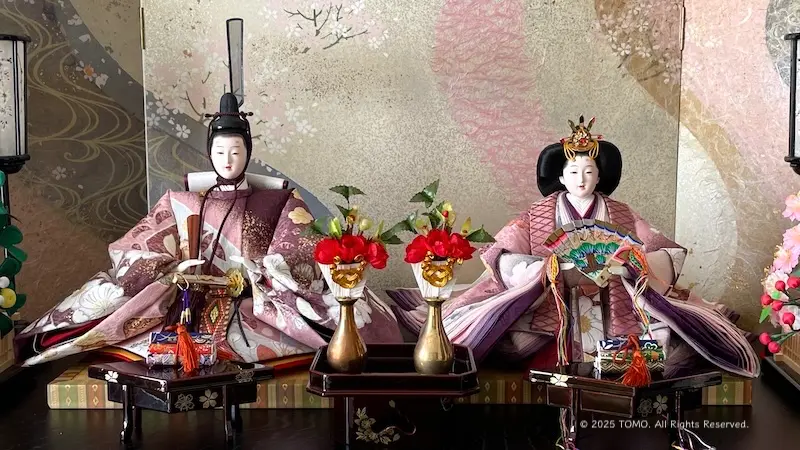
March 3 is Hinamatsuri (ひな祭り).
In Japan, it is also known as Girls’ Day.
t is a traditional spring festival.
People decorate peach blossoms and display Hina dolls in their homes.
Why do people display these dolls?
Why is the festival called the Peach Festival?
Do you know the history of Hinamatsuri and the important role of the dolls?
In this article, I will explore the meaning behind Hinamatsuri.
I will also explain its traditional foods and customs in detail.
The Story Behind Hinamatsuri
First, let’s look at how Hinamatsuri began.
Why Is It Called the Peach Festival?
Hinamatsuri is a traditional annual event in Japan.
It takes place on March 3 each year.
It is also known as the Peach Festival (桃の節句, Momo no Sekku).
The festival is held when peach and plum flowers begin to bloom.
Because of this, it is also seen as a sign of spring’s arrival.
Its origins are believed to come from an ancient Chinese seasonal custom.
At that time, it was called Jōshi no Sekku (上巳の節句).
Originally, people believed this day could purify the body.
It was also thought to drive away misfortune during seasonal changes.
From Nagashi-bina to Hina Dolls
In Japan, people once made small dolls from paper or straw.
They transferred their impurities, called kegare (穢れ), to the dolls.
Then, they set the dolls afloat on rivers or in the sea.
This custom is known as Nagashi-bina (流し雛).
People believed the dolls would take on misfortune in their place.
Meanwhile, aristocrats during the Heian period enjoyed Hīna-asobi (ひいな遊び).
It was a form of doll play.
Over time, these two traditions merged.
Eventually, displaying dolls became a seasonal custom.
During the Edo period, the practice spread among samurai families and townspeople.
Later, it became a celebration of girls’ growth and happiness.
The Meaning Behind Hina Dolls
So, what kind of dolls are displayed for Hinamatsuri?
What Kind of Dolls Are Displayed?
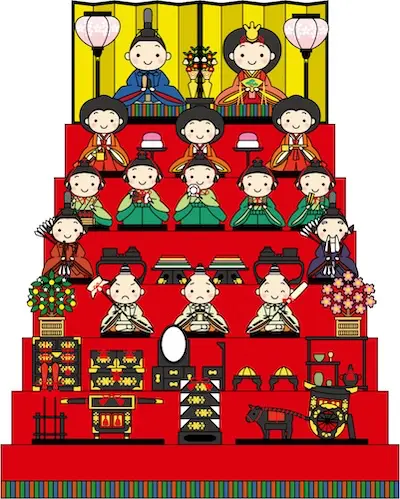
Hina dolls represent a wedding scene from the imperial court of the Heian period.
At the top tier sit the Odairi-sama and the Ohina-sama.
Below them are the Sannin-kanjo, the Gonin-bayashi, the Zuijin, and the Shichō.
Each Doll Has a Special Meaning
Each type of doll has a specific role.
- Odairi-sama (おだいりさま) / Obina (おびな).
He wears formal court robes.
He is said to represent the emperor. - Ohina-sama (おひなさま) / Mebina (めびな).
She wears elegant layered kimono.
Her robe is called Jūnihitoe (じゅうにひとえ).
It was the formal dress of the Heian period.
She is said to represent the empress. - Sannin-kanjo (さんにんかんじょ).
They are court ladies who serve in the palace.
They attend to the empress. - Gonin-bayashi (ごにんばやし).
They are five young musicians.
They perform court music to celebrate the wedding. - Zuijin (ずいじん).
They are guards who carry bows and arrows.
They protect the palace. - Shichō (しちょう).
They are attendants who handle various tasks.
Their facial expressions are often different from one another.
The Meaning Behind Hina Dolls
Tiered displays are said to represent formality and the importance of wishes.
They also reflect the family’s hopes.
Hina dolls are believed to protect children from misfortune.
They are a form of the family’s prayers made visible.
When to Display and Put Away Hina Dolls
Many families begin displaying Hina dolls after Risshun (立春).
It falls around February 4.
After March 3 passes, the dolls are put away as soon as possible.
There is a traditional saying.
If you delay putting them away, marriage will also be delayed.
There is no scientific evidence for this belief.
However, it is widely known in Japan.
Such sayings reflect how deeply people value seasonal traditions.
Traditional Foods and Spring Scenery
Hinamatsuri is celebrated with colorful seasonal dishes.
The colors themselves also carry meaning.
Pink, green, and white are commonly used.
These are soft spring colors.
Through food, people express their joy for the changing season.
Traditional Foods
- Chirashi-zushi (ちらしずし).
Scattered sushi topped with colorful ingredients.
Shrimp symbolizes long life, and lotus root represents a clear future. - Hishi-mochi (ひしもち).
A three-layered diamond-shaped rice cake.
Green stands for health, white for purity, and pink for protection. - Shirozake (しろざけ).
A sweet traditional drink.
It was originally associated with purification.
Hinamatsuri Today
Today, fewer families display large, multi-tiered doll sets.
Many homes now have smaller spaces.
This has changed the way people display Hina dolls.
However, many families still celebrate with small dolls or simple decorations.
Hinamatsuri is also celebrated in preschools.
It is also held in elementary schools.
In some areas, it has become a community event.
The style has changed over time.
However, the meaning remains the same.
The wish for children’s happiness is still passed down.
Conclusion
Hinamatsuri is a traditional Japanese festival for girls.
It celebrates health, happiness, and growth.
Hina dolls carry wishes to protect children.
Learning Japanese culture can also help you understand the language more deeply.
Discover more about Japanese culture in the Japan & Culture category.
Related Posts
 Beyond Sakura: Early Spring Flowers in Japan
 Jūnihitoe and the Miyabi of Layered Colors
3月3日は「ひな祭り」。
桃の花を飾り、ひな人形を眺める日本の伝統的な春の行事です。
なぜ人形を飾るのか。
なぜ「桃の節句」と呼ぶのか。
ひな祭りの歴史や、人形が持つ大切な役割をご存知でしょうか。
この記事では、伝統的な料理の意味など詳しく紐解いていきます。
ひな祭りに込められた意味と始まり
まずは、ひな祭りの成り立ちから見ていきましょう。
なぜ「桃の節句」と呼ばれるの?
ひな祭りは、毎年3月3日に行われる日本の年中行事です。
別名「桃の節句」とも呼ばれます。
桃や梅の花が咲き始めるころに行われる行事です。
そのため、春の訪れを感じさせる節目でもあります。
その起源は、古代中国から伝わった節句の行事にあるとされています。
当時は「上巳(じょうし)の節句」と呼ばれていました。
もともとは、季節の変わり目に身を清め、災いを払う日と考えられていました。
流し雛からひな人形へ
日本では、紙や草で作った人形に穢れ(けがれ)を移し、川や海に流す風習がありました。
これを「流し雛」といいます。
自分の身代わりとして災いを引き受けてもらうという考え方です。
一方で、平安時代の貴族の間では「ひいな遊び」が行われていました。
人形を使ったままごと遊びです。
この二つの文化が結びつきました。
やがて、人形を飾る行事へと発展していきます。
江戸時代になると、武家や町人の間にも広まりました。
そして、女の子の成長を祝う行事として定着しました。
ひな人形に込められた願い
では、具体的にどのような人形を飾るのでしょうか。
どんな人形が飾られるの?
ひな人形は、平安時代の宮廷の婚礼の様子を表しています。
最上段には、お内裏様とお雛様が並びます。
その下には、三人官女、五人囃子、随身、仕丁などが配置されます。
それぞれの人形には意味がある
それぞれの人形には、次のような役割があります。
- お内裏様(おだいりさま)/男雛(おびな)
宮中の装束を身につけた男性の姿です。
天皇を表しているとされます。 - お雛様(おひなさま)/女雛(めびな)
華やかな着物をまとった女性の姿です。
着物は、平安時代の正装である「十二単(じゅうにひとえ)」です。
皇后を表しているとされます。 - 三人官女(さんにんかんじょ)
宮中に仕える女官です。
お雛様の身の回りの世話をする役割を表しています。 - 五人囃子(ごにんばやし)
楽器を持った五人の少年です。
結婚式を盛り上げる雅楽の演奏者を表しています。 - 随身(ずいじん)
弓矢を持つ護衛役です。
宮中を守る武官を表しています。 - 仕丁(しちょう)
雑用を担当する従者です。
表情がそれぞれ異なることも特徴です。
ひな人形に込められた願い
段飾りは、格式や願いの大きさを象徴すると言われています。
人形には、子どもを災いから守るという意味があります。
家族の祈りが形になったものです。
ひな人形を飾る時期と片付けの意味
ひな人形は、立春(2月4日ごろ~18日ごろ)を過ぎた頃から飾る家庭が多いです。
そして、3月3日が終わったら、できるだけ早く片付けます。
「片付けが遅れると結婚が遅れる」という言い伝えがあります。
科学的な根拠はありませんが、日本では広く知られています。
こうした言い伝えも、行事を大切にする気持ちの表れといえるでしょう。
ひな祭りの料理と春の風景
ひな祭りには、華やかな料理が並びます。
そして色合いにも意味があります。
桃色や緑、白といった春らしい色が使われます。
季節の喜びを、食卓でも表現しているのです。
代表的な食べ物
- ちらし寿司
えびやれんこんなど、縁起のよい食材が使われます。
長寿や見通しのよさを願う意味があります。 - ひしもち
三色の菱形の餅です。
緑は健康、白は清らかさ、桃色は魔除けを表すとされています。 - 白酒
甘みのある伝統的な飲み物です。
もともとは厄払いの意味がありました。
現代のひな祭り
現代では、大きな段飾りを持たない家庭も増えました。
それは、住宅事情の変化も影響しています。
その一方で、小さな人形や簡易的な飾りで祝う家庭も多くあります。
保育園や学校で取り上げられることもあります。
また、地域のイベントとして行われることもあります。
形は変わっても、願いの気持ちは現在に受け継がれています。
まとめ
ひな祭りは、女の子のための日本の伝統行事です。
健康や幸せ、成長を願うお祝いです。
ひな人形には、子どもを守る願いが込められています。
日本文化を学ぶと、日本語の理解もより深まります。
日本文化についてもっと知りたい方は、Japan & Culture カテゴリをご覧ください。