

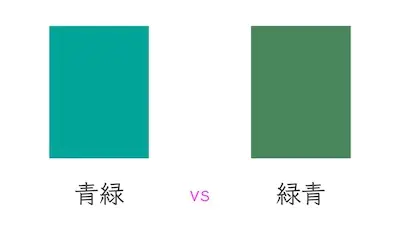
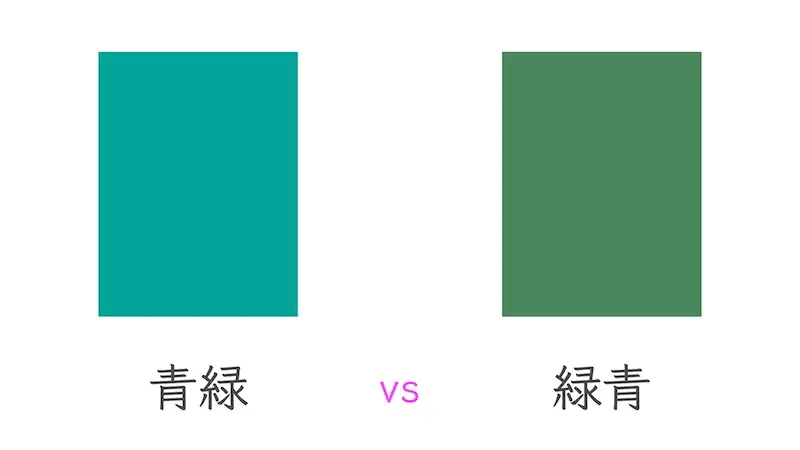
青緑 (aomidori, blue-green) and 緑青 (rokushō, malachite green).
Both are written using the same two kanji: 青 (ao, blue) and 緑 (midori, green).
Reverse the order, and they are read aomidori and rokushō.
The colors they describe—and the stories behind them—are different.
These two similar color names reveal the charm of Japanese language and color culture.
青緑 and 緑青 — Kanji Readings
The difference between 青緑 (aomidori) and 緑青 (rokushō) is not just the color.
First, let’s look at how the kanji are read.
On’yomi and Kun’yomi
Japanese kanji have two main types of readings: 音読み (on’yomi) and 訓読み (kun’yomi).
It is also common for one kanji to have several different readings.
- 訓読み (kun’yomi): a Japanese reading based on the meaning of the kanji
- 音読み (on’yomi): a reading based on the original Chinese pronunciation of the kanji
For example, 山 has the やま (yama) reading in 訓読み (kun’yomi).
In 富士山 (Fujisan, Mount Fuji), さん (san) is an 音読み (on’yomi) reading.
Even the same kanji can be read differently depending on the word.
Readings of 青 (ao, blue) and 緑 (midori, green)
青 (ao, blue) and 緑 (midori, green) each have both on’yomi and kun’yomi readings.
- 青 (blue): kun’yomi あお (ao) / on’yomi セイ・ショウ (sei, shō)
- 緑 (green): kun’yomi みどり (midori) / on’yomi リョク・ロク (ryoku, roku)
In these two color names, they are read as follows:
- 青緑 (aomidori)
青 is read ao, and 緑 is read midori.
Both use kun’yomi readings. - 緑青 (rokushō)
緑 is read roku, and 青 is read shō.
Both use on’yomi readings.
More Than Just Reversing the Kanji
Looking only at the kanji, it may seem that 青 and 緑 have simply switched places.
In fact, they are used as two different color names.
青緑 (aomidori) combines the two color words 青 and 緑.
緑青 (rokushō) is used as a single word.
For this reason, 緑青 (rokushō) is not read midoriao.
The reading does not change simply because the kanji are reversed.
Each word has its own reading.
Comparing these two color names makes one thing clear.
Japanese kanji do not always have just one reading.
青緑 (aomidori)
Next, let’s look at the two colors themselves.
We’ll start with 青緑 (aomidori).
What Kind of Color Is 青緑 (aomidori)?
青緑 (aomidori) is a color between 青 (ao, blue) and 緑 (midori, green).
It can be described as a green with blue tones or a blue with green tones.
The color names 青 and 緑 are combined directly into one word.
This makes the color easy to imagine from its name.
青緑 (aomidori) can range from bright to more subdued shades.
Different color references may show it slightly differently.
Origins of 青緑 (aomidori)
青緑 (aomidori) is a color name that has been used since ancient times.
The name also appears in the Engishiki (『延喜式』), compiled during the Heian period.
In traditional dyeing, yellow dyes such as kihada (Amur cork tree) were layered over indigo.
This created a green color from blue and yellow.
Many colors were made by combining natural dyes.
青緑 (aomidori) is also closely connected with traditional Japanese dyeing.
Did 青 (ao, blue) Include Green in Japanese?
Looking beyond 青緑 (aomidori), 青 (ao, blue) has some interesting uses in Japanese.
Some older ideas about color still remain in the language today.
青 (ao, blue) in Modern Japanese
In the past, blue did not refer only to what we now call blue.
It could also include colors we would now call green.
For example, 青葉 (aoba, green leaves) refers to green leaves.
青菜 (aona, green vegetables) also refers to green vegetables.
Even today, a green traffic light is called 青信号 (ao shingō, green light) in Japan.
This older way of seeing color still remains in everyday language.
The Boundary Between Blue and Green
Today, blue and green are usually seen as separate colors.
In older Japanese words, the boundary between them was less clear.
This shows how closely color names are tied to language and culture.
緑青 (rokushō)
In contrast to 青緑 (aomidori), 緑青 (rokushō) is connected with minerals, pigments, and metals.
Its name becomes clearer when we look at the history behind the color.
What Kind of Color Is 緑青 (rokushō)?
緑青 (rokushō) is a green with blue tones.
It is often shown as a calmer, slightly muted color than 青緑 (aomidori).
From the name, it may seem like a simple mix of 緑 (midori, green) and 青 (ao, blue).
緑青 (rokushō) also has a long history as a pigment.
Malachite and 緑青 (rokushō)
緑青 (rokushō) was originally a green pigment made from malachite.
Malachite is a natural mineral with a beautiful green color.
When finely ground, it was used to make the pigment called 緑青 (rokushō).
The color of this pigment also came to be called 緑青 (rokushō).
In other words, the pigment gave its name to the color itself.
The shade of malachite changes with the size of its particles.
Finer particles create a lighter, softer green.
緑青 (rokushō) has been used to color Japanese paintings and works of art.
A natural mineral became one of the colors used in Japanese art.
Why Is Copper Patina Also Called 緑青 (rokushō)?
Copper and copper alloys can change over time outdoors.
A blue-green layer may form on the surface.
This color is also called 緑青 (rokushō).
緑青 (rokushō) was originally the name of a traditional green pigment.
Later, the same name was used for green corrosion on copper.
The color looked similar.
Malachite pigment differs from the 緑青 (rokushō) found on copper.
Copper corrosion is a separate substance.
Chemically, the two are also different.
Even so, both colors are often called 緑青 (rokushō).
The color name 緑青 (rokushō) began with a natural mineral.
It later became closely connected with Japanese art and architecture.
You can learn more about the history and culture of traditional Japanese colors here.
[Traditional Japanese Colors: History, Culture, and Modern Influence]
Summary
青緑 (aomidori) and 緑青 (rokushō) use the same two kanji.
Yet their readings, colors, and origins are different.
青緑 (aomidori) lies between blue and green.
緑青 (rokushō) is connected with malachite pigment and copper.
Comparing the two shows how interesting Japanese readings can be.
Their color names also reflect Japan’s natural and cultural history.
Explore More Japanese Traditional Colors
I created Japanese Traditional Color Cards to make these colors easy to explore.
Each card briefly introduces a color’s origin and its connection to Japanese culture.
Please feel free to take a look and discover more traditional Japanese colors.
Japanese Traditional Color Cards: Set2
Related Posts
 Why Do Japanese Shops Hang Noren?
「青緑」と「緑青」。
どちらも使っている漢字は「青」と「緑」です。
順番を入れ替えて、「あおみどり」と「ろくしょう」と読みます。
表す色も、その背景も違います。
よく似た二つの色名には、日本語と日本の色文化の面白さが隠れています。
青緑と緑青―漢字の読み方
「青緑」と「緑青」の違いは、色だけではありません。
初めに漢字の読み方です。
音読みと訓読み
日本語の漢字には、大きく分けて「音読み」と「訓読み」があります。
一つの漢字が、複数の読み方を持つことも珍しくありません。
- 訓読み:漢字の意味に日本語の言葉を当てた読み方
- 音読み:中国から伝わった漢字の発音をもとにした読み方
たとえば「山」には、「やま」という訓読みがあります。
「富士山」の「さん」は音読みです。
同じ漢字でも、言葉によって読み方が変わります。
そのため、日本語では漢字一文字だけでなく、言葉として読み方を覚えることも大切です。
「青」と「緑」の読み方
「青」と「緑」にも、それぞれ音読みと訓読みがあります。
- 青:訓読み「あお」/音読み「セイ・ショウ」
- 緑:訓読み「みどり」/音読み「リョク・ロク」
二つの色名では、次のように読みます。
- 青緑 → あおみどり
「青=あお」「緑=みどり」で、どちらも訓読みです。 - 緑青 → ろくしょう
「緑=ろく」「青=しょう」で、どちらも音読みです。
同じ二つの漢字を使っていても、読み方は大きく違います。
漢字を入れ替えただけではない
色名の漢字だけなら、「青」と「緑」の順番を変えただけに見えます。
しかし、それぞれ別の色名として使われています。
青緑は、「青」と「緑」という二つの色名を組み合わせた言葉です。
緑青は、「ろくしょう」という一つの言葉として使われています。
そのため、「緑青」を「みどりあお」とは読みません。
並べ替えたから読み方が変わるのではありません。
それぞれの言葉にそれぞれの読み方があります。
この2つの色名を並べると、日本語の漢字が一通りの読み方ではないことが分かります。
青緑(あおみどり)
次は二つの色そのものを見ていきます。
まずは青緑です。
青緑はどんな色?
青緑は、青と緑の間にある色です。
青みを含んだ緑、または緑みを含んだ青として表されます。
「青」と「緑」という色名が、そのまま一つの言葉になっています。
そのため、名前から色を想像しやすいのが特徴です。
実際の青緑には、鮮やかなものから落ち着いたものまで幅があります。
色見本によって、少し違った色で表されることもあります。
青緑の由来
青緑は、古くから使われてきた色名です。
平安時代にまとめられた『延喜式』にも、その名が見られます。
染色では、藍に黄蘖(きはだ)などを重ねて作られました。
青系の藍に黄色を重ねることで、緑系の色が生まれます。
植物などから得た染料を組み合わせることで、多くの色が作られてきました。
青緑も、日本の伝統的な染色とつながる色です。
日本語の「青」は緑も含んでいた?
青緑から少し視点を広げると、日本語の「青」の使われ方にも面白い特徴があります。
現在の色分けとは少し違う感覚が、今の言葉にも残っています。
今も残る「青」
昔の日本では、「青」が現在の青色だけを指していたわけではありません。
今なら緑と呼ぶ色まで、広く「青」と表すことがありました。
たとえば、「青葉」は緑色の葉です。
「青菜」も緑色の野菜を指します。
今でも交通信号の緑色も、日本では「青信号」と呼びます。
日常的な言葉の中に、昔の色の捉え方が残っています。
青と緑の境界
現在は、青と緑を別の色として区別するのが一般的です。
昔から使われてきた言葉には、その境界が今より広かったことが感じられます。
日本語の「青」を見ていくと、色の名前が文化や言葉と深く関係していることが分かります。
緑青(ろくしょう)
青緑とは対照的に、緑青には鉱物や顔料、金属とのつながりがあります。
色の背景をたどると、その名前の意味が見えてきます。
緑青はどんな色?
緑青は、青みを含んだ緑色です。
青緑よりも、落ち着いた少しくすみのある色として表されることが多くあります。
名前だけを見ると、「緑」と「青」を合わせた色のように感じます。
そして、緑青は色の背景に顔料の歴史があります。
孔雀石と緑青
緑青は、もともと孔雀石(マラカイト)から作られた緑色の顔料です。
孔雀石は、美しい緑色をした天然の鉱物です。
これを細かく砕いて作った顔料を緑青と呼んでいました。
そして、その顔料の色も緑青と呼ぶようになりました。
つまり、顔料の名前が色そのものの名前にもなったということです。
孔雀石は粒子の大きさによって、色の見え方も変わります。
細かくすると、より淡く白みを帯びた緑になります。
緑青は、日本画や日本の美術品などの彩色にも使われてきました。
自然の鉱物そのものが、日本の美術を彩る色に使われています。
なぜ銅のさびも「緑青」と呼ぶ?
銅や銅合金を長い間屋外に置くと、表面に青緑色のものが現れることがあります。
これらの色も「緑青」と呼ばれます。
緑青は、もともと古くから使われてきた緑色顔料の名前です。
その後、よく似た色をした銅の酸化したものにも、「緑青」を使ったとされています。
孔雀石から作る岩緑青と、銅の表面にできる緑青は同じものではありません。
成分も異なります。
しかし、色名はどちらも「緑青」と表すことが多いです。
緑青という色名は、自然の鉱物から生まれ、日本の美術や建築とも深く関わってきた色です。
日本の伝統色の歴史や文化については、こちらで紹介しています。
[Traditional Japanese Colors: History, Culture, and Modern Influence]
まとめ
「青緑」と「緑青」は、同じ漢字を使っています。
しかし、読み方も成り立ちも違う色名です。
青緑は、青と緑の間にある色です。
緑青は、孔雀石の顔料や銅とも深く関わっています。
二つを比べると、日本語の読み方の面白さがよく分かります。
そして、色名の背景には、日本の自然や文化の歴史も息づいています。
日本の伝統色をもっと気軽に楽しんでいただけるように、伝統色カードを作りました。
色の由来や、日本文化とのつながりを短い文章でご紹介しています。
ぜひ、一度のぞいてみてくださいね。
Japanese Traditional Color Cards: Set2