

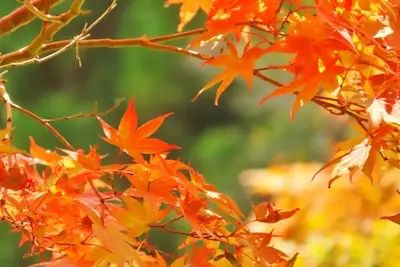
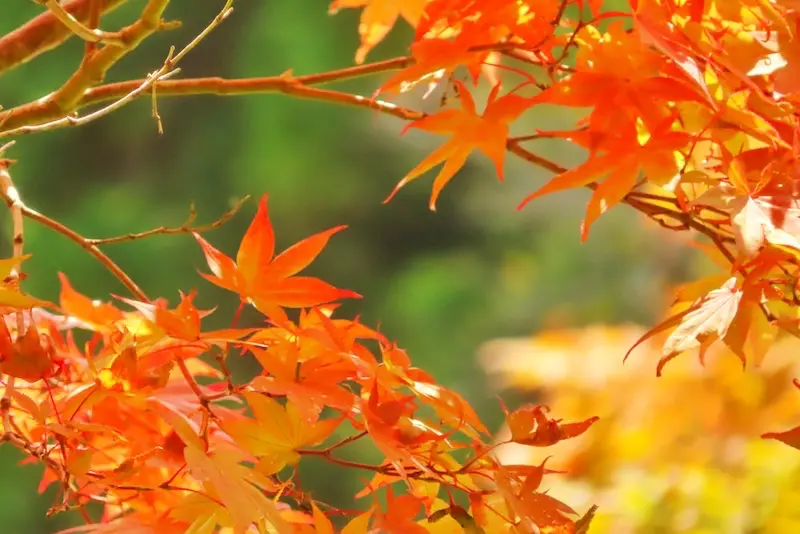
What comes to mind when you think of autumn in Japan?
Many people may picture red momiji and yellow ginkgo leaves.
Japanese autumn scenery also has its own seasonal words.
This time, we will look at 秋晴れ (akibare, clear autumn weather).
We will also explore 紅葉狩り (momijigari, autumn leaf viewing).
Akibare: A Word for Clear Autumn Skies
A clear and pleasant autumn day is called 秋晴れ (akibare).
It means more than simply having good weather.
The word describes the crisp, clear weather of autumn.
As the strong summer sun becomes gentler, it becomes easier to spend time outdoors.
The high blue sky and colorful leaves also create a scene that feels like autumn.
One of the best things to enjoy on an akibare day is 紅葉 (kōyō).
The changing season can be seen in the mountains.
It is also easy to find in parks, gardens, shrines, and temples.
Is 紅葉 Read as Kōyō or Momiji?
紅葉 has two readings in Japanese.
They are kōyō and momiji.
Although their meanings overlap, they are used a little differently today.
- 紅葉 (kōyō)
It describes the change in which leaves turn red or yellow in autumn.
Although it is a noun, it has a verb-like sense of movement.
Here are two common examples of how kōyō is used.- 紅葉が始まる (kōyō ga hajimaru)
This means “the leaves begin to change color.” - 山が紅葉する (yama ga kōyō suru)
This means “the mountains turn autumn colors.”
- 紅葉が始まる (kōyō ga hajimaru)
- 紅葉 (momiji)
It refers to colored autumn leaves.
Today, momiji is also often used for certain kinds of maple trees and their leaves.
The History of the Word もみじ (momiji)
The word もみじ (momiji) has a very long history.
It appears as momichi in the Collection of Ten Thousand Leaves.
This collection was compiled in the late eighth century.
Originally, the word described leaves changing color in autumn.
So, in the past, momiji did not refer only to red leaves.
It also included leaves that turned yellow.
Today, some people may associate the kanji 紅葉 (kōyō) with red leaves.
However, autumn leaves can also be yellow, orange, and other colors.
Originally, もみじ (momiji) described the changing colors of autumn leaves.
So, the word is connected with the whole range of color changes in autumn, not just red.
When Did 紅葉狩り (momijigari) Begin?
In Japan, people have enjoyed looking at colorful autumn leaves for a long time.
Before the word 紅葉狩り (momijigari) came into use, another expression was also used.
That expression was 紅葉見 (momijimi).
From 紅葉見 (momijimi) to 紅葉狩り (momijigari)
An early example of 紅葉見 (momijimi) can be found in a work from around 1005.
This suggests that people were already going out to enjoy autumn leaves during the Heian period.
An early use of 紅葉狩り (momijigari) appears in a work from around 1310.
The custom of enjoying autumn leaves came first.
Later, the expression momijigari came into use.
In spring, people enjoy 花見 (hanami) and admire cherry blossoms.
In autumn, they enjoy momijigari and view colorful leaves.
Both reflect the tradition of enjoying seasonal changes.
Why Is It Called 狩り (kari)?
The word 狩り (kari) literally means “hunting.”
So why is it used in 紅葉狩り (momijigari) when nothing is being hunted?
There are several theories.
One theory says that people walked through the mountains and fields.
Their purpose was to look for beautiful autumn leaves.
Such an activity was compared to hunting.
Another theory says that people once picked colorful branches and leaves to enjoy them.
That may also be why the word kari came to be used.
However, there is no single accepted explanation for the origin of the word.
Even so, the idea of going out to search for something beautiful still fits modern momijigari.
How Is Kari Used Today?
In Japanese today, kari is not used only for hunting animals.
It is also used for activities that involve gathering or picking something.
Examples include ぶどう狩り (budōgari) and きのこ狩り (kinokogari).
Red Momiji and Yellow Ginkgo Leaves
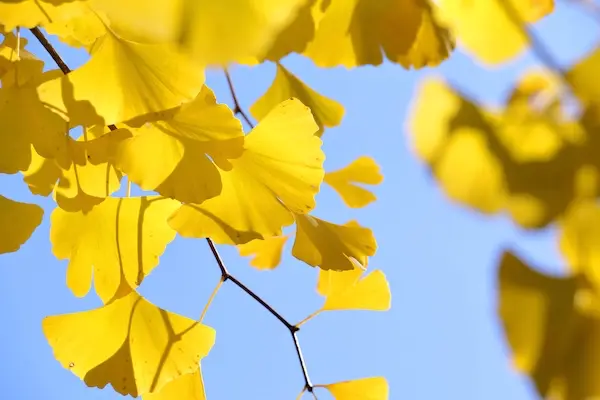
Two colors often represent autumn in Japan.
They are red momiji and yellow イチョウ (ichō, ginkgo) leaves.
Both change color in autumn.
However, the way they change color is different.
Why Do Leaves Change Color?
In autumn, the chlorophyll that makes leaves green begins to decrease.
As a result, other colors that were hidden by the green become more visible.
In ichō, yellow pigments become more noticeable.
This is why the leaves turn bright yellow in autumn.
On the other hand, anthocyanin pigments are involved in the red color of momiji.
So, momiji and ichō change color in different ways.
Ichō Namiki: An Autumn Scene
Ichō trees are also commonly seen along streets in Japan.
A street lined with these trees is called イチョウ並木 (ichō namiki, ginkgo-lined street).
In autumn, the trees turn yellow at around the same time.
When the leaves fall, ichō namiki can look like a yellow carpet spread across the ground.
Autumn in Japan Is a Season of Changing Colors
When the weather suddenly turns colder in autumn, kōyō is said to progress quickly.
Colors often become more vivid at the same time.
As a result, the autumn scenery can look especially beautiful.
However, autumn temperatures are different every year.
The timing and appearance of kōyō can also vary from year to year.
Mountains and trees can quickly turn red and yellow.
This dramatic change is one of the beauties of autumn.
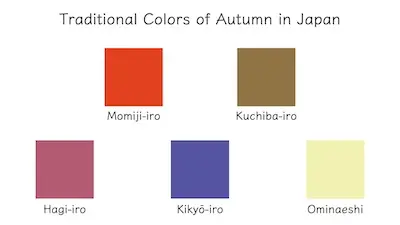
Japan also has many traditional colors inspired by subtle differences in nature.
Plants, fallen leaves, and the sky have all influenced the names of these colors.
Want to discover more colors found in Japan’s autumn scenery?
[What Are the Traditional Colors of Autumn in Japan?]
Conclusion
Autumn leaves under a clear akibare sky create a beautiful seasonal scene.
During momijigari, people enjoy colorful trees.
It is also a time to feel the change of the season.
Many places offer both red momiji and yellow ichō.
Their colors look especially beautiful against the blue autumn sky.
Related Posts

 What Are the Traditional Colors of Autumn in Japan?
日本の秋といえば、何を思い浮かべますか。
赤いもみじや黄色いイチョウを思い浮かべる人も多いでしょう。
そして、秋の景色には日本ならではの言葉があります。
今回は「秋晴れ」や「紅葉狩り」から、日本の秋を見ていきます。
秋の青空を表す「秋晴れ」
空気が澄み、気持ちよく晴れた秋の日を「秋晴れ(あきばれ)」と呼びます。
単に天気がよいだけではありません。
秋らしい爽やかな晴天を表す言葉です。
夏の強い日差しが落ち着くと、外を歩きやすくなります。
そして、高く見える青空と色づいた木々が、秋らしい景色を作ります。
そんな秋晴れの日に楽しみたいのが、紅葉(こうよう)です。
山だけでなく、公園や庭園、寺社などでも季節の変化を感じられます。
「紅葉」は「こうよう」? それとも「もみじ」?
「紅葉」という漢字には、二つの読み方があります。
「こうよう」と「もみじ」です。
意味は重なりますが、現在の使い方には少し違いがあります。
- 紅葉(こうよう)
秋になり、木々の葉が赤や黄色に色づいていく変化を表します。
文法上は名詞ですが、意味としては動詞に近い、動きのある名詞ともいえます。
そのため、「紅葉が始まる」「山が紅葉する」のように使われます。 - 紅葉(もみじ)
色づいた葉を表す言葉です。
現在は、特にカエデの仲間やその葉を「もみじ」と呼ぶことも多くあります。
「もみじ」という言葉の歴史
実は、「もみじ」という言葉はとても古いです。
8世紀後半の『万葉集』にも、「もみち」という形で登場します。
もともとは、秋に草木の葉が色づくことを表す言葉でした。
そのため、昔の「もみじ」は赤い葉だけを指していたわけではありません。
黄色く色づく葉も含まれていました。
現在は「紅葉」という漢字から、赤い葉を思い浮かべる人もいるでしょう。
一方で、実際の紅葉には黄色や橙色など、さまざまな色があります。
もともと「もみじ」は、秋の葉が色づいていく変化を表す言葉でした。
そのため、赤だけではなく、秋の葉の変化全体と結びついた言葉です。
「紅葉狩り」はいつから始まった?
日本では、古くから色づいた葉を眺めて楽しんできました。
そして、「紅葉狩り」という言葉より前には、「紅葉見(もみじみ)」という言葉も使われていました。
「紅葉見」から「紅葉狩り」へ
「紅葉見」の古い例は、1005年ごろの『小大君集』に確認できます。
つまり、平安時代には紅葉を見に出かける文化があったと考えられます。
一方、「紅葉狩り」という言葉の古い用例は、1310年ごろの『夫木和歌抄』に見られます。
まず紅葉を楽しむ文化があり、その後「紅葉狩り」という表現が使われるようになったのです。
春には桜を楽しむ「花見」があります。
そして秋には、色づいた木々を見る「紅葉狩り」があります。
どちらにも、季節の変化を楽しむ日本の文化が表れています。
なぜ「狩り」と呼ぶの?
では、何も捕まえないのに、なぜ「狩り」なのでしょうか。
これには、いくつかの説があります。
一つは、美しい紅葉を探して山野を歩く姿を、狩猟になぞらえたという説です。
また、昔は紅葉した枝や葉を手に取って楽しんだため、「狩り」と呼ばれたという説もあります。
ただし、語源は一つに決まっているわけではありません。
それでも、美しいものを探して出かける様子は、現在の紅葉狩りにも通じています。
現在の日本語でも、「狩り」は動物を捕まえる場合だけに使われません。
「ぶどう狩り」や「きのこ狩り」なども、その例です。
赤いもみじと黄色いイチョウ
日本の秋を代表する色といえば、もみじの赤とイチョウの黄色です。
どちらも秋に色づきます。
この二つの色は、色づく仕組みに違いがあります。
なぜ葉の色が変わるの?
秋になると、葉の緑色を作っていたクロロフィルが減っていきます。
すると、それまで緑色に隠れていた色が目立つようになります。
イチョウは、黄色の色素が目立つようになります。
そのため、秋になると葉が鮮やかな黄色に変わります。
一方、もみじの赤にはアントシアニンという色素が関係しています。
つまり、同じ秋の紅葉でも、赤と黄色では色づく仕組みが違います。
秋の風景を作る「イチョウ並木」
イチョウは、日本の街路樹としてもよく見られます。
そして、道の両側にイチョウが続く場所を「イチョウ並木」と呼びます。
秋になると、木々は一斉に黄色く色づきます。
さらに葉が落ちると、地面にも黄色いじゅうたんのような景色が広がります。
日本の秋は「色の変化」を楽しむ季節
秋に寒さが一気に進むと、紅葉も一斉に進むと言われています。
さらに、葉の色もより鮮やかになり、美しい紅葉を楽しめるようになります。
一方で、秋の気温や冷え込み方は毎年同じではありません。
そのため、紅葉の進み方や色の見え方も、年によって少しずつ変わります。
山や木々が一気に赤や黄色に染まる景色は、秋ならではの美しさです。
また、日本には自然の微妙な色の違いから生まれた伝統色が数多くあります。
植物や落ち葉、空など、身近な自然が色の名前と結びついてきました。
日本の秋を彩る伝統色について、こちらの記事もご覧ください。
[What Are the Traditional Colors of Autumn in Japan?]
まとめ
秋晴れの空の下で楽しむ紅葉は、秋ならではの美しい風景です。
紅葉狩りでは、季節の変化を感じながら色づいた木々を楽しめます。
赤く色づいたもみじと黄色いイチョウを一緒に楽しめる場所も多くあります。
秋晴れの青空に、二つの色が重なる景色も、この季節ならではの魅力です。