

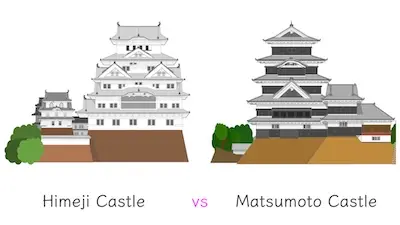
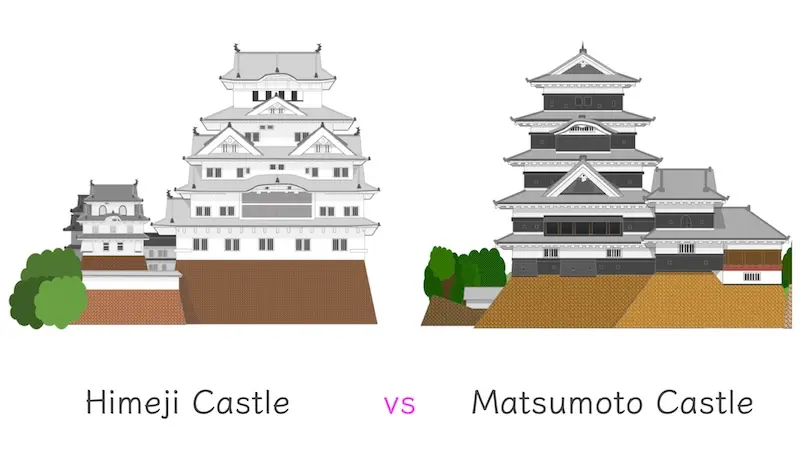
Himeji Castle vs Matsumoto Castle
Japan has many beautiful castles.
But only five are designated as National Treasures (国宝, Kokuho).
A National Treasure is a building or artwork that has the highest cultural value in Japan.
It also means preservation is especially important.
Among them, Himeji Castle and Matsumoto Castle stand out.
Both are full of history and charm.
And you can still explore their keeps inside, which remain in their original form.
Himeji Castle
Called the “White Heron Castle (白鷺城, Shirasagijō).”
It is famous for its bright white and graceful appearance.
Matsumoto Castle
Known as the “Black Crow Castle (烏城, Karasujō).”
Its dark, heavy look reflects the spirit of the Sengoku period.
Interestingly, Himeji City and Matsumoto City are sister cities.
So, let’s compare these two National Treasure castles.
And think about which one you would like to visit.
The Elegant White Beauty of Himeji Castle
This was Japan’s first World Heritage Site.
It is known as the “Shirasagijō“ for its pure white beauty.
If you plan to visit, it takes about 3.5 to 4 hours from Narita Airport by train and Shinkansen.
A Glimpse into the Castle’s History
The first fort was built in 1333.
Later, in 1609, Ikeda Terumasa completed the current main keep.
During the Edo period, large renovations continued.
And today, the castle still preserves its original form almost entirely.
Hidden Details in the Castle Structure
- Five Levels and Seven Floors
The main keep looks like five stories from the outside.
But it actually has seven floors inside. - Beauty and Defense
The white plaster walls are beautiful.
They also protect the castle from fire and enemies. - The Maze
Inside, there are maze-like passages and complex gates.
These were clever strategies for defense.
The Powerful Black Beauty of Matsumoto Castle
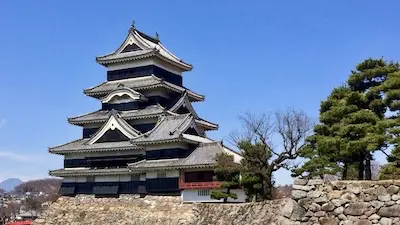
This black-lacquered castle stands against the Northern Japan Alps.
Known as “Karasujō”, its dark exterior captures the spirit of the Sengoku period.
It takes about 3.5 to 4 hours from Narita Airport by train and the Limited Express Azusa.
A Glimpse into the Castle’s History
The construction of Matsumoto Castle began in 1504.
In 1593, Ishikawa Kazumasa completed the large main keep.
During the Edo period, the castle was maintained and renovated.
It escaped both wars and natural disasters.
So its original form is still preserved today.
Hidden Details in the Castle Structure
The main keep has six levels and six floors inside, including one basement floor.
The black plastered walls create a strong and heavy impression.
Its roof has modest but detailed decorations.
Inside, narrow passages and complex gates reflect defensive needs from the Sengoku period.
From the top, you can enjoy views of Matsumoto City.
You can also see the Northern Alps mountains (北アルプス, Kita Alps).
The seasonal scenery blends beautifully with the castle’s atmosphere.
Comparison of Himeji Castle and Matsumoto Castle
Here are the differences between these two castles.
| Item | Himeji Castle (姫路城, Shirasagijō) | Matsumoto Castle (松本城, Karasujō) |
|---|---|---|
| Nickname | Shirasagijō | Karasujō |
| National Treasure | Yes | Yes |
| UNESCO World Heritage | Yes | No |
| Construction Began | 1333 | 1504 |
| Main Keep Completed | 1609 (by Ikeda Terumasa) | 1593 (by Ishikawa Kazumasa ) |
| Structure | 5 stories, 7 floors | 6 stories, 6 floors (including basement) |
| Exterior Color | White, elegant | Black, imposing |
| Architectural Features | Graceful design, complex defense layout | Heavy style, retains Sengoku atmosphere |
3 Key Terms to Enjoy Your Castle Visit
Castles are full of wisdom from the past.
Learning these terms will make your visit even more exciting.
天守 (Tenshu)
Literally “天を守る” (ten o mamoru, Protecting the Heaven).
The “天” (Ten) means the highest place, and “守” (Shu) means to protect.
The lord watched over the land and its people from here.
It is the heart of the castle.
本丸 (Honmaru)
“本” (Hon) means center, and “丸” (Maru) means enclosure.
Japanese castles were built in a circular defensive structure.
The Honmaru is the innermost area.
It was designed to protect the most important part of the castle.
石垣 (Ishigaki)
“石” (Ishi) means stone, and “垣” (Gaki) means a fence or boundary.
Rather than simple walls, these are strong barriers built like puzzles.
Each stone helps protect the castle.
Such craftsmanship balances wisdom, harmony with nature, and safety.
Difference between Tenshu and Honmaru
- Tenshu (天守)
It stands at the top of the castle.
This structure symbolizes authority and divinity. - Honmaru (本丸)
Its location is in the innermost part of the castle.
This area served as the residence for the lord and his family.
Conclusion
Himeji Castle and Matsumoto Castle are both National Treasures of Japan.
Learning about these structures is essential to understanding Japanese culture.
Which castle would you like to visit first?
If you enjoyed comparing Japanese culture, check these articles.
Discover more about Japanese culture in the Japan & Culture category.
Related Posts

姫路城と松本城:二つの国宝のお城を比べてみよう
日本には美しい城がたくさんあります。
しかし国宝に指定された城はわずか5つしかありません。
国宝とは、日本の文化財の中でも特に価値が高いもの。
そして保存が重要とされる建物や美術品に指定されます。
そのうちの二つ、姫路城と松本城は、どちらも歴史と魅力にあふれています。
そして、この二つのお城は、天守の内部も当時の姿のまま見学することができます。
- 姫路城: 真っ白で優雅な外観から「白鷺城」と呼ばれます。
- 松本城: 黒く重厚な姿から「烏城」と呼ばれています。
戦国時代の雰囲気を今に伝えています。
さらに面白いことに、姫路市と松本市は姉妹都市です。
今回は、この二つの国宝の名城を比べて、どちらに行きたいか考えてみましょう。
姫路城の魅力
「日本で初めて世界遺産に登録されたお城です。
真っ白で美しい姿から『白鷺城』とも呼ばれ、世界中から愛されています。
アクセスは成田空港から新幹線などを乗り継いで約3.5〜4時間ほどです。
歴史
1333年に最初の築城が始まります。
1609年に池田輝政が現在の天守を完成させました。
その後も江戸時代を通じて大規模な改修が行われました。
そのため、今も当時の姿をほぼそのまま残しています。
建築の特徴
城の天守は5層7階建てです。
そして、屋根には優雅な曲線と装飾が施されています。
壁には白漆喰が使われています。
美しさだけでなく防火性や敵の侵入を防ぐ効果もあります。
城内には迷路のような通路や複雑な門の配置があります。
それは、防御戦略として巧妙に設計されています。
松本城の魅力
北アルプスを背にした、黒漆が美しいお城です。
『烏城』の愛称で親しまれ、戦国時代の力強さを今に伝えています。
アクセスは成田空港から特急あずさで約3.5〜4時間です。
歴史
松本城の築城は1504年に始まりました。
そして、1593年に石川数正によって大規模な天守が完成しました。
江戸時代には城の保存や改修が行われました。
また、戦火や天災を免れました。
そして、現在も当時の姿をほぼそのまま残しています。
建築の特徴
城の天守は6層6階建て(地下一階含む)です。
黒漆喰の壁が重厚感を演出しています。
屋根には控えめながらも精巧な装飾が施されています。
さらに、内部は戦国時代の防御を意識した狭く複雑な通路や門の配置になっています。
また、天守からは松本市街や北アルプス山脈を楽しむことができます。
そして、四季折々の風景と城の雰囲気が調和します。
姫路城と松本城の比較
2つのお城の違いをまとめます。
| 比較項目 | 姫路城 | 松本城 |
|---|---|---|
| 基本情報 | 白鷺城 | 烏城(からすじょう) |
| 国宝指定 | ○ | ○ |
| 世界文化遺産 | ○ | × |
| 築城開始 | 1333年 | 1504年 |
| 天守完成 | 1609年(池田輝政) | 1593年(石川数正) |
| 天守の層数 | 5層7階 | 6層6階(地下1階含む) |
| 外観の色 | 白く華やか | 黒く重厚 |
| 建築の特徴 | 優雅で防御設計も巧妙 | 重厚で戦国時代の雰囲気 |
お城をもっと楽しむ!3つのキーワード
お城には、当時の人々の知恵が隠されています。
キーワードの意味を知ると、見学がより楽しくなります。
- 天守(てんしゅ)
「天を守る」と書きます。
最も高い場所を意味する「天」を、「守る」場所です。
城主はここから民と土地の平和を見守っていました。
お城の心臓部といえる場所です。 - 本丸(ほんまる)
「本(中心)」と「丸(囲い)」でできています。
日本の城は、中心から円を描くように守りを固める構造です。
その最も中心にあるのが「本丸」です。
大切に守る場所を円で囲んだ、当時の防御の形です。 - 石垣(いしがき)
「石」と「垣(境界線)」を組み合わせた言葉です。
石をパズルのように組み上げます。
敵から城を守るための強固な境界線です。
自然と共存しながら場所を守る、日本の知恵が詰まっています。
「天守」と「本丸」の違い
- 天守
城の頂上にあり、権威や神聖さを象徴する場所。
「天(神仏)を守る」という意味が強いです。 - 本丸
城の最も内側にあり、城主自身や家族を守る場所。
いわば「城主の家」です。
まとめ
姫路城と松本城は、どちらも日本を代表する国宝のお城です。
どちらも日本文化や城の魅力を知る上で欠かせません。
あなたは、どちらのお城に行ってみたいですか?
2つの違いを楽しんでいただけた方は、こちらの記事もぜひご覧ください。
日本文化についてもっと知りたい方は、Japan & Culture カテゴリをご覧ください。