

Why do people make wishes on 七夕 (Tanabata)?
July 7th is Tanabata, the Japanese Star Festival.
It is a traditional Japanese festival with a long history.
A famous story lies behind this tradition.
This article explains the origins of Tanabata.
It also introduces popular Japanese customs.
The Story of Orihime and Hikoboshi
Tanabata comes from a famous legend.
First, let’s explore the story of 織姫 (Orihime) and 彦星 (Hikoboshi).
Lovers Who Meet Only Once a Year
The main characters are Orihime and Hikoboshi.
Orihime was the daughter of a god.
She was a skilled weaver and the daughter of a god.
Hikoboshi was a hardworking cowherd.
They fell in love and got married.
However, they played all the time and stopped working.
Angered by this, the god separated them across the 天の川 (Amanogawa).
They were deeply saddened and cried every day.
The god made them a promise.
“If you work hard, you can meet just once a year.”
That special day is the night of July 7th.
Amanogawa: The River of Heaven
The story of Tanabata is connected to actual stars.
Look up at the summer night sky.
You can see the stars from the legend.
Why is it Called “Amanogawa”?
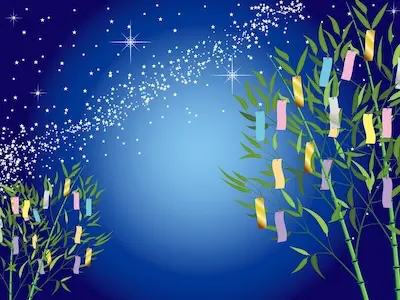
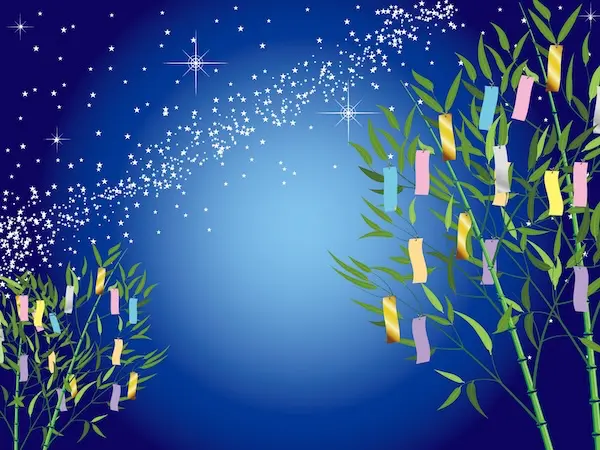
You can see a large, glowing white band in the summer night sky.
This is the 天の川 (Amanogawa).
It is made of countless stars.
People in the past saw these stars as a large river flowing in the sky.
That is why they called it the “天にある川” (Ten ni aru kawa, river in the sky).
In English, it is known as the Milky Way.
The Stars of Orihime and Hikoboshi
Orihime is the star Vega in the constellation Lyra.
Hikoboshi is the star Altair in the constellation Aquila.
Both are known as bright stars in the summer night sky.
You can see these two stars all over the world, not just in Japan.
However, seeing them as a lovers’ story is a culture unique to East Asia.
The Summer Triangle
Vega and Altair are famous for forming the Summer Triangle.
The third star is Deneb in the constellation Cygnus.
These three stars are relatively easy to find in the summer night sky.
During the Tanabata season, be sure to look up and search for them.
The History and Roots of Tanabata
Tanabata has a long history.
An Event Introduced from China
The roots of Tanabata are in China.
There was a festival in China called Kikkoden.
It was a ritual to wish upon the stars for better sewing and craft skills.
People wished to improve their own skills, inspired by Orihime.
This tradition came to Japan during the Nara period.
Tanabata in the Heian Period
Tanabata came to Japan and spread among the aristocrats.
During the Heian period, it became a traditional court event.
In their gardens, the nobles built altars.
They composed 和歌 (waka, Japanese poems) while looking at the stars.
The Edo Period: Spreading to the Public
During the Edo period, this festival spread to the common people.
Children studied at 寺子屋 (terakoya, temple schools)
They began wishing for better handwriting.
This tradition evolved into the customs we see today.
Tanabata Customs in Modern Japan
Even today, the traditions of Tanabata continue.
Why Use Bamboo and Bamboo Grass?
For Tanabata, people decorate 竹 (take, bamboo) and 笹 (sasa, bamboo grass).
Bamboo grows straight and tall toward the sky.
That is why people believed it could deliver wishes to the gods.
It stays green even in winter.
Therefore, it was a symbol of strong vitality.
On the other hand, bamboo grass leaves make a rustling sound in the wind.
People believed this sound was a signal to call the gods.
Additionally, bamboo grass leaves are said to ward off evil spirits.
The True Meaning of the Five-Colored Tanzaku
People hang 短冊 (tanzaku, paper strips) with their wishes on the leaves.
There are five colors of tanzaku.
They are blue, red, yellow, white, and black (or purple).
These colors come from the Chinese philosophy of the Five Elements.
In Japan, this custom started in the imperial court during the Heian period.
Back then, people wrote waka poems on plant leaves instead of paper.
Different Wishes for Each Color
- Blue (Green): Wishes to improve your character
- Red: Wishes of gratitude to parents and ancestors
- Yellow: Wishes for friends and good relationships
- White: Wishes to follow rules and duties
- Black (Purple): Wishes for better studies or work
Which color of tanzaku will you choose?
Common Expressions for Wishes
There is a common phrase used when writing wishes on a tanzaku.
It is the phrase “〜ますように (~ masu youni)“.
This is a polite way to make a wish to the gods or stars.
For example, imagine you want to improve your Japanese.
You can write,
“にほんごが じょうずに なりますように。”
(Nihongo ga jouzu ni narimasu youni.)
(I hope my Japanese improves.)
The phrase “~ masu youni“ has two parts.
- ます (masu): A word that shows politeness.
- ように (youni): A word that expresses a wish or hope.
By combining these, you create a respectful wish.
What Tanabata Means to Japanese People
Even today, Tanabata remains a well-loved festival.
A Special Event for Children
In modern Japan, Tanabata is strongly recognized as an event for children.
At schools and kindergartens, children write wishes on tanzaku.
They also make sasa decorations.
You can see these beautiful displays at shopping malls and stations, too.
The Rainy Season and Tanabata
Tanabata is a traditional sign of summer’s arrival.
The Amanogawa is also a beautiful symbol of the summer night sky.
However, Tanabata in Japan overlaps with 梅雨 (tsuyu).
Therefore, we cannot always see the Amanogawa on this day.
Even so, many people look up at the night sky to make wishes.
You can learn more about Japan’s rainy season in this article.
[What Makes June in Japan Special? Discover the Beauty of Tsuyu]
Conclusion
Tanabata is a traditional event in Japan.
It has been loved for a very long time.
The story of Orihime and Hikoboshi is behind this festival.
People write wishes on tanzaku and hang them on sasa.
Even today, many people enjoy this special day.
On July 7th, be sure to look up at the night sky.
Discover more about Japanese culture in the Japan & Culture category.
Related Posts


 What is the Secret of the Maneki Neko?
 What Is Japonism?: How Ukiyo-e Captivated Europe
なぜ七夕の日には願い事をするのでしょうか。
7月7日は七夕(たなばた)の日。
日本で古くから続く伝統行事です。
その背景には有名な物語があります。
この記事では、七夕の由来や日本の風習などをご紹介します。
織姫と彦星の物語
七夕には有名な伝説があります。
まずは、織姫と彦星の物語を見てみましょう。
一年に一度だけ会える恋人たち
主人公は「織姫(おりひめ)」と「彦星(ひこぼし)」です。
織姫は機織りが上手な神様の娘です。
彦星は真面目に働く牛飼いの青年です。
二人は恋に落ち、結婚しました。
しかし、二人は遊んでばかりで仕事をしなくなりました。
神様は怒り、二人を天の川の両岸に引き離しました。
二人は深く悲しみ、毎日泣き続けました。
神様は「真面目に働くなら、年に一度だけ会うことを許す」と約束しました。
その特別な日が、7月7日の夜です。
天の川と夏の星空
七夕の物語は、実際の星とも結びついています。
夜空を見上げると、伝説の舞台となった星々を見ることができます。
なぜ「天の川」と呼ぶのか?
夏の夜空には、白く光る大きな帯が見えます。
これが「天の川(あまのがわ)」です。
これは無数の星が集まってできています。
昔の人は、この星の集まりを「空に流れる大きな川」に見立てました。
そのため、「天にある川」と呼び始めました。
英語では「Milky Way」と呼ばれています。
織姫と彦星の星
織姫は「こと座のベガ」という星です。
彦星は「ワシ座のアルタイル」という星です。
どちらも夏の夜空で明るく輝く星として知られています。
この二つの星は、日本だけでなく世界各地で見ることができます。
しかし、これを恋人の物語とするのは東アジアならではの文化です。
夏の大三角
ベガとアルタイルは、「夏の大三角」を形作る星としても有名です。
もう一つの星は、はくちょう座のデネブです。
夏の夜空では、この三つの星を比較的見つけやすいと言われています。
七夕の季節には、ぜひ夜空を見上げて探してみてください。
七夕の歴史とルーツ
七夕は長い歴史を持つ行事です。
中国から伝わった行事
七夕のルーツは中国にあります。
中国には「乞巧奠(きこうでん)」という行事がありました。
裁縫や技芸の上達を星に願う儀式です。
人々は織姫にあやかり、自分の技術が向上することを願いました。
このことが奈良時代に日本へ伝わりました。
平安時代の七夕
日本へ伝わった七夕は、貴族たちの間で広まりました。
平安時代になると、七夕は貴族の宮中行事として定着しました。
貴族たちは庭に祭壇を作りました。
そして、星を眺めながら和歌を詠みました。
庶民へ広がった江戸時代
江戸時代になると、この行事が庶民にも広く浸透しました。
寺子屋の子どもたちが、字の上達を願うようになりました。
それが現在の風習に繋がっています。
現代の日本での七夕の風習
現在でも、七夕の伝統は受け継がれています。
なぜ笹や竹を使うのか?
七夕では笹や竹に飾りをつけます。
竹は空に向かってまっすぐ高く育ちます。
そのため、神様に願いを届けてくれると信じられていました。
また、冬でも緑色を保つため、強い生命力の象徴でした。
一方、笹の葉は風に揺れると「さらさら」と音が鳴ります。
この音が神様を呼ぶ合図だと信じられていました。
さらに、笹の葉には悪いものを払う魔除けの力もあると言われています。
五色の短冊の本当の意味
人々は笹の葉に、願い事をしたためた「短冊(たんざく)」を飾ります。
短冊には青・赤・黄・白・黒(紫)の五色があります。
これらは中国の五行思想に由来しています。
日本では平安時代に宮中で始まりました。
当時は、紙ではなく植物の葉に和歌を書いていました。
実は、色によって願い事が違います。
- 青(緑): 自分の人間性を高める願い
- 赤: 親や祖先への感謝の願い
- 黄: 友人や人間関係に関する願い
- 白: 規則や義務を守る願い
- 黒(紫): 学業や仕事の向上に関する願い
あなたは、どの色の短冊を選びますか?
願い事でよく使う表現
短冊に願い事を書く時、よく使われる表現があります。
それは「〜ますように」という言葉です。
これは、神様や星に丁寧にお願いをする時の言い方です。
例えば、日本語が上手になりたい時です。
「日本語が上手になりますように」と書きます。
「〜ますように」の言葉の仕組みは以下の通りです。
- 「ます」: 丁寧な気持ちを表す言葉。
- 「ように」: 願いや希望を表す言葉。
これらを組み合わせることで、敬意を持った願い事になります。
日本人にとって七夕とは
七夕は現代でも親しまれています。
子どもたちに身近な行事
現代の日本では、七夕は子どもたちの行事という印象が強くなっています。
学校や幼稚園では短冊を書き、笹飾りを作ります。
商業施設や駅で笹飾りを見かけることもあります。
梅雨と七夕
七夕は夏の訪れを感じる風物詩の一つです。
また、天の川は、夏の夜空を代表する美しい星景でもあります。
しかし、日本の七夕は梅雨の時期と重なります。
そのため、実際に天の川が見られる年とは限りません。
それでも、多くの人が夜空を見上げて願いを込める日となっています。
日本の梅雨については、こちらの記事でも紹介しています。
[What Makes June in Japan Special? Discover the Beauty of Tsuyu]
まとめ
七夕は、日本で古くから親しまれてきた伝統行事です。
その背景には、織姫と彦星の物語があります。
人々は短冊に願い事を書き、笹に飾ります。
今でも七夕は、多くの人に親しまれています。
7月7日には、ぜひ夜空を見上げてみてください。
日本文化についてもっと知りたい方は、Japan & Culture カテゴリをご覧ください。