

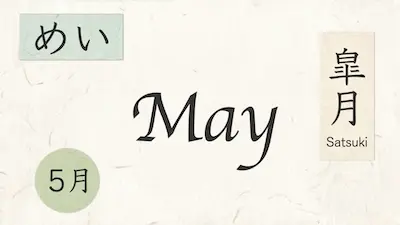
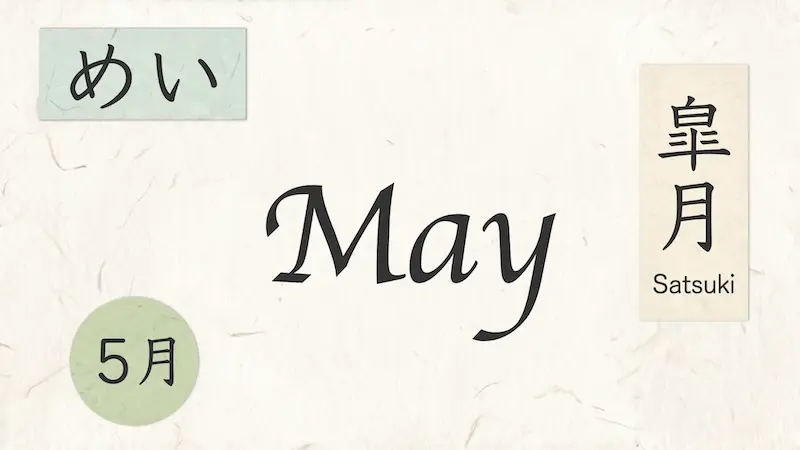
Have you ever heard the names “さつき (satsuki)” and “めい (mei)”?
Both of these names are connected to the month of May.
So, what is the connection between them?
In this article, I will explore their meanings and background.
I also look at how they relate to Japanese month names.
The Japanese Month System (Number + “-gatsu”)
In modern Japan, months are written as 1月 (ichigatsu), 2月 (nigatsu), and 3月 (sangatsu).
This pattern continues for all months.
You simply add “-gatsu” (-gatsu) after a number.
In this way, it is a very simple system.
Unlike English, each month does not have a unique name.
Therefore, there is no need to memorize different names.
However, this system has not always been used.
The current form was organized in the modern era.
4月 (shigatsu) and 7月 (shichigatsu) Pronunciation
There are a few months that need special attention.
4月 is read as しがつ (shigatsu).
And 7月 is read as しちがつ (shichigatsu).
They are not read as よんがつ (yongatsu) or なながつ (nanagatsu).
This is because all month names from 1月 to 12月 use on-yomi.
These are Chinese-derived readings.
On-yomi refers to pronunciations that came from ancient Chinese.
In contrast, よん (yon) and なな (nana) are kun-yomi.
These are native Japanese readings.
This difference is an interesting feature.
It is one of the unique aspects of the Japanese language.
Traditional Japanese Month Names (Wafū Getsumei)
Japan officially adopted the modern Gregorian calendar in Meiji 5 (1872).
Before this, different month names were used.
These were called 和風月名 (wafū getsumei).
This means traditional Japanese month names.
Wafū getsumei reflected the seasons.
It also showed the changes in nature.
Wafū getsumei reflected the seasons and changes in nature.
These names were based on daily life and seasonal events.
They also reflected the natural world of each season.
In other words, the names were very descriptive.
Simply hearing a month’s name gave people a sense of the season.
In this way, the system allowed people to understand the season.
They could do this just by looking at the month’s name.
Traditional Japanese Month Names
Examples of Wafū Getsumei:
- 1月: 睦月 (mutsuki)
Family and close friends gathered this month.
It reflected New Year celebrations and warm relationships. - 3月: 弥生 (yayoi)
Plants and trees grow more vigorously now.
This name represents the deepening of spring. - 5月: 皐月 (satsuki)
This name comes from 早苗月 (sanaezuki).
It refers to the month for planting rice seedlings. - 8月: 葉月 (hazuki)
This name likely comes from 葉落ち月 (haochizuki).
It suggests autumn’s start, when leaves begin to fall.
Traditional Japanese month names were deeply connected to nature.
They were closely tied to nature.
These words also mirrored everyday life.
The Old Calendar and the Meaning of Satsuki
Wafū getsumei was based on the old lunar calendar.
Because of this, the seasonal timing was different.
It did not match the modern calendar exactly.
For example, 皐月 (satsuki) was in the old calendar.
It sometimes matched what is now June.
There is a theory that 皐月 (satsuki) comes from 早苗月 (sanaezuki).
This means the season when rice planting begins.
In ancient Japan, agriculture was central to everyday life.
Seasonal changes were also deeply connected to daily living.
Because of this, month names expressed the season.
They also described everyday life.
Such names reflected how closely nature and daily living were connected.
Wafū Getsumei in Modern Life
Today, wafū getsumei is seen less often on calendars.
However, these traditional month names are still important.
They are often used in personal names.
These words are also valued in Japanese sweets and crafts.
Recently, they have become familiar to people overseas.
This is often through anime character names.
Many people enjoy their original sound.
Wafū getsumei still lives on today in different forms.
It continues to exist in modern life and around the world.
Some of these words may seem difficult at first.
But once you understand their meanings, things change.
Familiar scenery may look a little different.
When you look for month names in daily life.
Seasonal changes may become more enjoyable.
My Neighbor Totoro and the Connection Between the Names
さつき (Satsuki) and めい (Mei).
You may know these names through My Neighbor Totoro.
In the story, two sisters named さつき (Satsuki) and めい (Mei) appear.
Each name has a different background.
The Meanings of Satsuki and Mei
さつき (Satsuki) is used as a Japanese girl’s name.
It also refers to 皐月 (satsuki), the traditional Japanese name for May.
It has a sound that reflects the season.
In Japan, names are sometimes connected to the season of birth.
They may also reflect images from nature.
On the other hand, めい (Mei) is a name derived from the English name May.
It is connected to the Latin word Maius and the Roman goddess Maia.
Because of this, May has been associated with growth and abundance.
Two Different Cultural Meanings of May
These two names each represent “May” from different cultures.
In Japanese, it appears as 皐月 (satsuki).
In English, it is May.
Many scenes in the film leave a strong impression.
They show the beauty of the fresh green season.
Note: Curious about Japan’s fresh green season?
You may also enjoy: Is “Green” Different in Japan? Meaning and Culture
Conclusion
In modern Japan, May is called 5月 (gogatsu).
It is a very simple and easy-to-understand system.
When you look at the names さつき (satsuki) and めい (mei),
you can see both Japanese and English cultural perspectives.
Even familiar words have deeper backgrounds.
By learning them, you can understand Japanese more deeply.
It may also begin to feel more natural to you.
Explore more Japanese expressions in the Japanese Words category.
Related Posts


 Children’s Day in Japan: Koinobori and May 5 Traditions
 What Shrines Mean to Japanese People
「さつき」と「めい」という名前を聞いたことがありますか?
この二つの名前は、どちらも「5月」と関係しています。
どんな関係なのでしょうか?
この記事では、その意味と背景を日本語の月の名前とあわせて見ていきます。
日本の月(数字+月)の仕組み
現代の日本では、月は「1月・2月・3月…」のように数字で表します。
数字の後に「月(がつ)」をつけるだけです。
このように、とてもシンプルな仕組みになっています。
この形は、日本語学習者にとって覚えやすい特徴の一つです。
英語のように月ごとに異なる単語を覚える必要はありません。
しかし、この形は昔から使われていたわけではありません。
現在の形は、近代以降に整理されたものです。
4月と7月の読み方
少し注意したい月もあります。
4月は「しがつ」です。
そして7月は「しちがつ」です。
「よんがつ」や「なながつ」ではありません。
これは、1月から12月までの読み方がすべて「音読み」だからです。
音読みとは、昔の中国由来の読み方です。
一方、「よん」や「なな」は「訓読み」です。
これらは、日本固有の読み方です。
こうした違いも、日本語の面白さのひとつです。
昔の月名(和風月名)とは
日本で今のカレンダー(新暦)が採用されたのは、明治5年(1872年)でした。
それ以前は、別の月の名前が使われていました。
これが「和風月名(わふうげつめい)」です。
和風月名は、季節や自然の変化を表す名前でした。
これらの名前は、日々の暮らしや行事に基づいたものでした。
つまり、月の名前を見るだけで季節の様子が分かる仕組みでした。
和風月名
和風月名の例:
- 1月:睦月(むつき)
新年に家族や親しい人が集まる月。 - 3月:弥生(やよい)
草木がいっそう生い茂り、春が深まる月。 - 5月:皐月(さつき)
苗を植える「早苗月」を略した、田植えをする月。 - 8月:葉月(はづき)
木の葉が落ちる「葉落ち月」が変化した、秋の訪れを感じる月。
このように、和風月名は自然と生活が結びついた言葉でした。
旧暦と皐月の意味
和風月名は旧暦をもとにしていました。
そのため、現在のカレンダーとは正確に一致しませんでした。
(例えば、皐月は旧暦の月でした。
それは今の6月にあたることもありました。
皐月は「早苗月(さなえづき)」が短くなったという説があります。
これは田植えが始まる季節を示す言葉です。
日本では古くから農業が生活の中心でした。
そして、季節の変化は暮らしと深く結びついていました。
そのため、月の名前は季節を表していました。
それらは日々の暮らしについても述べていました。
今も残る和風月名
和風月名は、今ではカレンダーなどで見る機会は減りました。
しかし、これらの伝統的な月の名前は今でも大切にされています。
それらは人の名前、和菓子、そして伝統工芸の世界で使われています。
最近では、これらは海外の人々にも親しまれています。
アニメのキャラクター名を通じて知られることが多いです。
和風名月は、形を変えて今の暮らしや世界に息づいています。
難しく感じる言葉もあります。
しかし、意味を知るといつもの景色が少し違って見えるかもしれません。
暮らしの中で月名を探してみると、季節の変化がもっと楽しくなりそうです。
となりのトトロと名前のつながり
さつきとめい。
「となりのトトロ」で、この名前を知っている方もいるかもしれません。
作品の中では「さつき」と「めい」という姉妹が登場します。
それぞれの名前には異なる背景があります。
「さつき」は日本の女の子の名前として使われています。
和風名月の「皐月」のことです。
季節を感じさせる響きを持っています。
日本では、生まれた季節や自然のイメージを名前に込めることがあります。
一方で、「めい」は英語の May に由来する名前です。
ラテン語の Maius やローマ神話の女神 Maia に関連しています。
そのため、成長や豊かさを表す月とされています。
この二つの名前は、それぞれ異なる文化の「5月」を表しています。
日本語では「皐月」、英語では「May」という形です。
作品全体にも、新緑の季節を感じさせるシーンが印象的です。
* 日本の新緑の季節について知りたい方は、こちらもおすすめです。
Is “Green” Different in Japan? Meaning and Culture
まとめ
現代の日本では「5月」は「ごがつ」と呼ばれます。
とてもシンプルで分かりやすい形です。
「さつき」と「めい」。
2つを通して見ると、日本語と英語、それぞれの文化が見えてきます。
身近な言葉にも背景があります。
それを知ることで、日本語をより深く理解できるようになります。
そして、より自然に感じられるでしょう。
日本語表現についてもっと知りたい方は、Japanese Words カテゴリをご覧ください。