


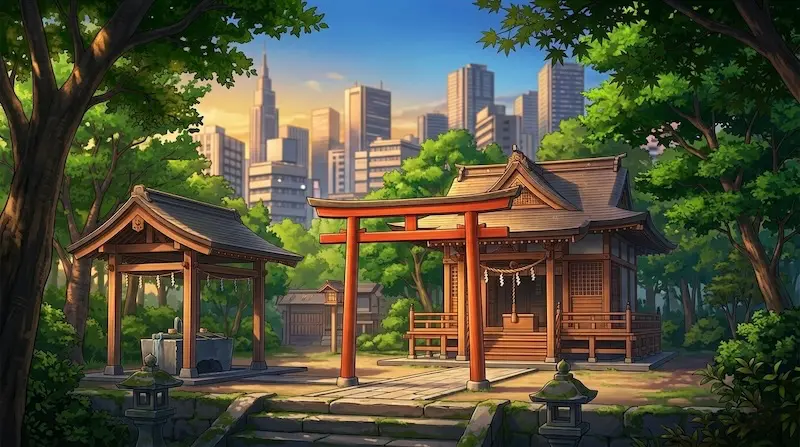
Many Japanese people describe themselves as non-religious.
Yet, many still follow traditions like visiting shrines in Japan for the New Year.
It is also common to stop by for a moment during a casual walk.
This habit isn’t driven by deep religious conviction.
Instead, it comes from a familiar sense of comfort.
Shrines are deeply woven into daily life in Japan.
People visit them naturally without even thinking about it.
This is perhaps the most accurate reflection of modern life in Japan.
Local Shrines Blending into the Cityscape
Shrines are not only located in large forests.
You can find them on the rooftops of city buildings.
They also sit quietly at the edge of residential streets.
These small shrines appear in many unexpected places.
You might see a commuter give a quick nod while walking by.
Someone returning from shopping may stop for a moment.
They often pause briefly to put their hands together.
These moments do not feel like a formal ritual.
It is simply a warm scene, similar to greeting a neighbor.
A shrine is not just a place to visit when you have big worries.
It exists as a natural part of the daily landscape.
This physical closeness gives people a quiet sense of comfort.
A Peaceful Escape from the Busy City
Recently, more people are visiting shrines as places to recharge.
Modern life is constantly filled with digital notifications.
Because of this, a shrine is a perfect place to go offline for a while.
First, you pass through the torii gate (鳥居).
Then, you visit the “temizuya (手水舎)” water pavilion.
You can hear the soothing sound of running water.
Rinsing your hands with the cold water feels very refreshing.
This experience is especially wonderful on a sunny summer day.
The deep shade from the thick trees is surprisingly cool.
This is a natural coolness, quite different from an air conditioner.
Feeling this change in atmosphere can be very refreshing.
This feeling is important in modern life.
Experiencing the Changing Seasons
Shrines are wonderful places to feel the change of seasons.
Cherry blossoms bloom beautifully during the spring.
Vibrant red leaves decorate the grounds throughout the autumn.
Our busy daily lives often make us forget how the seasons shift.
However, a visit to a shrine helps you notice seasonal changes.
For example, you begin to see the changing colors of the trees.
You can take a moment to realize that a new season has arrived.
For modern people who value efficiency, this is a truly luxurious time.
Original Meanings and the “Atmosphere” We Value
In previous blog posts, I have explained the history of Shinto.
I have also shared its original meanings.
Learning this background helps you see shrines in a deeper way.
At the same time, we value the “atmosphere” of these spaces.
We also appreciate the silence we experience there today.
When we put our hands together at a shrine, we do more than make wishes.
It is also a quiet moment for reflection.
We use this time to express gratitude for daily life.
Some people also share recent updates or mention their goals.
Shrines are quiet places that offer no spoken words.
Within that silence, you might find your own clarity.
The Joy of Preserving Your Travel Memories
Recently, shrines have become popular travel destinations.
Their beautiful architecture reflects Japanese culture.
Their carefully maintained gardens do as well.
The detailed carvings on the buildings are also a highlight.
You can see the incredible skill of the craftsmen in these decorations.
It feels like visiting an outdoor art museum.
Goshuin: A Unique Travel Log
Collecting Goshuin (Shrine stamps) is wonderful way to preserve memories.
It also makes each shrine visit feel more special.
Originally, these stamps served as proof of a visit.
Today, many people enjoy collecting them as a personal travel log.
The warmth of unique, handwritten calligraphy is special.
It offers a different feeling than a digital photo.
Each location uses different designs and traditional washi (washi paper) .
Enjoying these details is part of the experience.
Collecting your favorite memories in this way is a wonderful experience.
This type of analog hobby is a great way for adults to enjoy visiting shrines.
Conclusion
For many people in Japan today, shrines are a natural part of daily life.
They are a familiar presence in everyday life.
People often visit them casually on a whim or during a trip.
Recently, more people have started to appreciate shrines.
Many now see them as an important part of Japanese culture.
Shrines are places where Japanese people drop by very casually.
Please feel free to visit one yourself whenever you like.
Discover more about Japanese culture in the Japan & Culture category.
Related Posts

 Why Are “Satsuki” and “Mei” Connected to May?
 Why do Japanese people say “Chotto” So Much?
多くの日本人は「自分は無宗教だ」と言います。
しかし、お正月には神社へ行き、散歩の途中にふらりと境内に立ち寄ります。
そこには、強い信仰心というよりも、もっと身近な安心感があるようです。
神社があまりにも生活の一部になりすぎていて、意識することなく足を運ぶ。
それが、現代の日本人のリアルな姿なのかもしれません。
街角に溶け込む「街角の神社」
神社は、大きな森の中にだけあるわけではありません。
都会のビルの屋上や、住宅街の道の端。
そんな意外な場所にも、小さな社(やしろ)があります。
通勤途中の人が、歩きながら小さく会釈(えしゃく)をする。
買い物帰りの人が、少しだけ足を止めて手を合わせる。
そこには、特別な儀式のような雰囲気はありません。
まるで近所の友人に挨拶をするようです。
そこにはあたたかい光景があります。
大きな悩みがある時だけ行く場所ではありません。
日常の風景として、そこにある。
この「距離の近さ」が、日本人が感じる安心感を与えてくれます。
都会の喧騒を忘れる「聖域」
最近では、神社を「パワースポット」として訪れる人が増えています。
現代の生活は、常にデジタルの通知に追いかけられています。
そんな時、神社は「オフラインになれる場所」です。
鳥居をくぐり、まず「手水舎(てみずや)」へ向かいます。
水の流れる音が聞こえます。
冷たい水で手を清めると、心が少し洗われる気がします。
特に、よく晴れた夏の日は格別です。
生い茂る木々が作る濃い日陰は、驚くほどひんやりとしています。
それはエアコンの冷気ではなく、自然が作り出す、生きた涼しさです。
こうした「空気感の違い」を感じることもあります。
それは、現代人にとって大切なリフレッシュになっています。
四季を感じる
神社は、より季節の変化を感じられる場所です。
春には桜が咲き、秋には鮮やかな紅葉が境内を彩ります。
忙しい毎日を送っていると、季節の移り変わりを忘れがちです。
しかし、ふと神社に立ち寄ると、木々の色の変化に気づきます。
「今年もこの季節が来たんだな」と感じます。
そして、立ち止まって季節の変化を確認できます。
本来の意味と、大切にしたい「感覚」
これまでのブログでは、神道の本来の意味や歴史を伝えてきました。
知識として背景を知ることで、神社の見え方は深くなります。
一方で、現代の私たちは、その場所の「空気」や「静寂」も大切にしています。
神社で手を合わせる時、それはただ「お願いする」だけではありません。
日々の感謝や、近況の報告、目標なども伝えます。
何も答えず、ただ静かに佇む神社の空間。
その沈黙の中で、私たちは自分なりの答えを見つけているのかもしれません。
「記憶」を形にする楽しみ
最近では、神社は旅の目的地としても魅力的です。
美しい建築や、手入れされた庭園は日本文化そのものです。
また、建物の細かな彫刻も見どころの一つです。
職人の技が光る装飾は、まるで屋外の美術館のようです。
その思い出を形に残すのが、御朱印の収集です。
本来は参拝の証(あかし)ですが、今は「旅のログ」としての楽しみも広がっています。
一つひとつ異なる墨書きの温かみは、デジタルの写真とは違う良さがあります。
それぞれの神社で使われている和紙や、デザインも楽しむこともできます。
そして、大切な記憶をコレクションする。
こうしたアナログな楽しみも、大人の神社巡りの醍醐味です。
まとめ
現代の多くの日本人にとって神社は、日常の中に自然にと存在する場所です。
ふと思いついた時や旅先で気楽に立ち寄る、そんな身近な存在と言えるでしょう。
最近では、日本文化の一つとしてあらためて大切に感じる人も増えています。
日本人も日常の中でふらりと立ち寄る場所です。
あなたもぜひ、難しく考えず気軽に足を運んでみてください。
日本文化についてもっと知りたい方は、Japan & Culture カテゴリをご覧ください。