

“Shun-ka-shū-tō”: Discover Japan’s Four Seasons and Living Vocabulary
- Feel Japan’s Four Seasons Through Words
- Spring (Haru: はる): New Beginnings and Seasonal Challenges
- Summer (Natsu: なつ): Humidity and Intense Heat
- Autumn (あき): Colors and Harvest Time
- Winter (Fuyu: ふゆ): Traditions and Dryness
- Conclusion: Feeling the Seasons Through Words
- 日本の四季を「言葉」で感じる
- 春:新しい生活と、少しの悩み
- 夏:湿気と熱気
- 秋:色彩と実りの時間
- 冬:伝統と乾燥
- まとめ
Feel Japan’s Four Seasons Through Words
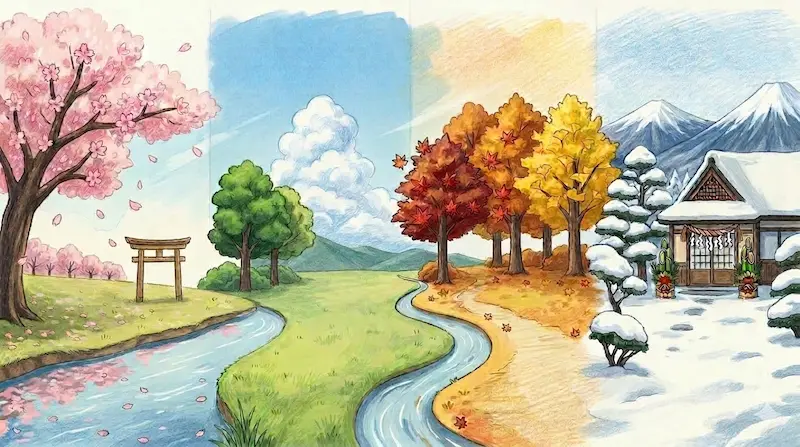
“Shun-ka-shū-tō” (春夏秋冬): This beautiful phrase represents the four distinct seasons of Japan.
Japan is famous for its clear seasonal transitions.
In fact, each season has its own set of “living words” that Japanese people use every single day.
These words are deeply connected to our daily weather, lifestyle, and unique culture.
In this article, I will introduce essential seasonal vocabulary.
Furthermore, I’ll explain the hidden meanings and cultural backgrounds behind them.
Spring (Haru: はる): New Beginnings and Seasonal Challenges
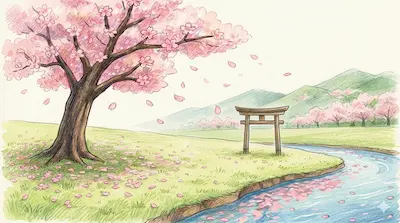
In Japan, spring means a “New Start.”
It is the season for schools and careers to begin.
Furthermore, temperatures rise. Spending time outdoors becomes very pleasant.
1. Shin-nendo(しんねんど):The New Fiscal/Academic Year
The social year in Japan starts in April. Specifically, school and business schedules begin now.
January is the “New Year.” However, Shin-nendo(しんねんど) is a different, essential “start” for society.
- Insight: Entrance ceremonies in April are iconic Japanese events.
2. Atatakaku naru(あたたかくなる):Getting Warmer
In March, the harsh winter cold softens. Consequently, this is a very common greeting.
It has a positive and happy sound. People look forward to going outside.
- Example: “It has become quite warm recently, hasn’t it?”
3. Kafun-shō(かふんしょう):Hay Fever
In spring, you will hear the word Kafun-shō(かふんしょう) often.
It refers to sneezing and runny noses from cedar pollen.
Many people in Japan suffer from this. Therefore, some feel that “spring is a difficult season.”
- Teacher’s Note: Knowing how to manage symptoms is important for your stay.
Summer (Natsu: なつ): Humidity and Intense Heat
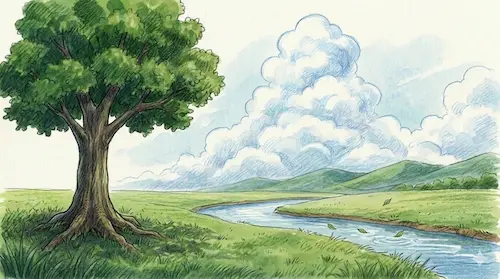
Summers in Japan are not just hot. Specifically, the high humidity is a key feature.
Therefore, you must manage your health carefully.
Furthermore, as spring becomes shorter, summer-like heat often arrives earlier than expected.
1. Tsuyu(つゆ):The Rainy Season
From late May to July, Japan experiences a period of continuous rain.
This is an essential season before the peak of summer begins.
It is crucial for agriculture. However, some people feel gloomy because laundry does not dry easily.
- Teacher’s Note: The kanji for “Plum (梅:うめ)“ is used because plums ripen during this rainy period.
2. Mushi-atsui(むしあつい):Steamy and Humid
This is an indispensable word to describe Japanese summers.
It means it is not only hot but also very humid. It feels like being inside a sauna.
Especially in Tokyo, it is very Mushi-atsui(むしあつい). This expression captures the true essence of summer in Japan more than just saying “hot.”
- Example: “It is more humid today than it was yesterday, isn’t it?”
3. Netchū-shō(ねっちゅうしょう):Heatstroke
Netchū-shō(ねっちゅうしょう) is a condition where you feel unwell due to the heat.
It happens easily when both temperature and humidity are high. Therefore, drinking water and using air conditioning are vital.
Recently, portable fans called “handy fans” have become very popular.
- Insight: When the situation is serious, the government issues a “Heatstroke Alert” (Netchū-shō Keikai Alert).
Autumn (あき): Colors and Harvest Time
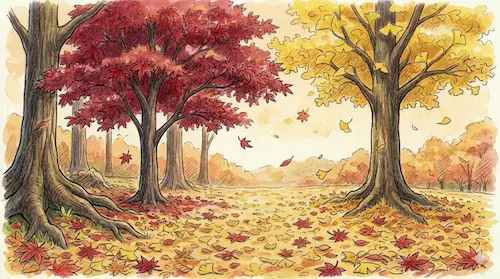
In autumn, temperatures drop. Therefore, it becomes a very comfortable season.
The changes in nature are beautiful. Consequently, more people enjoy going outdoors.
1. Kōyō(こうよう):Autumn Leaves
While spring has “Sakura(さくら),” autumn is represented by Kōyō(こうよう).
This word refers to leaves changing into red or yellow. Specifically, this happens as the temperature falls.
If it becomes cold suddenly, the colors become even more vivid.
Many people go on trips or hiking to see these beautiful landscapes.
- Insight: The characters for Kōyō(こうよう) can also be read as “Momiji(もみじ).”
2. Shokuyoku no Aki(しょくよくのあき):Autumn Appetite
This phrase means “Autumn makes you want to eat because the food is delicious.”
There are many seasonal tastes like saury (sanma), chestnuts, mushrooms, and pears.
This is one of the main reasons why Japanese people love autumn.
- Teacher’s Note: It is also related to your appetite returning after the intense summer heat.
3. Kōraku(こうらく):Excursions and Outings
Autumn weather is mild. Therefore, it is easy to spend time outside.
Kōraku(こうらく) refers to going on mountain walks or sightseeing during this pleasant season.
The term “Kōraku Season(こうらくシーズン)” is a sophisticated expression that symbolizes the enjoyable atmosphere of autumn.
- Example: “It looks like this weekend will be perfect for an outing (Kōraku-biyori).”
Winter (Fuyu: ふゆ): Traditions and Dryness
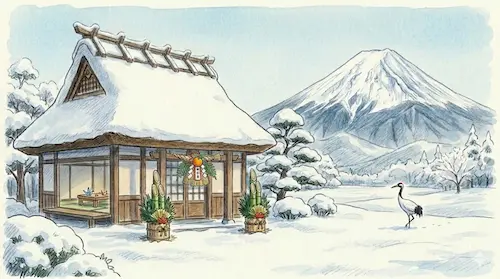
In winter, temperatures drop. Specifically, the cold becomes very harsh.
Furthermore, many special events occur at the end of the year. Consequently, this is a very busy time.
The air also becomes dry. Therefore, you must take care of your health.
1. Nen-matsu(ねんまつ):The Year-End
Nen-matsu(ねんまつ) refers to the period at the very end of the year.
In December, people become busy with work and deep cleaning (O-soji:おおそうじ).
It is an important time to prepare for the new year. Specifically, this period has a unique energy as the year reaches its milestone.
- Insight: The last business day of December is called “Shigoto-osame.”
2. Otoshidama(おとしだま):New Year’s Gift Money
This is money that adults give to children during the New Year.
It is handed over in small envelopes called “Pochi-bukuro(ポチぶくろ).”
For children, winter is the most exciting season of the year. It is one of the biggest highlights of the New Year holidays.
- Teacher’s Note: There are general market rates for the amount given, depending on the recipient’s age.
3. Kansō(かんそう):Dryness
The air in Japan during winter is very dry. This is because low temperatures lead to less moisture in the air.
Therefore, your skin and throat can easily become dry. Taking precautions is necessary during this season.
- Example: “The air is dry in winter, so please take care of your throat.”
Conclusion: Feeling the Seasons Through Words
Japanese has many words deeply connected to the seasons.
Specifically, understanding these words helps you understand Japanese life and thinking.
Generally, the four seasons are divided into three-month intervals:
- Spring: March – May
- Summer: June – August
- Autumn: September – November
- Winter: December – February
However, more people now feel that spring and autumn are becoming shorter.
This is due to Global Warming (地球温暖化). Therefore, the way we experience seasonal changes is gradually shifting.
Which seasonal word impressed you the most? Please try to feel Japan’s seasons and culture through these everyday words.
Explore Japanese Culture Further
Someiyoshino vs Yaezakura Explore the unique characteristics and beauty of Japan’s most beloved cherry blossoms.:
The spirit of “Mottainai” Discover the deep respect for resources embedded in Japanese culture.:
What is Mottainai? The Japanese Concept of Respect and Gratitude
The world of “Bento” Learn about the aesthetics, rules, and origins of Japanese lunch boxes.:
What is a Bento Box? Discover the Japanese Spirit of Hospitality
Master your Self-introduction Build better connections with essential phrases for any professional setting.:
How to Use “Yoroshiku Onegaishimasu” for Your Self-Introduction
Japanese of the Day / 今日の日本語
- Word:春夏秋冬 (Shun-ka-shū-tō) – The four seasons
- Meaning:A formal and poetic way to say “four seasons.”
Each kanji represents Spring (春), Summer (夏), Autumn (秋), and Winter (冬). - Example:日本には美しい春夏秋冬があります。(Nihon ni wa utsukushii shun-ka-shū-tō ga arimasu.)
(Japan has the beautiful four seasons.) - Fun Fact:Shun-ka-shū-tō is a more sophisticated and literary expression than the common word “Shiki.”
- Teacher’s Note: Both Shiki and Shun-ka-shū-tō mean “four seasons.” Shiki is the common word for daily conversation.
In contrast, Shun-ka-shū-tō is a more formal and literary expression.
◆ Would you like to practice speaking Japanese? ◆
In my lessons, you can use Japanese a lot and learn to speak naturally with me.
日本の四季を「言葉」で感じる
「春夏秋冬(しゅんかしゅうとう)」。日本にははっきりとした四季があります。
それぞれの季節には、日本人が毎日使う「リアルな言葉」があります。
これらの言葉は、天気や生活、文化と深く関係しています。
この記事では、日本で実際によく使われる季節の言葉。今日はその意味や背景をご紹介します。
春:新しい生活と、少しの悩み
日本の春は、学校や仕事が始まる「新しいスタート」の季節です。
気温も少しずつ上がり、外で過ごしやすくなります。
1. 新年度(しんねんど)
日本では、4月に新しい一年が始まります。 学校や会社、政府のスケジュールはすべて4月がスタートです。
1月の「新年」とは別に、社会的な「始まり」を感じる大切な言葉です。
- Insight: 日本の入学式や入社式は、4月の象徴的な行事です。
2. 暖かくなる(あたたかくなる)
3月になると、厳しい冬の寒さが和らぎます。 この時期、日本人が挨拶として最もよく使う言葉です。
外出が楽しくなる、ポジティブな響きを持つ言葉です。
Example: 「最近、ずいぶん暖かくなりましたね。」
2. 花粉症(かふんしょう)
春になると、「花粉症」という言葉をよく聞きます。スギなどの花粉が原因で、くしゃみや鼻水が出る症状です。
日本では多くの人が悩んでいて、「春はつらい季節」と感じる人も少なくありません。
- Teacher’s Note: 日本での滞在を楽しむために、薬などの対策を知っておくことは重要です。
夏:湿気と熱気
日本の夏は気温が高いだけでなく、湿気も多いのが特徴です。そのため、体調管理に気をつける必要があります。
また、春が短くなっている影響で、早い時期から夏のような暑さになることが増えています。
1. 梅雨(つゆ)
5月の終わりから7月にかけて、雨の日が続く時期です。 夏本番が来る直前の、大切な雨の季節です。
農作物には欠かせません。しかし、洗濯物が乾かず、少し憂鬱に感じる人もいます。
- Teacher’s Note: 「梅(Plum)」の漢字を使うのは、この時期に梅の実が熟すからです。
2. 蒸し暑い(むしあつい)
日本の夏を表現するのに欠かせない言葉です。
気温が高いだけでなく、湿度が高くてサウナの中にいるような不快さを表します。 特に東京は蒸し暑いです。
「暑い」よりも、より「日本の夏」を実感させる表現です。
- Example: 「今日は昨日よりも蒸し暑いですね。」
3. 熱中症(ねっちゅうしょう)
「熱中症」は、暑さによって体調が悪くなることです。気温や湿度が高いと起こりやすくなります。
水分を摂ること、エアコンを使うことが大切です。
また、最近では、持ち歩き扇風機「ハンディファン」が人気です。
- Insight: 深刻な状況の時は、自治体から「熱中症警戒アラート」が出されます。
秋:色彩と実りの時間
秋は気温が下がり、過ごしやすくなる季節です。自然の変化も美しく、外出を楽しむ人が増えます。
1. 紅葉(こうよう)
春の「桜」に対し、秋を代表するのが「紅葉(こうよう)」です。「紅葉」は、葉の色が赤や黄色に変わることです。
気温が下がることで、このような変化が起こります。急に寒くなると、きれいな紅葉が見られます。
多くの人が、綺麗な景色を見るために旅行やハイキングに出かけます。
- Insight: 「紅葉」は「もみじ(Momiji)」と読むこともあります。
2. 食欲の秋(しょくよくのあき)
「秋は食べ物がおいしいので、食欲が増す」という意味の言葉です。
サンマ、栗、きのこ、梨など、この時期にしか味わえない味覚がたくさんあります。
日本人が秋を愛する大きな理由の一つです。
- Teacher’s Note: 夏の暑さで落ちた食欲が、涼しくなって戻ることも関係しています。
3. 行楽(こうらく)
秋は気候がよく、外で過ごしやすくなります。秋の穏やかな気候の中、山歩きや観光に出かけることを言います。
「行楽シーズン」という言葉は、秋の楽しい雰囲気を象徴する知的な表現です。
- Example: 「今週末は行楽日和(Kouraku-biyori)になりそうですね。」
冬:伝統と乾燥
冬は気温が下がり、寒さが厳しくなる季節です。年末には特別な行事も多く、忙しくなる時期でもあります。
また、空気が乾燥しやすく、体調管理にも注意が必要です。
1. 年末(ねんまつ)
「年末」は、年の終わりの時期を指す言葉です。
12月になると、仕事や大掃除などで忙しくなります。新しい年を迎える準備をする、大切な時期です。
独特の活気がある、一年の節目となる時期です。
- Insight: 12月の最終営業日は「仕事納め(Shigoto-osame)」と呼ばれます。
2. お年玉(おとしだま)
お正月に、大人が子供にあげるお金のことです。
小さな「ポチ袋」という封筒に入れて渡します。 子供たちにとって、冬は一年で最も嬉しい季節です。
子どもにとっては、お正月の楽しみの一つです。
- Teacher’s Note: 渡す相手や年齢によって、相場(一般的な金額)が決まっています。
3. 乾燥(かんそう)
日本の冬の空気は、とても乾燥しています。 気温が低く、空気に水分が少なくなるためです。
肌やのどが乾きやすくなり、対策が必要な季節です。
- Example: 「冬は空気が乾燥するので、のどに気をつけてください。」
まとめ
日本語には、季節と深く結びついた言葉がたくさんあります。
これらの言葉を知ることで、日本人の生活や考え方も理解しやすくなります。
一般的に日本の「春夏秋冬」は3か月ごと分かれています。(春:3-5月、夏:6-8月、秋:9-11月、冬:12-2月)
しかし、最近では、地球の温暖化の影響で、春や秋が短くなっていると感じる人が増えています。
そのため、季節の変化を感じる機会も少しずつ変わってきています。
あなたは、どの季節の言葉が一番印象に残りましたか?
日常でよく使われる言葉を通して、日本の季節や文化をぜひ感じてみてください。
日本文化をもっと深く知る
ソメイヨシノと八重桜 日本を代表する二つの桜、それぞれの特徴と美しさの秘密を探ります:
「もったいない」の精神 日本文化に根付いた、物に感謝する心をご紹介します:
What is Mottainai? The Japanese Concept of Respect and Gratitude
「お弁当」の世界 日本の弁当に込められた美意識、独自のルール、そしてその成り立ちを紐解きます:
What is a Bento Box? Discover the Japanese Spirit of Hospitality
自己紹介のマスターガイド あらゆる場面で信頼を築くための、必須のフレーズを学びましょう:
How to Use “Yoroshiku Onegaishimasu” for Your Self-Introduction