

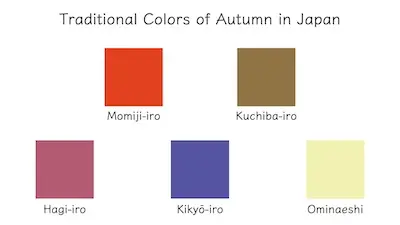
What colors come to mind when you think of autumn?
Many people may picture red and yellow autumn leaves.
But autumn colors in Japan are not limited to fall foliage.
Some also come from fallen leaves and seasonal flowers.
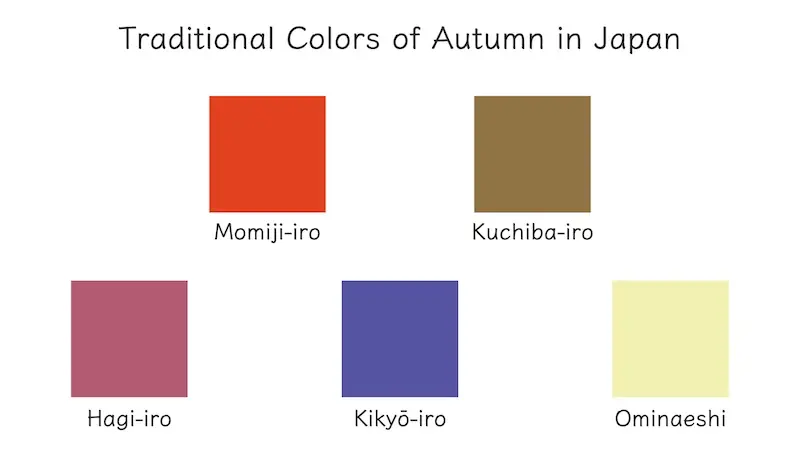
In this article, we will explore five traditional colors of autumn in Japan.
Autumn Colors Inspired by Changing and Fallen Leaves
In autumn, leaves gradually begin to change color.
They turn vivid shades of red and yellow.
Eventually, they fall to the ground.
In Japan, these changes were also expressed through color names.
One example is 紅葉色 (Momiji-iro, autumn leaf red).
Another is 朽葉色 (Kuchiba-iro, withered leaf color).
Momiji-iro — The Red of Autumn Leaves
Momiji-iro is a red that recalls maple leaves in autumn.
As its name suggests, it comes from fall foliage.
Autumn leaves have long been a symbol of the season in Japan.
They also appear many times in classical waka poetry and literature.
Even today, people enjoy viewing autumn leaves.
Across generations, this scenery has remained part of Japanese autumn.
Kuchiba-iro — The Color of Deep Autumn
Kuchiba-iro is a yellowish brown that resembles dried leaves.
The word kuchiba means faded and withered leaves.
Bright autumn foliage eventually comes to an end.
Soon, fallen leaves begin to cover the ground.
So, Kuchiba-iro brings late autumn to mind.
People have used this color name since the Heian period.
The word kuchiba also appears in The Tale of Genji.
Other color names came from shades of fallen leaves.
Examples include Aka-kuchiba and Ki-kuchiba.
Each name shows a reddish or yellowish tone.
Such names reveal a close attention to small color differences.
Traditional Colors Inspired by the Seven Autumn Flowers
Autumn is not colored only by the leaves of trees.
Meanwhile, seasonal flowers and grasses bloom in fields and mountains.
Japan has a traditional group of seasonal plants.
People call them the Seven Flowers of Autumn, or aki no nanakusa.
Their origin can be traced to poems by Yamanoue no Okura in the Man’yōshū.
The Seven Herbs of Spring are linked to a food tradition.
People eat them in a rice porridge called nanakusa-gayu.
In contrast, the Seven Flowers of Autumn are admired for their beauty.
Instead of eating them, people enjoy looking at the flowers.
Some of these plants also inspired traditional color names.
Here, we will look at three plants.
They are hagi (bush clover), kikyō (Japanese bellflower), and ominaeshi (golden lace).
Hagi-iro — Reddish Purple in the Autumn Fields
萩色 (Hagi-iro, bush clover color) is a reddish purple.
It comes from hagi, or bush clover.
Hagi is one of the Seven Flowers of Autumn.
Small flowers bloom all along its branches.
Many poems in the Man’yōshū also mention this plant.
Unlike autumn leaf red, Hagi-iro has a hint of purple.
Its soft reddish purple comes from flowers in the autumn fields.
Kikyō-iro — Blue-Purple in Autumn
Red and yellow often stand out in autumn.
Blue-purple, however, feels a little different.
One example is 桔梗色 (Kikyō-iro, bellflower color).
Kikyō-iro adds another shade to the autumn palette.
The color comes from kikyō, or Japanese bellflower.
Kikyō is also one of the Seven Flowers of Autumn.
Its five open petals form a distinctive shape.
When fully open, the flower can look like a star.
Among autumn reds and yellows, its blue-purple color stands out.
People have known this color name since the Heian period.
It shows another side of Japanese autumn colors.
Ominaeshi — Yellow in the Autumn Fields
女郎花 (Ominaeshi, golden lace color), or golden lace, produces many small yellow flowers.
It is one of the Seven Flowers of Autumn.
People have admired this plant since ancient times.
A traditional color also comes from this flower.
Ominaeshi is a soft, pale yellow.
Autumn leaves can also be yellow.
In contrast, Ominaeshi comes from an autumn wildflower.
Nature offers different yellows within the same season.
Why Is It Written 女郎花?
The kanji 女郎花 may seem unusual at first.
It contains the characters 女郎.
In the past, these characters were also used for courtesans.
However, 女郎 once had the broader meaning of “woman.”
Several theories explain the origin of the word ominaeshi.
One theory connects omina with the meaning “woman.”
Another links the yellow flowers to rice mixed with millet.
No single explanation has been accepted as certain.
Older texts also used different kanji spellings.
Autumn Colors in Japanese Clothing
In Japan, seasonal colors were also used in clothing.
One example is kasane no irome.
This color tradition appeared in Heian-period court dress.
Different colors were layered in a garment.
For example, the outer and inner sides could have different colors.
Together, these combinations represented seasonal plants and scenery.
People enjoyed the seasons through more than nature itself.
Seasonal colors also appeared in what they wore.
Clothing helped express a sense of the season.
This custom is another part of Japan’s color culture.
Japanese Color Names Inspired by Nature
All five colors in this article are connected with nature.
Some took their names directly from plants.
Momiji-iro and Kikyō-iro are examples.
Kuchiba-iro, meanwhile, came from withered leaves.
So, vivid flowers were not the only source of color names.
People also noticed changing leaves and small wildflowers.
Careful attention was given to subtle differences in color.
Over time, those differences remained in words.
A nature-based color name can bring a season to mind.
It can also recall a particular landscape.
That is one fascinating feature of traditional Japanese colors.
Conclusion
The five colors introduced here came from leaves and seasonal flowers.
Each one is closely connected with autumn in Japan.
Learning these names can change how we see the season.
Many different colors live within the Japanese autumn.
Want to explore another seasonal color in Japan?
[Is “Green” Different in Japan? Meaning and Culture]
Discover more about Japanese culture in the Japan & Culture category.
Related Posts

 青緑 (aomidori) vs 緑青 (rokushō)
秋の色と聞かれたら、何色を思い浮かべますか?
赤や黄色の紅葉を思い浮かべる人が多いかもしれません。
日本の秋の色は、紅葉の色だけではありません。
落ち葉や草花から生まれた色もあります。
今回は、日本の秋を表す5つの伝統色をご紹介します。
紅葉と落ち葉から生まれた秋の色
秋になると、木々の葉は少しずつ色づいていきます。
そして、鮮やかな赤や黄色に変わった葉も、やがて地面へ落ちていきます。
日本では、こうした葉の変化も色名として表されました。
その代表的な色が、紅葉色と朽葉色です。
紅葉色(もみじいろ)― 秋を彩る赤
赤く色づいた楓の葉を思わせるのが紅葉色です。
その名の通り、秋の紅葉から生まれました。
紅葉は古くから、秋を代表する風景として親しまれてきました。
また、和歌や文学にも紅葉の景色が何度も登場します。
現在でも、秋になると紅葉を楽しむ習慣があります。
紅葉は、時代を超えて親しまれてきた秋の風景です。
朽葉色(くちばいろ)― 深まる秋の色
枯れた葉を思わせる黄褐色が朽葉色です。
「朽葉」とは、色あせて枯れた葉を表しています。
鮮やかな紅葉が終わる頃、足元には落ち葉が重なります。
そのため、朽葉色は深まる秋の景色を思わせます。
この色名は、平安時代から使われてきました。
また、『源氏物語』にも「朽葉」という名前が登場します。
また、落ち葉の色合いから『赤朽葉』や『黄朽葉』も生まれました。
赤みや黄みの違いまで、細かく色名に表されています。
こうした細かい違いまで捉えていたことがわかります。
秋の七草から生まれた伝統色
秋を彩るのは、木々の葉だけではありません。
一方、野や山には、この季節ならではの草花も咲きます。
日本には、古くから「秋の七草」と呼ばれる草花があります。
その由来は、『万葉集』に収められた山上憶良の歌にあります。
春の七草は、七草粥として食べる習慣で知られています。
一方、秋の七草は、花を眺めて季節を楽しむものです。
その中には、伝統色の名前になった草花もあります。
ここでは、萩、桔梗、女郎花に由来する3色を紹介します。
萩色(はぎいろ)― 秋の野の紅紫
萩の花から生まれた紅紫色が萩色です。
萩は、秋の七草の一つに数えられています。
小さな花を枝いっぱいに咲かせる姿が特徴です。
また、『万葉集』にも数多く詠まれてきました。
紅葉の赤とは異なり、萩色は少し紫を含んでいます。
秋の野に咲く草花から生まれた、やわらかな紅紫です。
桔梗色(ききょういろ)― 秋を彩る青紫
赤や黄色が目立つ秋の中で、青紫は少し異なる存在です。
そのため、桔梗色は秋の色彩に広がりを与えています。
桔梗の花に由来する青紫色が桔梗色です。
桔梗も、秋の七草の一つに数えられています。
五つに開いた花びらが特徴で、星のような形にも見えます。
赤や黄色が多い秋の景色では、青紫の花が印象的です。
色名としては、平安時代から知られていました。
暖かな色だけではない、日本の秋を伝える伝統色です。
女郎花(おみなえし)― 秋の野の黄色
女郎花は、小さな黄色い花を数多く咲かせる植物です。
秋の七草の一つとして、古くから親しまれてきました。
その花に由来する色も「女郎花」と呼ばれます。
少し緑みを含んだ、やわらかな黄色です。
紅葉にも黄色がありますが、こちらは秋の草花から生まれた色です。
同じ季節でも、自然の中には異なる黄色があります。
なぜ「女郎花」と書く?
「女郎花」という漢字を見ると、不思議に感じるかもしれません。
かつて遊女を指す言葉にも使われた「女郎」と、同じ漢字が含まれています。
しかし、「女郎」には古くは女性を表す意味もありました。
「おみなえし」の語源にも、いくつかの説があります。
その一つが、「おみな」を女性とする説です。
また、黄色い花を粟飯に見立てたという説もあります。
語源は一つに定まっていません。
古くは、現在とは異なる漢字表記も使われていました。
秋の色と日本の装い
日本では、季節の色を衣服にも取り入れてきました。
平安時代の装束に見られる「襲の色目」も、その一つです。
襲の色目では、衣服の表と裏などに異なる色を重ねます。
その組み合わせで、季節の植物や風景を表しました。
自然を眺めるだけでなく、身につける色でも季節を楽しんでいました。
衣服の色には、季節感を表す役割もありました。
そこにも、日本の色彩文化を見ることができます。
自然から生まれた日本の色名
今回ご紹介した5色は、すべて自然とつながっています。
紅葉や桔梗など、植物の名前がそのまま色名になったものもあります。
そして、朽葉色は枯れた葉から生まれた色です。
鮮やかな花だけが、色の名前になったわけではありません。
季節とともに変わる葉や、野に咲く小さな花にも目が向けられました。
そして、その微妙な色の違いが言葉として残されてきました。
自然の名前で色を表すと、その季節や風景まで思い浮かびます。
そこが、日本の伝統色の面白さの一つです。
まとめ
今回紹介した5色は、葉や草花から生まれた色です。
そして、どれも日本の秋の自然と深くつながっています。
色名を知ると、秋の景色にも新しい発見が生まれます。
日本の秋には、さまざまな色が息づいています。
日本の季節の色について、もう少し見てみませんか?
[Is “Green” Different in Japan? Meaning and Culture]
日本文化についてもっと知りたい方は、Japan & Culture カテゴリをご覧ください。