

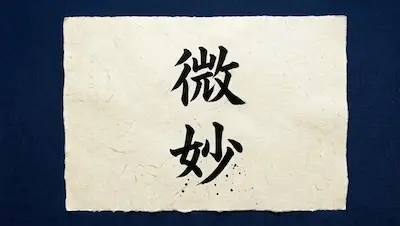
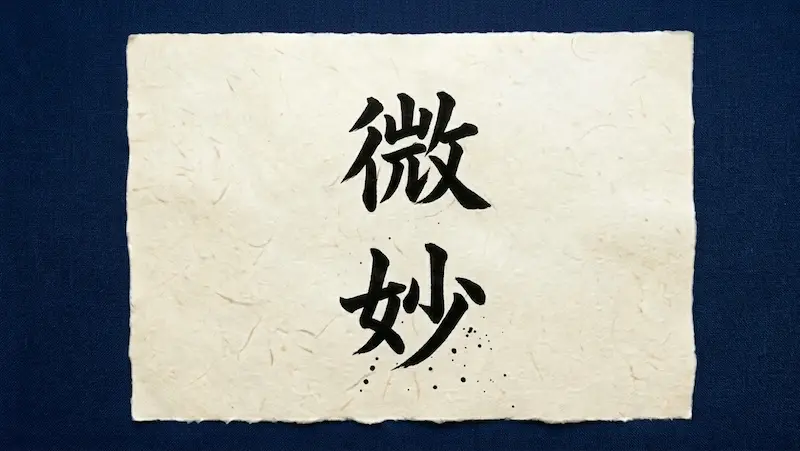
微妙 (bimyo, subtle) is a word you will often hear in Japanese conversations.
However, it can be difficult for Japanese learners to understand.
Dictionaries define it as “not quite right” or “not very good.”
It is also common in everyday Japanese conversation.
For example:
A: この料理どう?
(Kono ryōri dō?)
(What do you think of this dish?)
B: うーん、微妙だね。
(Ūn, bimyo da ne.)
(Hmm, it’s not that great.)
So, what does bimyo really mean in this conversation?
In this article, I will explore the original meaning of bimyo.
I will also look at how Japanese people use it today.
A Buddhist Term? “Bimyo”
Bimyo was originally a Buddhist term.
It described something profound and rich in meaning, beyond words.
The word was also used to describe something exceptionally good.
How Is “Bimyo” Used Today?
In everyday conversation, bimyo can have a negative nuance.
Not quite right or not very good
For example:
A: この映画、どうだった?
(Kono eiga, dō datta?)
(What did you think of the movie?)
B: うーん、微妙だった。
(Ūn, bimyo datta.)
(Hmm, it wasn’t that great.)
It does not mean that it was not interesting.
However, it has the nuance that it was not as good as expected.
A: 昨日のテストはどうだった?
(Kinō no tesuto wa dō datta?)
(How did your test go yesterday?)
B: 微妙だった。
(Bimyo datta.)
(It didn’t go that well.)
It means that you did not do very well.
The result was not very good.
Not sure yet
For example:
A: 明日の飲み会、行ける?
(Ashita no nomikai, ikeru?)
(Can you come to the get-together tomorrow?)
B: 微妙かな。
(Bimyo kana.)
(I’m not sure.)
It means that you are not sure yet whether you can go.
A slight difference or change
For example:
A: この2つの色、微妙に違うね。
(Kono futatsu no iro, bimyo ni chigau ne.)
(These two colors are slightly different.)
Here, bimyo ni means that the difference is small but noticeable.
As you can see, “bimyo” does not have just one meaning.
Its meaning and nuance change depending on the conversation and situation.
When Did the Meaning Change?
This change is said to have happened from the late 1980s to the 1990s.
It began to be used, especially by young people, to describe something unclear.
Over time, the negative nuance of “not very good” became established.
The Difference Between “Bimyo” and “Chotto”
There is an expression that can be confusing for Japanese learners.
- A: 明日、空いてる?
(Ashita, aiteru?)
(Are you free tomorrow?)
B: あ、明日は ちょっと…
(A, ashita wa chotto...)
(Well, tomorrow is a little…) - A: 明日、空いてる?
(Ashita, aiteru?)
(Are you free tomorrow?)
B: 微妙です。
(Bimyo desu.)
(I’m not sure.)
Both can be used to politely decline an invitation.
However, they have slightly different meanings and nuances.
- Chotto is a polite way to decline.
- Bimyo avoids clearly saying whether you can go.
Both chotto and bimyo can make an answer less direct.
Chotto is also a typically Japanese expression that can be vague.
[Why do Japanese people say “Chotto” So Much?]
Can You Use “Bimyo” at Work?
Bimyo is a casual expression commonly used in everyday conversation.
It is often used with friends and family.
A: 昨日のテストどうだった?
(Kinō no tesuto dō datta?)
(How did your test go yesterday?)
B: 微妙だった。
(Bimyo datta.)
(It wasn’t that great.)
This is a natural conversation.
However, be careful when using bimyo at work.
「この案は微妙です。」
(Kono an wa bimyo desu.)
(This proposal is not very good.)
This can sound rude.
At work, it is better to say:
「少し検討が必要です。
(Sukoshi kentō ga hitsuyō desu.)
(It needs some consideration.)
This is a more appropriate expression at work.
Three Common Uses of “Bimyo”
Bimyo can have different meanings depending on the situation.
Here is a summary of the uses we have covered, with examples.
| Example | Meaning |
|---|---|
| この映画は微妙だった。 (Kono eiga wa bimyo datta.) (The movie wasn’t that great.) | Not quite right or not very good |
| 明日の飲み会は微妙かな。 (Ashita no nomikai wa bimyo kana.) (I’m not sure about tomorrow’s get-together.) | Not sure yet |
| この2つの色は微妙に違う。 (Kono futatsu no iro wa bimyo ni chigau.) (These two colors are slightly different.) | A slight difference or change |
Conclusion
Bimyo originally had a positive meaning. It described something exceptionally good.
Today, it is used in many different ways.
It does not only mean “not quite right.”
It can also mean “unclear” or “slightly different.”
Like chotto, it can also make an answer less direct.
Bimyo is a useful word.
It conveys a nuance without clearly saying whether something is good or bad.
Explore more Japanese expressions in the Japanese Words category.
Related Posts

 What Is “Iki”? A Japanese Aesthetic
 What Is Tenugui? Japan’s Everyday Cloth
「微妙(びみょう)」は、さまざまな場面で使われています。
しかし、日本語学習者にとって、とても難しい言葉の一つです。
辞書には、「いまひとつ」や「あまりよくない」という意味があります。
そして、日本人の日常会話では、よく使われます。
例えば、
A:この料理どう?
B:うーん、微妙だね。
この「微妙」は、どんなニュアンスで使われているのでしょうか。
この記事では、「微妙」の本来の意味を掘り起こしてみます。
また、現在の日本人がどのように使っているかも紹介します。
仏教語?「微妙」
「微妙」は、もともと仏教で使われていた言葉です。
言葉では表しきれないほど奥深く、趣のあるものを指しました。
そこには、「非常に優れている」という肯定的な意味がありました。
現代の「微妙」はどう使う?
現在の会話では、「微妙」は否定的な使われ方もします。
いまひとつ、あまり良くない
例文:
A:この映画、どうだった?
B:うーん、微妙だった。
→ おもしろくなかったわけではありません。
しかし、期待したほどではないというニュアンスです。
A:昨日のテストはどうだった?
B:微妙だった。
→よくできたわけではなく、あまり結果は良くない。という気持ちです。
どちらとも決まっていない
例文:
A:明日の飲み会、行ける?
B:微妙かな。
→ 行けるかどうか、まだはっきりしないという意味です。
わずかな違いや変化
A:この2つの色、微妙に違うね。
→ 大きな違いではありませんが、よく見ると少し違うという意味です。
このように、「微妙」は一つの意味だけではありません。
前後の会話や状況によって、意味やニュアンスが変わります。
意味が変わったのはいつ?
1980年代後半から1990年代にかけてと言われています。
若者を中心に「はっきりしない様子」を表す言葉として使われるようになりました。
その後、「あまり良くない」という否定的なニュアンスが定着しました。
「微妙」と「ちょっと」の違い
外国人学習者が混乱しやすい表現があります。
- A:明日、空いてる?
B:あ、明日は ちょっと… - A:明日、空いてる?
B:微妙です。
どちらも、断る時に使われることがあります。
しかし、少し意味やニュアンスが違います。
- ちょっと:丁寧に断る表現です。
- 微妙: 行けるかどうかをはっきり言わない表現です。
「ちょっと」も「微妙」も、答えを少しぼかすニュアンスがあります。
「ちょっと」も日本語らしい曖昧な表現です。
[Why do Japanese people say “Chotto” So Much?]
仕事の場面でも使える?
「微妙」は、日常会話でよく使うカジュアルな表現です。
友達や家族との会話ではよく使われます。
A:昨日のテストどうだった?
B:微妙だった。
これは自然な会話です。
しかし、仕事の場面では注意が必要です。
「この案は微妙です。」
と言うと、失礼な印象を与えます。
仕事では、
「少し検討が必要です。」
のような表現の方が、円滑なコミュニケーションを取れるでしょう。
「微妙」の3つの使い方
「微妙」は、場面によってさまざまな意味で使われます。
ここまで紹介した「微妙」の使い方を、例文と一緒にまとめました。
| 例文 | 意味 |
|---|---|
| この映画は微妙だった。 | いまひとつ、あまり良くない |
| 明日の飲み会は微妙かな | どちらとも決まっていない |
| 2つの色は微妙に違う | わずかな違い・変化 |
まとめ
「微妙」は、もともと「非常に優れている」という肯定的な意味を持つ言葉でした。
しかし、現代ではさまざまな意味で使われています。
「いまひとつ」という意味だけではありません。
「はっきりしない」や「わずかな違い」を表すこともあります。
また、「ちょっと」と同じように、答えをぼかすこともできます。
「微妙」は、良い・悪いをはっきり言わず、相手にニュアンスを伝える便利な言葉です。
日本語表現についてもっと知りたい方は、Japanese Words カテゴリをご覧ください。