The Beauty of Japan a Thousand Years Ago: Jūnihitoe and Courtly Elegance
- Enter the World of Junihitoe (十二単)
- The Ultimate Beauty Born from Layering Junihitoe (十二単)
- The "Kasane no Irome" (かさねの色目): Expressing the Seasons
- The Ultimate Form Protected Through Time
- Conclusion: The Japanese Heart Embodied in the Junihitoe
- 千年の歴史を誇る「十二単」の世界へ
- 重ねることで生まれる、究極の美
- 季節を表現する「かさねの色目」
- 時代を超えて守られる「究極の形式」
- まとめ:十二単に込められた日本の心
Enter the World of Junihitoe (十二単)
In my last post, I wrote about Hinamatsuri (ひな祭り.
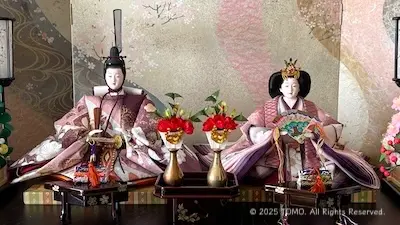
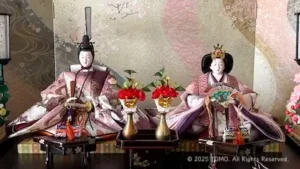
Today, I would like to introduce the Junihitoe (十二単). This is the exquisite outfit worn by Ohinasama.
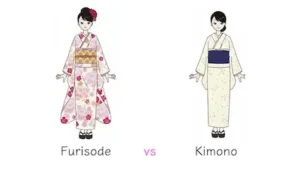
The Difference Between Junihitoe (十二単) and Kimono (着物)
What makes the Junihitoe (十二単) different from the traditional Kimono (着物)?
Usually, a Kimono is worn as a single layer fastened with an obi (帯 – sash).
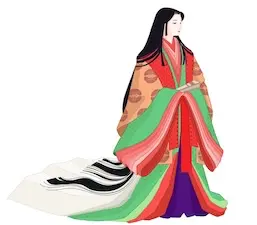
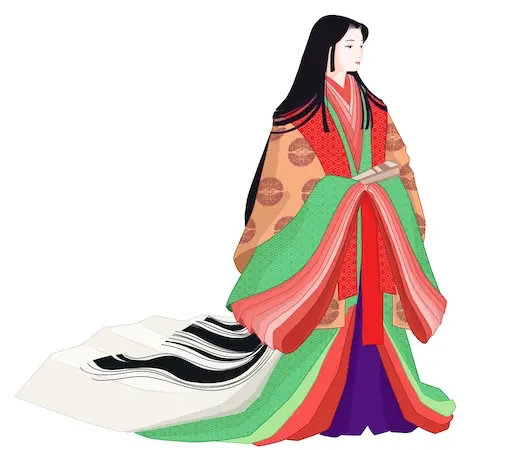
Instead, the Junihitoe consists of many thin silk robes layered on top of one another.
The number of layers can range from five to ten.
Therefore, all these robes are worn together, and finally, they are tied with cords, without using an obi.
The Junihitoe was the formal attire for noblewomen during the Heian period (平安時代 – 794–1185).
This costume dates back over 1,000 years. It features multiple layers of brilliantly colored silk.
It is a rare and breathtakingly beautiful style, even by global standards. Indeed, it is a reflection of the Japanese aesthetic of that era.
“Junihitoe” (十二単) a Nickname? The Formal Name
Actually, “Junihitoe” (十二単) is just a common name.
Formally, it is called Itsutsuginu-karaginu-mo (五衣唐衣裳). It is a very long and difficult name to remember.
Also, the number “twelve” does not refer to the actual number of layers.
Instead, it implies a large number of layers. In reality, women layered between five and ten robes.
The Ultimate Beauty Born from Layering Junihitoe (十二単)
The defining feature of the Junihitoe (十二単) is its overwhelming volume.
Several layers of robes are meticulously placed on top of one another.
This creates a magnificent, luxurious silhouette.
Elegance While Carrying 20 Kilograms
Remarkably, the total weight can reach nearly 20 kilograms.
That is roughly equivalent to the weight of a small child. It is an incredibly heavy costume.
However, women of that era walked with profound elegance. They transformed even the weight into a display of beauty.
The Beauty of “Miyabi” (雅) Hidden in the Gaps
The main highlight of the Junihitoe (十二単) is the neckline and the cuffs.
The edges of the robes are layered with a slight, deliberate offset.
This “layer of colors” expresses the aristocratic aesthetic of the time, known as Miyabi (雅 – elegance/refinement).
Miyabi signifies being sophisticated, graceful, and refined.
Noblewomen competed in their artistic sense through this subtle overlapping of colors.
The Junihitoe was truly a wearable work of art.
The “Kasane no Irome” (かさねの色目): Expressing the Seasons
The true beauty of the Junihitoe (十二単) lies in its color coordination.
This specific style is called Kasane no Irome (かさねの色目).
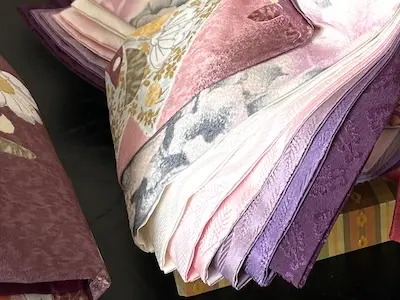
(Detail of layered sleeves on a Hina doll, showing traditional kasane no irome.)
Irome refers to the beautiful combination of colors created when multiple layers are placed together.
These combinations were designed to express the natural scenery and flowers of each season.
Embracing the Beauty of Nature
he Junihitoe (十二単) consists of many layers.
The overlap of these colors is its most distinct feature.
This technique is called “Nioi (匂い) “ (scent/gradation).
It is not merely for luxury; it represents the colors of nature through clothing.
Specific Color Combinations
The following color combinations can be mentioned:
- Kōbai (紅梅) no Nioi
This is a gradation that goes from white or pale pink on the outer layers to a deep crimson (Kurenai) on the inner layers.
It represents the appearance of red plum blossoms blooming magnificently from bud to flower amidst the cold.- Outer Layer (Uwagi): Shiratori (白練)
- Five-Layer Robe (Itsutsuginu – Light): Sakuranezu (桜鼠)
- Five-Layer Robe (Itsutsuginu – Medium): Usukōbai (薄紅梅)
- Five-Layer Robe (Itsutsuginu – Dark): Kōbairo (紅梅色)
- Five-Layer Robe (Itsutsuginu – Deepest): Kurenai (紅)
-
Shiratori
白練Sakuranezu
桜鼠Usukōbai
薄紅梅Kōbairo
紅梅色Kurenai
紅
- Moegi (萌黄) no Nioi
This is a gradation that goes from pale yellow on the outer layers to a vibrant green on the inner layers.
It represents the image of fresh, young leaves budding in early spring, bursting forth vibrantly as they catch the sunlight.- Outer Layer (Uwagi): Kinari-iro (生成り色)
- Five-Layer Robe (Itsutsuginu – Light): Yanagi-iro (柳色)
- Five-Layer Robe (Itsutsuginu – Medium): Wakaba-iro (若葉色)
- Five-Layer Robe (Itsutsuginu – Dark): Moegi (萌黄)
- Five-Layer Robe (Itsutsuginu – Deepest): Matsuba-iro (松葉色)
-
Kinari-iro
生成り色Yanagi-iro
柳色Wakaba-iro
若葉色Moegi
萌黄Matsuba-iro
松葉色
The Ultimate Form Protected Through Time
The Junihitoe is governed by strict rules and deep traditions. These are not just arbitrary regulations.
The color combinations hold profound meanings.
They reflect the refined education of nobles who cherished the four seasons.
Consequently, this style has been preserved to the present day without changing its form.
Rituals and the Junihitoe
Even today, the Junihitoe is worn for important imperial rituals.
For example, it is worn during the enthronement ceremonies of the Emperor.
Specifically, it is the attire worn by the Empress on such occasions.
A style from over a thousand years ago is still used today. This is exceptionally rare and valuable.
The Tradition of Hairstyles and Accessories
When wearing the Junihitoe, the hairstyle is also special.
The hair is styled as Osuberakashi. This is an elegant style where the hair hangs down long.
It was the standard of beauty for noble women in the Heian period.
Furthermore, a wooden fan called a Hiougi is held in the hand.
The costume, hairstyle, and accessories come together to form one complete beauty.
Not cutting corners on the details is the traditional Japanese approach.
Conclusion: The Japanese Heart Embodied in the Junihitoe
The Junihitoe is more than just a luxurious kimono.
It is filled with a heart that loves nature and cherishes the seasons.
There is a story behind every single color combination.
I hope you can feel the beauty of these traditional colors on my blog.
Which season’s colors do you like best? Please be sure to share your thoughts in the lesson.
For another beautiful color in Japanese culture, read “Vermilion in Japan (朱): Tradition and Culture.”
Japanese of the Day / 今日の日本語
- Word:匂い (nioi) – layered color gradation
- Meaning:In classical clothing, nioi means the subtle gradation created by layering different colors of fabric, not a smell.
- Example:十二単の匂いがとても美しいです。(Jūnihitoe no nioi ga totemo utsukushii desu.)
(The layered color gradation of the jūnihitoe is very beautiful.) - Fun Fact:Today, におい usually means “smell,” but in Heian culture it described visual beauty, not scent.
◆ Would you like to talk about Japanese culture? ◆
In the Culture Course, you can learn to speak about Japanese culture with me.
千年の歴史を誇る「十二単」の世界へ
前回は「ひな祭り」について書きました。
今回は、お雛様が着ている「十二単(じゅうにひとえ)」についてご紹介します。
十二単と「着物」の違い
「十二単」は「着物」とは何が違うのでしょうか。
着物は通常、一枚の着物を帯で締めて着ます。
しかし十二単は薄い絹の着物を、何枚も重ねて着ます。 その枚数は、5枚から10枚前後にもなります。
これらをすべて羽織り、最後に帯を使わずに紐で結んで完成させます。
「十二単」とは平安時代(794年〜1185年)の女性貴族の正装です。今から約1000年以上前の衣装です。
色鮮やかな絹を何枚も重ねて着ます。世界でも珍しい、とても美しいスタイルです。
それは、当時の日本人の美意識が詰まっています。
「十二単」は通称? 正式な名前とは
実は「十二単」は通称です。
正式には「五衣唐衣裳(いつつきぬからぎぬも)」と言います。 とても長くて難しい名前です。
また「十二」は枚数のことではありません。 「たくさん」という意味が込められています。
実際には5枚から10枚ほどを重ねていました。
重ねることで生まれる、究極の美
十二単の特徴は、そのボリューム感です。何枚も丁寧に重ねて着ていきます。
それによって、豪華さが生まれます。
20キロの重さを支える優雅さ
その重さは、合計で20キロ近くになります。 小さなお子さん一人分くらいの重さです。
とても重い衣装ですね。
しかし、当時の女性は優雅に歩いていました。 重ささえも美しさに変えていました。
隙間に宿る「雅(みやび)」の美しさ
十二単の一番の見どころは、襟元(えりもと)や袖口(そでぐち)です。
着物の端が、少しずつズレて重なっています。
この「色の層」が、当時の貴族の美意識である「雅(みやび)」を表現していました。
「雅」とは、上品で優雅、洗練されていることを意味します。
貴族の女性たちは、このわずかな色の重なりでセンスを競い合いました。 十二単は着る芸術品でした。
季節を表現する「かさねの色目」
十二単の美しさは、その配色にあります。
これを「かさねの色目(いろめ)」と呼びます。
「色目」とは、複数の色を重ね合わせたときの、美しい配色の組み合わせのことです。
自然の花や風景を色の組み合わせで表現しました。
自然の美を纏う
十二単は、多くの層を重ねます。その色の重なりが最大の特徴です。
これを「匂い(におい)」と呼びます。
これは、ただ豪華にするためだけのものではありません。衣服で自然の色彩を表現しています。
代表的な色の組み合わせ
具体的には、以下の色合いが挙げられます。
- 紅梅(こうばい)の匂い
外側が白や薄いピンクで、内側に行くほど濃い紅(くれない)色になるグラデーションです。
寒さの中に咲く紅梅が、蕾から花へと華やかに咲き誇る様子を表現しています。- 表着: 白練(しろねり)
- 五衣(薄): 桜鼠(さくらねず)
- 五衣(中): 薄紅梅(うすこうばい)
- 五衣(濃): 紅梅色(こうばいいろ)
- 五衣(極濃): 紅(くれない)
- 萌黄(もえぎ)の匂い
外側が薄い黄色で、内側に行くほど鮮やかな緑色になるグラデーションです。
春先に芽吹く瑞々しい若葉が、日の光を受けて鮮やかに萌え出る様子を表現しています。- 表着: 生成り色(きなりいろ)
- 五衣(薄): 柳色(やなぎいろ)
- 五衣(中): 若葉色(わかばいろ)
- 五衣(濃): 萌黄(もえぎ)
- 五衣(極濃): 松葉色(まつばいろ)
自然の移ろいを感じ、それを身に纏う。十二単は、自然との共生の哲学を形にしたものと言えます。
時代を超えて守られる「究極の形式」
十二単には、厳しい「決まり」と「伝統」があります。
これはただのルールではありません。
色の組み合わせにも、深い意味があります。それは、四季を愛でる貴族の教養が反映されているのです。
そして、このスタイルは、形を変えずに現代まで守られてきました。
儀式と十二単
現在でも、十二単は皇室の重要な儀式で着用されます。
例えば、天皇陛下が即位される際の儀式などです。その際、皇后陛下がお召しになる衣装です。
千年以上前のスタイルが、現代でも使われています。
これは非常に珍しく、貴重なことだと思います。
髪型と持ち物の伝統
十二単を着る時は、髪型も特別です。 髪は「おすべらかし」というスタイルにします。 長く垂らした、優雅なスタイルです。
これは平安時代の高貴な女性の美の基準でした。
また、手には「檜扇(ひおうぎ)」という木製の扇を持ちます。
衣装、髪型、持ち物。 そのすべてが揃って、一つの完成された美しさになります。
細部まで手を抜かないのが、日本の伝統的な姿勢です。
まとめ:十二単に込められた日本の心
十二単は、ただの豪華な着物ではありません。
自然を愛し、季節を慈しむ心が詰まっています。 色の組み合わせ一つひとつに、物語があります。
私のブログで、伝統色の美しさを感じていただけたら嬉しいです。
あなたは、どの季節の色が好きですか? ぜひ、レッスンで感想を聞かせてくださいね。
日本文化を彩るもう一つの色については、「Vermilion in Japan(朱):Tradition and Culture」もあわせてお読みください。