Washitsu as a Living Museum: 4 Life Lessons Carved by My Artist Ancestor
- Tokonoma: A Sacred Space for the Seasons
- Ranma: A Design to Control Light and Air
- Shoji: Designing Soft Light
- Kotatsu: The Hub of Winter Happiness
- Essential Japanese Phrases for Your Washitsu Experience
- Conclusion
- 床の間(Tokonoma):季節を招き入れる聖域
- 欄間(Ranma):光と風を操るデザイン
- 障子(Shoji):光を優しくデザインする
- こたつ(Kotatsu):冬の幸せの拠点
- 和室を楽しむ!日本語フレーズ
- まとめ
Have you ever been inside a Washitsu(和室)? This is a traditional Japanese room.
Imagine the scent of tatami mats. Feel the quiet air. These rooms are full of Japanese beauty.
They show incredible craftsmanship. In a way, a Washitsu is a “living museum.”
Actually, these rooms have delicate details. Sometimes, an artist hides a special wish inside them.
Do you know about these hidden messages?
In this post, I will share the charm of Washitsu. I will tell you about a special discovery from my own family.
Tokonoma: A Sacred Space for the Seasons
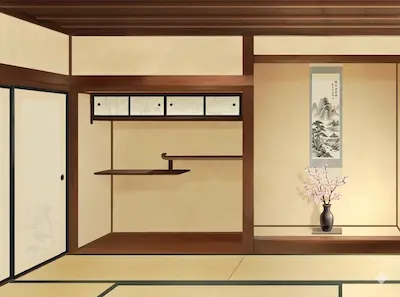
There is a raised floor area in a Washitsu. This is called the Tokonoma(床の間).
It is the most formal space in the house. Guests sit near it.
This seat is called the Kamiza(上座). It is the seat of honor.
The Starting Point of Omotenashi
The Tokonoma has deep roots. It comes from Shoin architecture(書院建築).
This style started in the 14th to 16th centuries. It is the original model for the modern Japanese room.
Originally, it was a place for high-ranking people. Today, it is a sacred space for “Omotenashi(おもてなし),” or Japanese hospitality.
It is a place to welcome guests from the heart.
Kakejiku: Giving Life to the Room
A Kakejiku(掛け軸) hangs on the wall of the Tokonoma.
This is a hanging scroll. It may show a beautiful landscape. Or it may show powerful calligraphy.
People choose the scroll for the season. They also choose it for the purpose of the day.
For a celebration, a lucky image is best. For a quiet talk, calm words are better.
One scroll changes the whole room. It makes the air feel sharp and elegant.
People also display seasonal flowers. They change the scroll often.
This culture is called Shitsurai(室礼). It is a luxurious moment in Japanese life.
Ranma: A Design to Control Light and Air
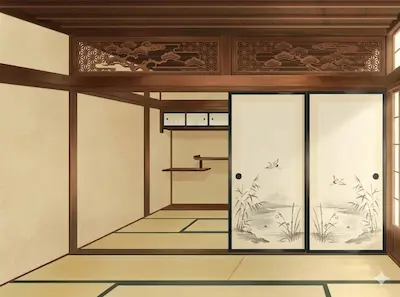
Look at the space between the ceiling and the lintel. These decorative panels are called Ranma(欄間).
They divide the rooms. However, they have a very unique role.
The Practical Role of Ranma
Many Ranma feature “openwork” carving. This is called Sukashibori(透かし彫り).
These carvings allow air to flow between rooms. They help keep the air fresh.
Ranma also bring in light. They carry light from the next room into the darker areas.
An artist studies the wood carefully. Then, they carve intricate patterns by hand.
Ranma as Art
Some Ranma are more than just functional. They are true masterpieces.
For example, some are carved deeply into a single, thick wooden board.
These have no “open spaces.” They have a heavy and powerful presence.
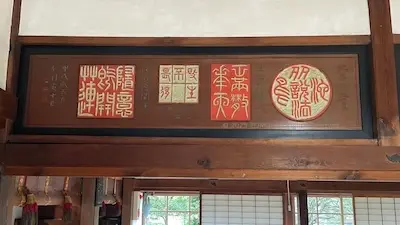
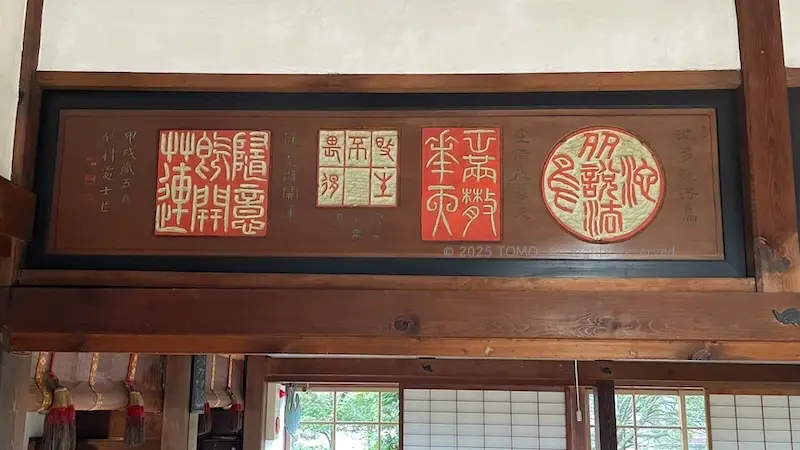
Actually, a special set of Ranma remains in a certain temple. My ancestor created them.
4 Life Lessons Carved in Wood
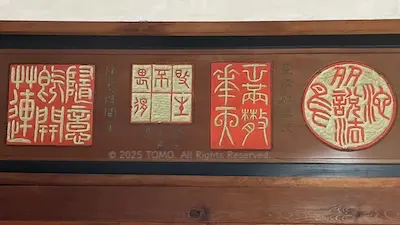
My ancestor carved four phrases into these panels. Together, they tell a story.
It is a journey from suffering to inner freedom. They are written in classical kanji. You read them from right to left.
The 4 Messages of the Ranma
- 池魚籠鳥 (Chigyo-Rōchō): Even in a restricted reality…
- 空満散翠天 (Kūman-Sansuiten): Look at the beautiful world outside…
- 得生不農退 (Tokusei-Funōtai): If you believe in your path and keep going…
- 随意即開蓮 (Zui-i-Soku-Kairen): A beautiful lotus flower will bloom in your heart.
These were created in 1934, about 90 years ago.
I believe my ancestor’s message was this:
“Even in difficult times, if you change your perspective and work hard, your life will bloom.”
This wisdom connects to Buddhist teachings. It is perfect for a temple.
You can learn more about my ancestor in [this series (Japanese Seal Art)].
Please see the passion they put into their work.
Shoji: Designing Soft Light
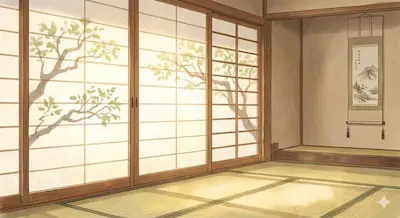
Shoji(障子) are wooden frames covered with Washi paper(和紙).
These screens are like “magic curtains.” Unlike glass, Shoji paper absorbs strong sunlight.
The paper wraps the entire room in a soft glow.
This is called “diffused light.” It makes the room look beautiful. It also brings peace to your heart.
Shoji also control humidity. Washi paper breathes.
It absorbs and releases moisture from the air. This keeps the room comfortable.
Through Shoji, you can see the shadows of garden trees. You can hear the sound of the rain.
Japanese people feel the outside world “gently” through this filter. They enjoy living in harmony with nature.
Want to learn more about Washi? Check out this post for its history and useful Japanese words.
[Washi (和紙) in Japan: Learn Japanese Words and Culture]
Kotatsu: The Hub of Winter Happiness
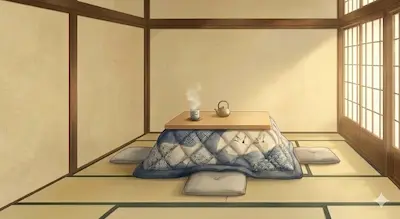
A Kotatsu(こたつ) is essential for a Japanese room in winter. It is a low table with a heater underneath.
A special quilt covers the table to trap the heat.
In the past, “Hori-gotatsu(掘りごたつ)” was common.
This type had a heater inside a hole in the floor. Today, electric models are the standard.
A Kotatsu is a place for community. Family and friends naturally gather there to talk.
Eating “Mikan” (mandarin oranges) at a Kotatsu is a classic winter tradition.
It is one of the most relaxing ways to spend time in Japan.
People sit on the tatami mats and share the same warmth. This brings people closer together.
Once you get inside, it is hard to leave. The warmth is so comforting. You will surely get addicted to it!
Essential Japanese Phrases for Your Washitsu Experience
- 床の間にきれいな花があります。Tokonoma ni kireina hana ga arimasu.
(There are beautiful flowers in the tokonoma.) - 欄間には細かい篆刻があります。Ranma ni wa komakai tenkoku ga arimasu.
(There are detailed carvings on the ranma.) - 障子の光はとても柔らかいです。Shōji no hikari wa totemo yawarakai desu.
(The light through the shoji is very soft.) - 冬はこたつでみかんを食べます。Fuyu wa kotatsu de mikan o tabemasu.
(We eat mandarin oranges in the kotatsu in winter.)
Conclusion
The details of a Washitsu(和室) reflect the Japanese heart.
They show a love for nature and a respect for craftsmanship.
Each element holds wisdom for a comfortable life. They also show a passion for beauty.
When you visit a Washitsu, don’t just look at the floor.
Please look up. Take a close look at the Ranma(欄間) and the Tokonoma(畳).
You might find a hidden message there.
In my next post, I will write about seasonal Japanese flowers. Don’t miss it!
A Ryokan is the best place to experience a Washitsu. Check this post to learn the differences from a hotel.
[Hotel vs. Ryokan: Understanding the Difference for Your Japan Trip]
Japanese of the Day / 今日の日本語
- Word:室礼 (Shitsurai) – Seasonal Arrangement
- Meaning:The art of decorating a room to welcome guests and celebrate the current season.
- Example:季節に合わせて室礼を整えます。(Kisetsu ni awasete shitsurai o totonoemasu.)
(I arrange the room decor according to the season.) - Fun Fact:Shitsurai is the heart of hospitality.
It brings the beauty of nature from the outside world into your room!
◆ Would you like to talk about Japanese culture? ◆
In the Culture Course, you can learn to speak about Japanese culture with me.


あなたは「和室(わしつ)」に入ったことがありますか。
畳(たたみ)の香りと、静かな空気。そこには日本の伝統的な美意識と、職人の技が詰まっています。
和室は、いわば「生きた美術館」のような空間です。
実は、和室の細工(さいく)には、芸術家が特別な『願い』を込めることがあります。
あなたは、そこに隠されたメッセージをご存知でしょうか。
今回は、私自身の家系に伝わるある発見を通して、和室の深い魅力についてお話しします。
床の間(Tokonoma):季節を招き入れる聖域
和室の中で一段高くなっている場所を「床の間」と言います。
ここは家の中で最も格が高い場所です。
そのため、お客様には床の間に近い「上座(かみざ)」に座っていただきます。
「おもてなし」が始まる場所
床の間のルーツは、室町時代(14世紀〜16世紀ごろ)から伝わる「書院建築(しょいんけんちく)」にあります。
もともとは身分の高い人が座る場所から派生しました。
現在では、お客様を心から歓迎するための「おもてなしの聖域」として大切にされています。
掛け軸(Kakejiku):空間に命を吹き込む
床の間の壁には「掛け軸」を飾ります。
掛け軸には、美しい風景画や、力強い筆文字が書かれています。
これらはその日の目的や季節に合わせて選ばれます。
例えば、お祝いの席には縁起の良い絵を、静かに語り合いたい時には落ち着いた言葉の掛け軸を選びます。
一本の掛け軸を掛けることで、部屋の空気がきりりと引き締まります。
また、季節の花を活け、掛け軸を掛け替える。この「室礼(しつらい)」の文化は、日本文化の贅沢なひとときです。
欄間(Ranma):光と風を操るデザイン
天井と鴨居(かもい)の間にある装飾を「欄間(らんま)」と呼びます。
和室を仕切る壁の一部ですが、ここには独特の役割があります。
欄間の実用的な役割
一般的な欄間は、木をくり抜いた「透かし彫り」のものが多いです。
これは、隣の部屋との通気性を良くするために作られました。
また、暗くなりがちな和室の奥まで、隣の部屋の光を届ける役割もあります。
職人は木材の性質を見極め、細かな模様を彫り上げます。
芸術としての欄間
欄間の中には、機能性以上に芸術性を追求したものもあります。
例えば、厚い一枚の板に深く繊細な篆刻を施した作品です。
これらは「透かし」がなく、重厚な迫力を持っています。
実は、あるお寺には私の先祖が手がけた特別な欄間が残っています。
欄間の四枚に込められた「人生の教訓」
私の先祖がこの欄間に彫り込んだ四つの言葉。
それは、人生の苦しみから心の自由へと至る、一つの物語になっています。
漢語で書かれていて、右側から左に読みます。一つの塊に4〜5つ漢字が彫られています。
欄間に刻まれた四つのメッセージ
- 池魚籠鳥:不自由な現実の中でも
- 空満散翠天:外に広がる美しい世界に目を向け
- 得生不農退:自分の道を信じて進み続ければ
- 随意即開蓮:心の中に、美しい蓮の花が開く
今から約90年前、1934年(昭和9年)に制作されました。
先祖がこの欄間に込めたのは、
「不自由であっても、見方を変え、努力すれば、花が咲く」ということだと思っています。
これは、仏教の教えに通じ、お寺にふさわしい言葉ではないでしょうか。
この欄間を手がけた私の先祖については、[こちらのシリーズ(Japnese Seal Art) ]に詳しくご紹介しています。
彼らがどのような想いで作品を作っていたのか、併せてご覧ください。
障子(Shoji):光を優しくデザインする
木の枠に和紙を貼った「障子」は、日本の魔法のカーテンです。
ガラスと違い、障子は外の強い光を吸収し、部屋全体を柔らかい光で包んでくれます。
この光は「拡散光(かくさんこう)」と呼ばれ、肌を美しく見せ、心に安らぎを与えます。
また、障子は湿度を調節する機能も持っています。和紙が空気中の湿気を吸ったり吐いたりして、室内を快適に保ちます。
そして、障子越しに見える庭の木の影や、雨の音。
日本人は障子というフィルターを通して、外の世界を「優しく」感じ、自然との調和を楽しんできました。
和紙について知りたい方。こちらの記事では、和紙の歴史と役立つ単語をご紹介しています。
[Washi (和紙) in Japan: Learn Japanese Words and Culture]
こたつ(Kotatsu):冬の幸せの拠点
冬の和室に欠かせないのが「こたつ」です。
テーブルの下に暖房(だんぼう)があり、専用の布団をかけて温まります。
昔は床の中に火を入れる「堀りごたつ」が一般的でしたが、現在は電気式のものが主流です。
また、こたつは家族や友達が自然と集まり、お喋りを楽しむコミュニティの場所です。
「こたつでみかんを食べる」は、日本人が最もリラックスする冬の過ごし方の一つです。
畳の上に座り、同じ温かさを共有することで、人々の心の距離も近くなります。
こたつを使うと、その暖かさから抜け出せなくなります。きっと一度使ったら病みつきになるでしょう。
和室を楽しむ!日本語フレーズ
- 床の間にきれいな花があります。Tokonoma ni kireina hana ga arimasu.
(There are beautiful flowers in the tokonoma.) - 欄間には細かい篆刻があります。Ranma ni wa komakai tenkoku ga arimasu.
(There are detailed carvings on the ranma.) - 障子の光はとても柔らかいです。Shōji no hikari wa totemo yawarakai desu.
(The light through the shoji is very soft.) - 冬はこたつでみかんを食べます。Fuyu wa kotatsu de mikan o tabemasu.
(We eat mandarin oranges in the kotatsu in winter.)
まとめ
和室の細部には、自然を愛し、職人の技を敬う日本の心が息づいています。
一つ一つの要素には、生活を快適にする知恵と、美しさを求める情熱が込められています。
あなたも和室を訪れた際は、ぜひ足元だけでなく、目線を上げて「欄間」や「床の間」にも注目してみてください。
次回は、この時期に欠かせない日本の花について書きたいと思います。お楽しみに!
和室を実際に体験するには、旅館が一番です。ホテルとの違いはこちらです。
[Hotel vs. Ryokan: Understanding the Difference for Your Japan Trip]