

The Word “ANATA” That Stood Out in Ado’s Song
I was listening to Ado’s “私は最強” (Watashi wa Saikyou / I’m Invincible) recently.
One specific line caught my attention.
It was the phrase “アナタと最強” (Anata to Saikyou, You and I are invincible).
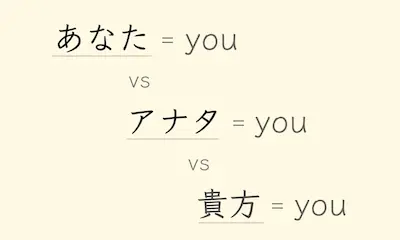
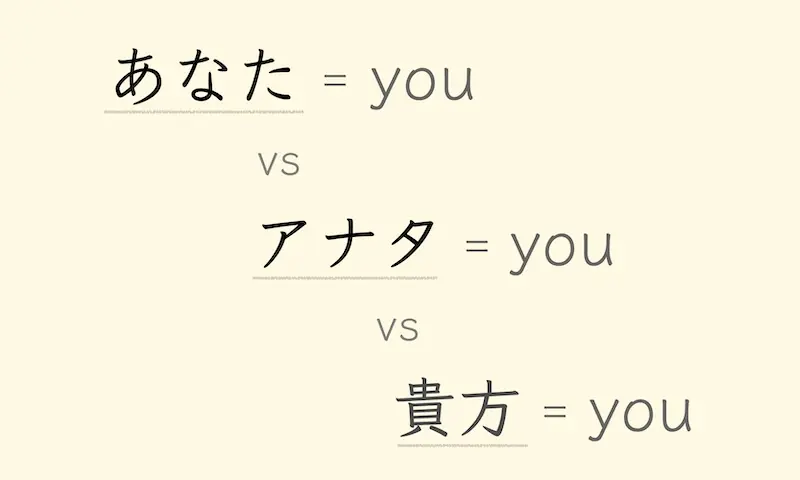
The artist used the katakana “アナタ”(anata, you).
This replaced the standard hiragana, “あなた” (anata, you).
The pronunciation and meaning are the same.
However, the visual impression is completely different.
Why was katakana chosen here?
I would like to explore the unique nuances of Japanese writing styles.
How Writing Creates Nuance in Japanese
In Japanese, how a word is written changes the impression.
It is not just about the sound.
As you may know, Japanese uses three types of characters.
These are hiragana, katakana, and kanji.
Even with the same word, the choice of characters changes the nuance.
This choice is especially important in song lyrics.
That is why the use of “アナタ” (katakana) feels as though it carries a special meaning.
“you” vs. 「あなた」
English uses only “you,” while Japanese is more diverse.
Only One “you” vs. Many Ways to Say It in Japanese
In English, the second person is basically just “you.”
The form stays the same whether you are speaking to one person or many.
Both “anata“ and “anata-tachi“ are expressed as “you.”
In contrast, people rarely use “anata“ when speaking Japanese.
Instead, it is common to use names or job titles.
Japanese also frequently omits the subject.
Japanese speakers use these choices to adjust their distance from others.
They do this very skillfully.
Why Japanese Speakers Avoid Using “Anata”
The word “anata“ originally comes from “kanata (彼方).”
“Kanata“ means “far away” or “the other side.”
Because of this, “anata“ carries a sense of distance.
It gives a slightly detached impression rather than a friendly one.
Today, “anata” is mainly used for equals or those of lower rank.
Using it for a superior can be considered rude.
Instead, people often use names or job titles.
It is also common to start a conversation with “Sumimasen“ or “Anō.”
Japanese speakers tend to avoid direct second-person pronouns.
Avoiding “anata” often leads to more polite expression.
「あなた」 vs 「アナタ」 — Differences in Nuance
In Japanese, different writing styles change the impression.
How Choosing Characters Changes the Impression
Here is a brief summary of each style.
- Hiragana “anata”
- It creates a soft and friendly impression.
- It feels natural in daily conversation and brings you closer to the person.
- Katakana “ANATA”
- It emphasizes emotion and the message.
- It functions as a way to speak directly to the reader or listener.
- Kanji “貴方”
- It feels formal and polite.
- This style is well-suited for writing and has a strong visual presence.
Writing styles reflect your emotions and relationships.
Therefore, the nuance changes depending on which form you choose.
Why “ANATA” Was Chosen in “I’m Invincible”
The real reason is known only to the songwriter.
Only Mr. Omori from Mrs. GREEN APPLE knows it.
I will share my thoughts here.
These are from the perspective of a Japanese teacher.
The Message and Worldview of the Song
The title “私は最強” (Watashi wa Saikyou. I’m Invincible) conveys a sense of great strength.
“Saikyou“ means being the very strongest.
Listening to this song can give anyone courage.
ANATA” as a Counterpart to “Watashi”
In the lyrics, the phrase “私は最強” (Watashi wa Saikyou / I’m Invincible) is used.
Its counterpart is the phrase “アナタと最強” (Anata to Saikyou / You and I are invincible).
In song lyrics, katakana stands out visually.
Originally, katakana is used for loanwords from other languages.
Using katakana here creates a strong sense of a message.
This power is unique to katakana.
It makes the listener feel like the message is for them.
Katakana in “I’m Invincible”
This song uses more katakana than just “ANATA.”
There are three other words written in katakana.
- ココロ (Kokoro / heart): Generally, this is written as “心” or “こころ”.
- ヒカリ (Hikari / light): Generally, this is written as “光” or “ひかり”.
- トゲ (Toge / thorn): The kanji “棘” is difficult. Therefore, it is commonly written in katakana.
Let’s focus on “Kokoro” and “Hikari.”
They appear in phrases like “Kokoro hareru” (heart clears up).
These phrases also include “Hikari no hō e” (toward the light).
Both phrases make the listener feel bright and positive.
When you re-read the lyrics, you will find interesting details beyond just the sound.
What did you feel when you heard “I’m Invincible”?
What did you take away from this song?
Conclusion
Take a look at the lyrics as text.
You will notice the unique charm of “ANATA.”
Try to pay attention to these different writing styles.
You will discover the true depth of the Japanese language.
For more Japanese language and culture insights.
Taisho Era(大正時代) Values in Demon Slayer: Learn Japanese Words on Inheritance and Tradition.
Explore more Japanese expressions in the Japanese Words category.
Related Posts
Ado『私は最強』で目に留まった「アナタ」
先日、歌番組でAdo『私は最強』を聴いていて、ある歌詞が目に留まりました。
それは「アナタと最強」という一節です。
ここでは、「あなた」ではなく、カタカナの「アナタ」が使われています。
発音や意味はどちらも同じですが、表記だけで印象は大きく変わります。
なぜ、カタカナがなのでしょうか。
今回は日本語の「表記」が生むニュアンスについて考えてみました。
日本語では「どう書くか」で表す
日本語は、音だけでなく「どう書くか」で、印象が変わります。
ご存知の通り、日本語にはひらがな、カタカナ、漢字と3つの文字があります。
同じ言葉でも、文字の選択一つでニュアンスは変わります。
特に歌詞では、その選択がとても大切です。
だからこそ、「アナタ」という表記には意味があるように感じました。
「 you」vs「あなた」
英語は “you” だけですが、日本語には多くの呼び方があります。
たった一つの「you」と、多彩な日本語の呼び方
英語の二人称は、基本的に you だけです。
相手が一人でも複数でも、形は変わりません。
「あなた」も「あなたたち」も、すべて「you」で表現できます。
一方で、日本語では「あなた」と呼ぶ機会は意外と少ないです。
ふだんは名前や肩書きで呼ぶことが多いです。
日本語は、主語を省略することも多いです。
また、呼び方一つで相手との距離感を上手に調整します。
日本語で「あなた」と言わないワケ
「あなた」という言葉は、もともと「彼方(かなた)」に由来しています。
「彼方」とは、「遠くの方」や「向こう側」という意味です。
そのため、「あなた」には、距離を感じさせる響きがあります。
親しみよりも、少し離れた印象がある言葉です。
現代では、「あなた」は対等か目下の人に使うことが多いです。
目上の人に使うと、失礼になることがあります。
そのため、名前や役職で呼ぶことがよくあります。
「すみません。」や「あのう…」と話しかけることも多いです。
日本語では、直接的な二人称を使わない傾向があります。
「あなた」を使わないことが、丁寧な表現につながるからです。
「あなた」vs「アナタ」ニュアンスの違い
日本語は、表記によって印象が大きく変わります。
文字の使い分けで変わる印象と役割
日本語は、どの文字で書くかによって、受ける印象が変わります。
それぞれの特徴を簡単にまとめました。
- ひらがなの「あなた」
・やわらかく、親しみやすい印象です。
・日常会話になじみやすく、相手との距離が近く感じられます。 - カタカナの「アナタ」
・感情やメッセージ性が強調されます。
・読み手や聴き手に、直接語りかけるような役割を持ちます。 - 漢字の「貴方」
・少し硬めで、丁寧な印象になります。
・文章向きの表記で、視覚的な存在感があります。
表記は、相手との関係性や感情を映し出します。
そのため。どの形を選ぶかで、伝わるニュアンスも変わります。
なぜ『私は最強』では「アナタ」が選ばれたのか
本当の理由は作詞したMrs. GREEN APPLE大森さんにしか分かりません。
ここでは、日本語教師としての視線で考えてみたいと思います。
楽曲が持つ世界観とメッセージ
「私は最強」というタイトルからは、強さが感じられます。
「最強」とは一番強いという意味です。
この曲を聞くと、誰もが勇気をもらえるのではないでしょうか。
「私」と対になる存在としての「アナタ」
歌詞には「私は最強」という言葉があります。
その対になるのが「アナタと最強」というフレーズです。
歌詞の中で、カタカナはとても目に留まりやすいです。
本来、カタカナは外来語に使われる文字です。
あえてカタカナを使うことで、強いメッセージ性が生まれます。
カタカナだからこそ表現できる力強さがあります。
聴いている人は、自分へのメッセージだと感じるはずです。
『私は最強』にあるカタカナ
この曲にあるカタカナは「アナタ」だけではありません。
ほかに3つのカタカナで表記されています。
- ココロ:一般的には、「心」や「こころ」と表記します。
- ヒカリ:一般的には、ひかり、光、光りと表記します。
- トゲ:漢字の「棘」は難しいため、カタカナで書くことが一般的です。
ここで「ココロ」と「ヒカリ」の2つの言葉に注目します。
曲の中では「ココロ晴れる」「ヒカリの方へ」という言葉で使われています。
どちらも、聞いている人を明るく前向きな気持ちにしてくれる言葉です。
歌詞を改めて読むと、音だけではない面白さがあります。
アナタは「私は最強」を聞いて、何を感じましたか?
この曲から、何を受け取りましたか?
まとめ
文字としての歌詞に注目してみましょう。
「アナタ」という表記ならではの面白さに気づくことができます。
こうした表記の違いを意識してみてください。
日本語の持つ奥深さを、さらに感じられるでしょう。
日本語と文化の理解を深めたい方は、こちらもどうぞ。
Taisho Era(大正時代) Values in Demon Slayer: Learn Japanese Words on Inheritance and Tradition
日本語表現についてもっと知りたい方は、Japanese Words カテゴリをご覧ください。