「九仙之名」: Kōsho Engraves the Soul of Epigraphy onto Wood
Lineage of Art: The Innovation of Master and Kōsho
In my previous article, I traced a magnificent artistic lineage.
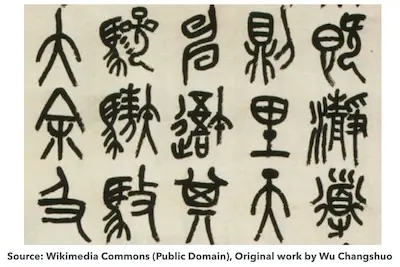
That heritage begins with the Chinese master, 呉昌碩 (Wu Changshuo).
<Previous Article: Wu Changshuo (呉昌碩)’s Legacy: From Stone Drum Script to Zōroku V and Kōsho>
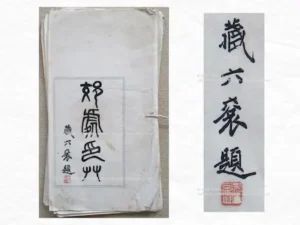
My ancestor, 郊処 (Kōsho), inherited that artistic spirit through his master, 濱村蔵六五世 (Hamamura Zōroku V).
Kōsho based his work on the tradition of his specialty: wood board engraving.
However, he sought a new form of expression.
He aimed to place the “literati philosophy” (expressed through Chinese poetry and prose) at the core of his creations.
This marked a significant search for innovation.
Ultimately, this article explores the unique appeal of 郊処 (Kōsho)‘s engraved plaque (Tenseki-gaku).
Fusion of Northern Stele and Epigraphy
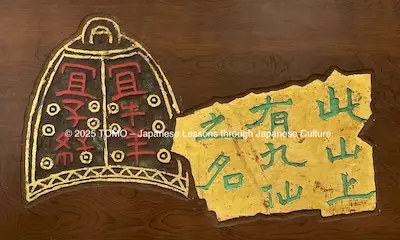
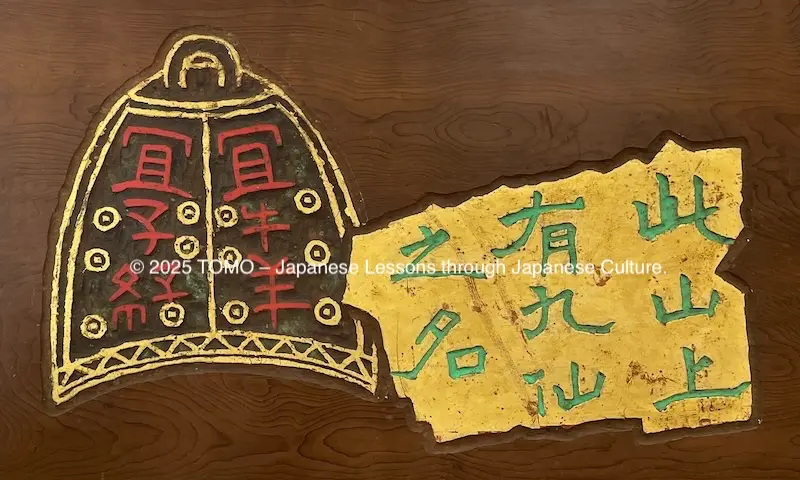
The engraved plaque featured in the photograph was created six years before the death of 郊処 (Kōsho).
This date corresponds to 1924 (Taishō 13).
Ultimately, two crucial artistic roots converge in the works of 郊処 (Kōsho).
Zheng Daozhao’s Regular Script (Kaisho)
楊守敬 (Yang Shoujing) was a Qing dynasty scholar specializing in epigraphy (金石学:Kinseki-gaku).
He visited Japan in 1880, bringing many rubbings with him.
He introduced the Northern Wei Script, a new style of Chinese calligraphy.
This marked a foundational beginning for its study in Japan.
The rubbings included the regular script 郊処(Kaisho) of 鄭道昭 (Zheng Daozhao) (d. 516 AD).
鄭道昭 (Zheng Daozhao)’s script blends softness with spring-like resilience in each line.
This unique quality is often called “stickiness” or tenacity.
The Inscription and Its Meaning in the Work
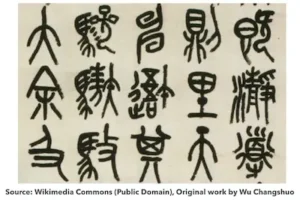
郊処 (Kōsho) chose the title inscription from 鄭道昭 (Zheng Daozhao)’s masterpiece, the 鄭羲下碑(Zheng Xi Xia Stele).
The eight chosen characters are: “此山上有九仙之名.”
This means, “On this mountain, the names of nine immortals remain.”
Significantly, 鄭道昭 (Zheng Daozhao) carved the Zheng Xi Xia Stele into a massive natural cliff face.
This was done to praise the achievements and virtue of his deceased father, 鄭羲 (Zheng Xi).
Ultimately, by engraving this text into his own artwork, 郊処 (Kōsho) conveyed a profound ideological depth befitting a literatus.
The Challenge of Engraving Regular Script (Kaisho)
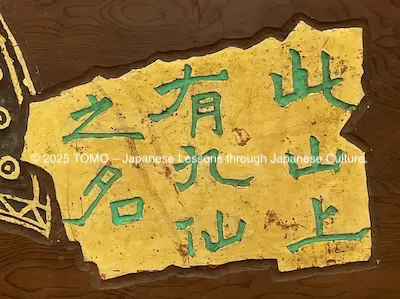
Then, 郊処 (Kōsho) incorporated the inscription “此山上有九仙之名” into his work.
This incorporated a new artistic form. That form was established by 呉昌碩 (Wu Changshuo): “engraving the literati philosophy.”
As a seal engraver, 郊処 (Kōsho) typically created most of his seals (Hanko) using the Seal Script (Tensho) style.
However, in this specific artwork, he utilized the Regular Script (楷書:Kaisho), just as 鄭道昭 (Zheng Daozhao) did.
郊処 (Kōsho)‘s script differs from 鄭道昭 (Zheng Daozhao)’s. His lines are thin, consistently sized, and notably angular.
I believe this script reveals a seriousness that contrasts with his known drinking anecdotes.
The Meaning Infused in the Colors
- The Inscription: “此山上有九仙之名”
- Color of the Characters:緑青 (Rokusho), or verdigris, is used.
- This is the color of aged and oxidized bronze. It evokes the heaviness of epigraphy (Kinseki) and the passage of time.
- Background around the Characters:Gold leaf (Kin-paku) is luxuriously applied.
- This expresses the brilliance of auspiciousness and the high formality of the artwork.
- Color Contrast: The contrast between this verdigris and the gold leaf emphasizes the sacred nature held by ancient bronzeware.
Furthermore, it highlights the artistic elegance that 郊処 (Kōsho) aimed for.
Two Auspicious Symbols: Words and Imagery
Auspicious Words Engraved on the Bell Motif
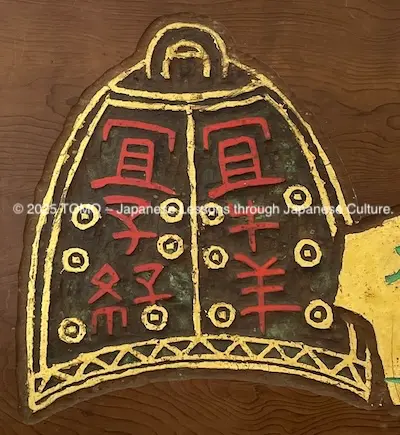
- Phrases and Wishes: The plaque features “宜牛羊” and “宜子孫.”
(note:吉祥 (Kichijō) means good fortune. These are signs wishing for luck and prosperity.)- “宜牛羊” prays for increased wealth and assets.
- “宜子孫” wishes for the prosperity of descendants.
- The Bell Imagery (Kane): The motif holds dual cultural significance.
- Japan: The bell acts as a charm against evil.
- China: The bell symbolized authority and ritual order in ancient times.
Combined Meaning: The image functions as a good luck charm (engimono). It ensures prosperity and abundance.
The message is a strong prayer: “May the family and descendants enjoy everlasting protection and growth of their assets.”
The Cultural Meaning Infused in the Colors
- Bell Frame (Outline):Gold leaf (Kin-paku) is used.
- Gold symbolizes eternity, high status, and wealth. It expresses the plaque’s sacred authority.
- Inscription Color:弁柄 (Bengara), a deep, vivid red, is used for the characters.
- This red is a celebratory color in Japanese culture. It symbolizes vitality, warding off evil, and the joy of Hare.
- The color illuminates the wish for “descendants’ prosperity.”
- Color Composition: The combination of Gold and Red (Bengara) represents the highest elegance.
- This is seen in Japanese arts like Makie and Urushi.
- This traditional aesthetic ensures the plaque conveys intense celebration and blessing as a special gift.
Work’s Power: A Fusion of Japanese-Chinese Aesthetics and Blessing
The engraved plaque (Tenseki-gaku) is presented as a congratulatory gift.
We can view this artwork as a fusion of Japanese culture and Chinese historical tales.
Its basis stems from the simple heart of the Japanese people.
This includes wishes for descendant prosperity and wealth. It also reflects a belief in warding off evil.
To give these wishes weight, the historical Chinese phrase “Name of the Nine Immortals” is used.
This confers “authority” and “permanence” to the wishes.
The best aspects of Japan and China are combined here. This results in a truly powerful amulet.
Furthermore, the auspicious words “宜牛羊” and “宜子孫” are included.
These phrases contain the sentiment of wishing happiness for the recipient.
Kōsho’s Legacy of Integration
This artwork is held in a museum collection. It demonstrates the innovation reached by 郊処 (Kōsho).
That innovation is the integration of material, form, and philosophy.
Succession and Development: The Apex of 郊処 (Kōsho)
郊処 (Kōsho) inherited epigraphy techniques from 呉昌碩 (Wu Changshuo) via 蔵六五世 (Zōroku V).
He then achieved innovation using Northern Wei rubbings brought by 楊守敬 (Yang Shoujing).
His integration of material, form, and philosophy taught the meaning of artistic “succession and development.”
The culture of seals (Hanko) was passed beyond engravers. It reached Japan’s prominent literary masters.
Next time, we will explore the theme, “Literary Masters and Seals (Hanko).”
We will examine the sentiment these masters infused into their personal seals.
Japanese of the Day / 今日の日本語
- Word:吉祥 (Kichijō) – Auspicious / Good Fortune
- Meaning:A state of happiness or blessing; a sign used to wish for luck and prosperity.
- Example:この模様は吉祥のしるしです。 (Kono moyō wa kichijō no shirushi desu.)
(This pattern is an auspicious sign.) - Fun Fact:This concept originated in Buddhism and is a common motif in Japanese and Chinese traditional arts.
◆ Would you like to talk about Japanese culture? ◆
In the Culture Course, you can learn to speak about Japanese culture with me.
芸術の系譜:師と郊処の革新
前回の記事では、壮大な芸術の系譜を辿りました。それは、中国の巨匠呉昌碩(ごしょうせき)から始まります。
<前回の記事:Wu Changshuo (呉昌碩)’s Legacy: From Stone Drum Script to Zōroku V and Kōsho>
先祖郊処(こうしょ)は、師である濱村蔵六五世を通じ、その精神を受け継ぎました。
郊処は、得意な木板への彫刻という伝統をベースにしました。
そこに、漢詩や漢文という「文人の思想」を作品の核に置くという、表現を模索しました。
こちらの記事では、そのである先祖郊処の「篆刻額(てんこくがく)」の魅力に迫ります。
北碑と金石の融合
写真の篆刻額は、郊処が亡くなる6年前の1924年(大正13年)に制作されました。
先祖郊処の作品には、二つの大切な芸術のルーツが集まっています。
鄭道昭の楷書
楊守敬(ようしゅけい)は清国の学者で、金石学に精通していました。彼は1880年に来日し、多くの拓本を日本へ持ち込みました。
彼は日本の書家に中国の新しい書風(北魏書)を紹介しました。それが日本における北魏書研究の始まりの一つとなりました。
その中には、北魏の書家、鄭道昭(ていどうしょう)(生年不詳〜516年)の楷書もありました。
鄭道昭の文字は線一本一本に柔らかさと、バネのような弾力(粘り強さ)が特徴です。
作品に刻まれた文字と意味
郊処が作品に選んだのは、鄭道昭の代表作『鄭羲下碑(ていぎかひ)』の題字です。
八つの漢字は、「此山上有九仙之名(このさんじょうきゅうせんのめいあり)」です。
意味は、「この山に九人の仙人の名が残されている」です。
『鄭羲下碑』は鄭道昭が亡き父・鄭羲(ていぎ)の功績と徳を称えるために、自然の大きな岩壁に刻みました。
そして、郊処はそれを自身の作品に刻むことで、文人としての思想的な深みを出しました。
楷書を刻む挑戦
そして、郊処は「此山上有九仙之名」の文字を、呉昌碩が確立した「文人の思想を刻む」という新しい芸術形式に取り入れました。
郊処は篆刻家として印章(ハンコ)などの多くを「篆書」という字体で作りました。
しかし、この作品では文字は、鄭道昭と同じく「楷書」を使っています。
郊処の文字は鄭道昭とは違い、線は細く、均一の太さで、角ばっているのが特徴です。
彼の酒飲みエピソードとは異なり、真面目さが現れている文字だと思います。
色彩に込められた意味合い
- 文字(「此山上有九仙之名」)の色:
- 緑青(ろくしょう)を使用
- 青銅が長い年月を経て錆びた色。金石の重厚さと時間の経過を感じさせる
- 文字の周りの背景色:
- 贅沢に金箔が貼られている
- 吉祥の輝きと、作品が持つ高い格式を表現
- 色彩のコントラスト:
- この緑青と金箔のコントラストが、古代の青銅器が持つ神聖さと、郊処が目指した芸術の格調を強調する役割を果たしている
二つの吉祥:ことばと絵柄
鐘の図様に刻まれた吉祥の言葉
- 2つのことば:「宜牛羊」「宜子孫」といった吉祥の文字が刻まれている
(※ 吉祥とは:「めでたいこと」「幸い」を意味する。そこから「幸運や繁栄を願うしるし」として使われる)- 宜牛羊:牛や羊(家畜)が栄えること。豊かさや財産の増大を願う
- 宜子孫:子々孫々の繁栄を願う
- 「鐘(かね)」の絵柄
- 日本:鐘の音には、古くから災厄を払う魔除けの力があると信じられている
- 中国:古代中国では「権威の象徴」や「儀式の秩序」といった意味合い表す
縁起物として鐘の絵柄が使われるときは、「子孫繁栄」や「豊かさ」を願う言葉が添えられることがよくあります。
そして、「家や子孫の末永い繁栄と財産を守る」という願いが込められています。
色彩に込められた意味合い
- 鐘の枠(図様の輪郭):金箔が使用
- 金は、永遠性、格式の高さ、富の象徴であり、篆刻額全体が持つ神聖な権威を表現
- 文字(「宜牛羊」「宜子孫」など)の色:弁柄(べんがら)濃く鮮やかな赤
- 生命力、魔除け、そして「ハレ」の日を象徴する慶祝の色
- 文字が伝える「子孫繁栄」という願いを、強い生命力と祝福の光で照らし出してる
- 色彩の構成:
- 「金」と「赤(弁柄)」の組み合わせは、日本の蒔絵や漆工芸でも最高の格調を表す配色
- 篆刻額が特別な贈り物であること。込められた祝意を視覚的に伝えるための、伝統的な美意識に基づく
作品が持つ力:日中の美意識と祝福の融合
篆刻額はお祝いの品として贈ります。
こちらの作品は、日本の文化と中国の故事が融合したものだと考えられます。
まず、ベースは日本の人々の素朴な心から生まれています。子孫繁栄や豊かさを願う気持ち、そして魔除けを信じる心です。
そして、これらの願いに「権威」や「永続性」といった重みを持たせるため、中国の歴史ある言葉「九仙之名」が使われています。
日本と中国の良いところが合わさって、より力強いお守りになっているのではないでしょうか。
それから「宜牛羊」「宜子孫」という吉祥の言葉にも、贈る相手への幸福を願い気持ちが込められています。
この作品は美術館に所蔵されています。郊処が到達した、素材・形式・思想の統合という革新が現れている作品となっています。
継承と発展:郊処の境地
郊処は、蔵六五世を通じて、呉昌碩の金石を書や篆刻に用いる技術を受け継ぎました。
そして、楊守敬がもたらした北魏の拓本を使い、独自の革新を加えました。
彼の示した、素材・形式・思想の統合が、現代に生きる私に、芸術の「継承と発展」を教えてくれました。
「印章(ハンコ)」という文化は、篆刻家だけでなく、日本の著名な文豪たちにも受け継がれていきました。
次回は、「文豪たちと印章(ハンコ)」というテーマで、彼らがハンコに込めた思いを探ります。