

Reunion with the Artwork
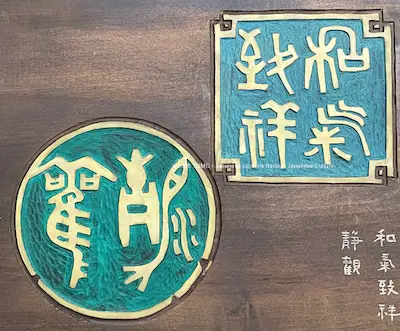
Why has this 篆刻額 (tenkoku-gaku) continued to remain for 80 years?
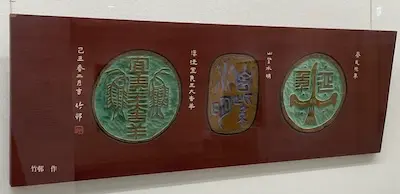
Among my ancestors’ works is a celebratory tenkoku-gaku.
“Tenkoku-gaku” wooden boards were used for gifts and decorations.
It was mainly used as a celebratory gift and decoration.
This work is about 80 years old.
Over many years, the colors have changed into a calm tone.
And this time, through digital restoration, the former brilliance was restored.
Structure and Meaning of the Seal Artwork
Let’s take a closer look at the structure and meaning of the seal artwork.
Main Composition and Details
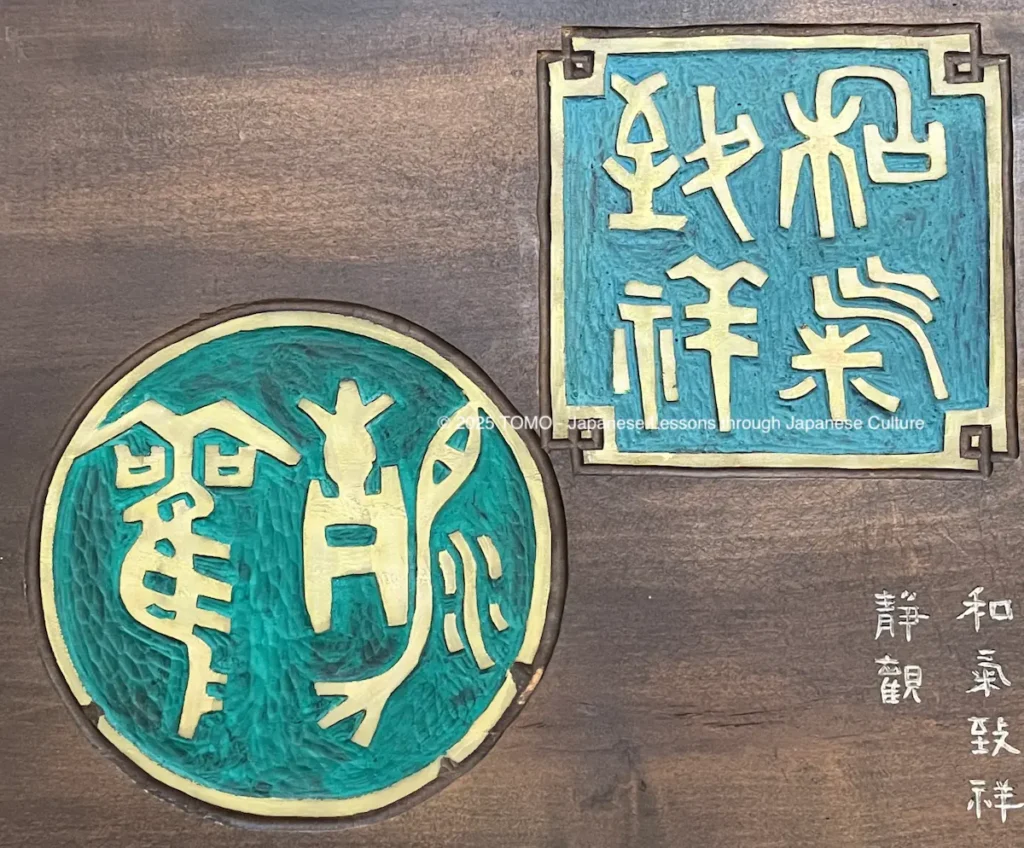
On the right side, “年製紀祥 (nen-sei-ki-shō)” is carved.
The reading order is top right → bottom right → top left → bottom left.
This phrase is an original word created by my ancestors.
Each kanji carries its own meaning.
The four kanji combine to express a special meaning.
And the left side is a pictorial representation of “年製紀祥”.
What might it resemble?
Words of Blessing
On the lower right, the white characters read “和氣致祥 (wakichishō)” and “静観 (seikan)”.
“Wakichishō” means that a peaceful and gentle spirit brings happiness.
“Seikan” means to calmly observe things with a settled mind.
Both are words that express wishes for peace of mind and happiness.
These elements are important parts that support the overall meaning of the artwork.
Meaning of the Seal Artwork
Each of the four kanji has its own meaning.
- 年 (nen): time, one year, an era
- 製 (sei): to make, manufacture, establish
- 紀 (ki): to record, chronicle, mark, era, year name
- 祥 (shō): auspicious, good omen, happiness, good fortune
Together, this part carries the following meaning.
“A specific year records an auspicious event and leaves it in form.”
Digital Restoration and the Story of Colors
Each character’s background color did not come from a single pigment.
Multiple pigments were likely used.
For this reason, I focused on three pigments that were easily available at the time.
They were green malachite, ultramarine, and gofun.
- 緑青 (rokushō, verdigris)
A blue-green pigment made from copper.
It has a calm, greenish blue tone. - 群青 (gunjō, ultramarine)
A blue with a slightly purplish tone.
It has depth and transparency. - 胡粉 (gofun, white pigment)
A white pigment made from shells.
It adds brightness and softness to colors.
Color Characteristics of the Artwork
The colors were based on green malachite, ultramarine, and gofun.
- Background of the text on the right: Greenish-blue
- Background of the illustration on the left: Bluish-green
Before and After
- Before
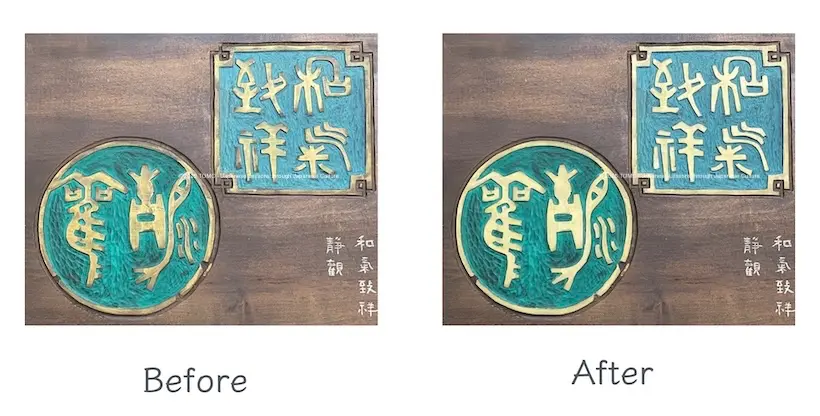
Here is the artwork before restoration.
Wood and seal impressions took on a calm tone over the years.
Time, not deterioration, created this unique expression.
You can truly feel the history of the piece. - After
New layers restored the gold sections.
Gold leaf regained its brilliance while preserving the wood grain.
Vivid colors strengthened the overall impression.
A polished look beautifully highlights the charm of the colors.
It almost feels like the original state has come back to life.
Warm Thoughts Behind the Artwork
My ancestor created this seal artwork for a family celebration.
Much time went into its careful production.
Deep feelings are embedded in the characters and colors.
Digital Restoration and Changes in Color
Digital restoration brought the colors back to life this time.
Now, you can also feel the thoughts behind the artwork.
Layered colors create depth within the calm tones.
Shimmering gold leaf adds brightness and hope to the entire piece.
Over time, the original colors changed.
Comparing the two versions clearly shows the rich expression of the artwork.
Thoughts Embedded in the Artwork
This seal artwork holds value far beyond just being a piece of art.
It also serves as a record of prayers and blessings for the family.
Deeply embedded in the piece is the concept of preserving time and wishes.
Meaning and Cultural Depth Behind Kanji
Each kanji carries its own unique meaning.
Combining them gives words a broader scope.
“年製紀祥” (nen-sei-ki-shō) is one such example.
Eras and emotions overlap within it.
Time, creation, recording, and blessing are all represented in “年製紀祥”.
Bringing these concepts together forms a single story.
Heartfelt wishes are truly embedded in the words.
Conclusion
Vivid colors returned through this recent digital restoration.
Radiant hues blend beautifully with meaningful characters.
The entire artwork now leaves a lively impression.
Furthermore, the piece conveys the richness of Japanese culture across eras.
A quiet resonance continues to linger beautifully even today.
Other articles explore the world of seal carving and my ancestor’s pieces.
Please feel free to read them if you are interested.
“Unlocking the Art of Japanese Seal Carving: The Story Behind an Ancestor’s Carved Seal
Explore more about Japanese seal art in the Japanese Seal Art category.
Related Posts
 The Story Behind an Old Japanese Seal Carving
 Daikisshō (大吉祥): More Than a Lucky Seal
作品との再会
この篆刻額は、なぜ80年もの間残り続けてきたのでしょうか。
長い年月を経て、静かに受け継がれてきた作品があります。
先祖が祝いのために残した篆刻額です。
木の板に刻まれた「篆刻額」は、贈り物や飾りとして使われてきました。
この作品は約80年前のものです。
時間の中で、色彩は落ち着いた風合いへと変化しました。
そして今回、デジタ修復によってかつての輝きがよみがえりました。
篆刻額の構造と意味
右側には「年製紀祥(ねんせいきしょう)」と刻まれています。
読む順番は 右上 → 右下 → 左上 → 左下 です。
この言葉は先祖による造語で、それぞれの漢字に意味が込められています。
四つの漢字を組み合わせることで、全体として特別な意味を表現しています。
そして、左側は「年製紀祥」を絵で表したものです。
何に見えますか?
右下の白文字には「和氣致祥(わきちしょう)」「静観(せいかん)」と刻まれています。
「和氣致祥」は「和やかな気持ちが幸福を招く」という意味で、
「静観」は心を落ち着けて物事を観るという意味です。
どちらも穏やかな心と幸せを願う言葉です。
作品全体の思いを支える重要な要素になっています。
篆刻額に込められた意味
この四つの漢字には、それぞれ意味があります。
- 年(ねん):歳月、一年、時代
- 製(せい):作る、製造する、定める
- 紀(き):記す、記録する、しるし、時代、年号
- 祥(しょう):めでたい、吉兆、幸福、幸運
この部分全体には、次のような意味が込められています。
「特定の年に、めでたい出来事を記録し、形として残す。」
つまり、「記念となる年に、幸運をもたらす」 という縁起の良い言葉です。
デジタル修復と色彩の物語
今残っている色を元に、デジタルで当時の色を再現してみました。
当時の顔料について
それぞれの文字の背景色は、一種類の顔料ではないと考えられます。
そこで、当時入手しやすかった緑青・群青・胡粉の三色を取り上げてみました。
それぞれの顔料の特徴は以下の通りです。
- 緑青(ろくしょう)
銅を原料とした青緑色の顔料です。
落ち着いた緑みの青が特徴です。 - 群青(ぐんじょう)
やや紫を帯びた青です。
深みと透明感があります。 - 胡粉(ごふん)
貝殻から作られた白色顔料です。
色に明るさと柔らかさを加えます。
作品の色の特徴
今回の復元では、緑青・群青・胡粉の三色をもとに色を再現しました。
- 右側の文字の背景
緑寄りの青 - 左側の絵の背景
青みの緑
ビフォー・アフター
- ビフォー(修復前)
修復前の作品です。
長年の時を経て、木肌や印影は落ち着いた色合いに。
劣化ではなく、時間の経過によって生まれた表情です。
作品が歩んできた時間を感じさせます。 - アフター(デジタル復元後)
金色の部分を重ねて修復しています。
木目を残したまま、金箔の輝きを取り戻しました。
色を鮮やかにし、全体の印象をしっかりさせました。
きちんとした印象になり、色彩の魅力がより一層引き立ちました。
当時の状態がよみがえったようにも感じられます。
作品に込められた温かい想い
この篆刻額は、先祖が家族のお祝いのために作った作品です。
時間をかけて制作され、想いが文字や色彩に込められています。
デジタル修復と色彩の変化
今回、デジタル修復で色彩がよみがえりました。
そして、作品の思いも感じられるようになりました。
それぞれの色が重なり、落ち着きの中に奥行きを生み出しています。
そこに金箔の輝きが加わり、作品全体に明るさと希望を与えています。
時間の経過で色彩は変化しました。
2つの色彩を比べると、作品の表情の豊かさがはっきりと伝わってきます。
作品に込められた考え方
この篆刻額は、美術作品としての価値にとどまりません。
家族への祈りや祝福の気持ちを伝える記録でもあります。
この作品には、時間や願いを形に残す考え方が込められています。
漢字に込められた意味と文化の深さ
漢字には、それぞれ意味があります。
それらが組み合わさることで、言葉に広がりが生まれます。
「年製紀祥」も、その一つの形です。
そこには、時代や気持ちが重なっています。
「年製紀祥」は、時、制作、記録、祝福を表しています。
それらを組み合わせることで、一つの物語になります。
言葉の中に願いが込められています。
まとめ
今回のデジタル修復で、色彩が鮮やかさを取り戻しました。
色の輝きと文字の意味が重なり、作品全体が生き生きとした印象になっています。
そして、時代を越えて日本文化の豊かさを伝えてくれます。
その余韻は、今も静かに残り続けています。
篆刻の世界や、先祖の作品についてもご紹介しています。
よろしければあわせてご覧ください。
「Unlocking the Art of Japanese Seal Carving: The Story Behind an Ancestor’s Carved Seal」
ハンコ文化についてもっと知りたい方は、Japanese Seal Art カテゴリをご覧ください。