

Japanese Culture Conveyed Through Art
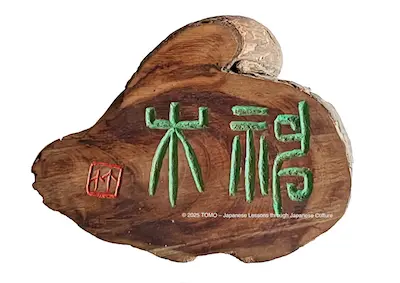
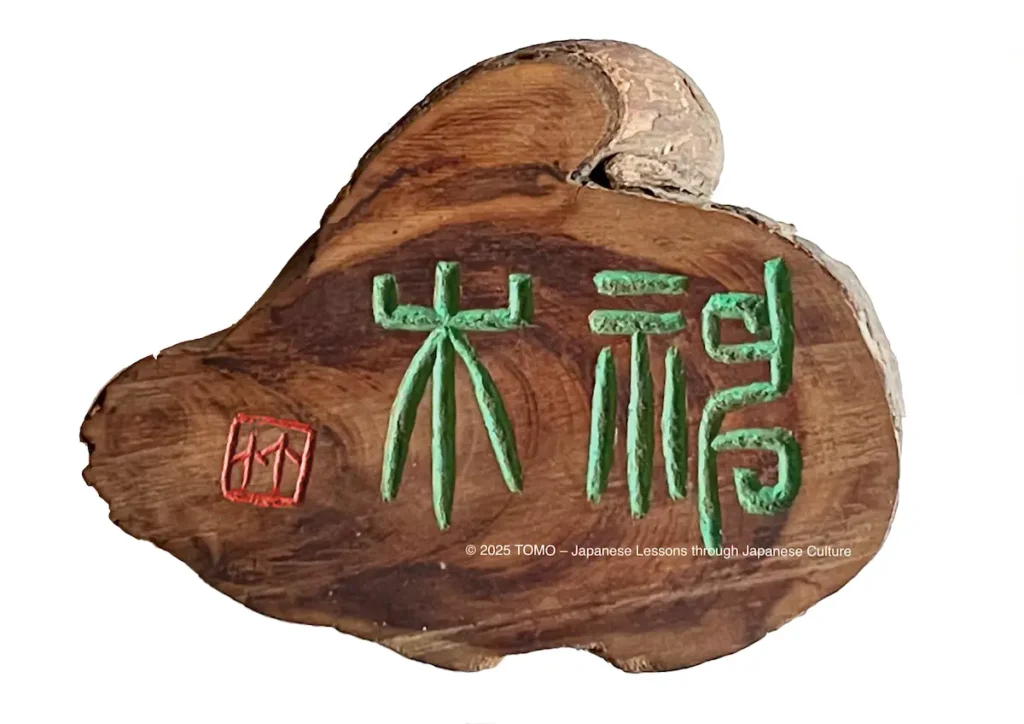
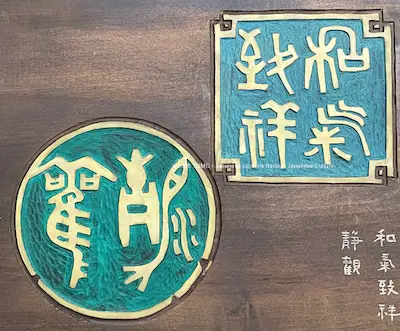
“木福 (Mokufuku).”
This auspicious word brings good luck.
Its characters represent the happiness and blessings of trees.
An ancestor of mine carved this seal on a tree stump.
Many years have passed since then.
Today, the piece still rests safely in my home.
Perhaps the creator made it just for practice.
Yet, a mysterious warmth fills its simple style.
Joy from living alongside trees shines through the carving.
A desire to find happiness in daily life also appears here.
Putting prayers into words is a deep part of Japanese culture.
The characters of “Mokufuku” perfectly capture this mindset.
Warmth, rather than pure technique, moved my heart first.
The Passage of Time and Digital Restoration
Over many years, the wood and seal colors slowly softened.
This is not just simple decay.
Time created this unique character.
Looking at the piece, I had a thought.
What could a descendant do for it?
Applying My Professional Background
Previously, my job involved art reproduction.
Color adjustment and large-format printing were also my tasks.
Using that experience, I tried to recreate the original colors.
Knowledge of colors helped me attempt a digital restoration.
Of course, knowing the true colors is impossible.
Still, I wanted to get closer to its initial appearance.
Preservation and restoration belong to specialized institutions.
My goal was sharing the artwork’s charm with many people.
What I Want to Convey as a Japanese Language Teacher
I have connected with people learning Japanese language and culture.
This connection comes from my role as a teacher.
Traces of handiwork left by a single craftsman exist in this artwork.
Deep inside, one can also feel daily life and thoughts toward creation.
The visible part of the artwork is not everything.
Unrecorded time and people’s feelings also exist there.
I want to convey both aspects.
This digital restoration is one small attempt for that purpose.
The Charm of Seal Carving Told by Colors and Time
Colors remaining in the artwork help us trace its past appearance.
Expressions of That Time Seen from Pigments
Detailed records from the time of creation do not remain.
Therefore, knowing the exact original colors is impossible.
I based my ideas on its condition and old materials.
Imagining the past appearance is one way to enjoy this piece.
緑青 (Rokushō, Verdigris) Used for the Characters
Rokushō was likely used for the characters in this artwork.
This natural pigment forms through copper oxidation.
A deep, muted green is its feature.
The coarser the particles, the darker the color becomes.
It has been used for shrine and temple roofs, along with Japanese paintings.
Sometimes, it is applied to background coloring, not just characters.
Possible Colors Used for the Seal
Either Shu or Bengara might have been used for the seal.
In Japan, vermilion is often used for seals.
Calligraphy, paintings, and signboards sometimes include the creator’s mark.
This artwork also features an engraved seal.
At that time, the following pigments were likely used.
- 朱 (Shu, vermilion)
It is a vivid red known as the color of seal paste.
Cinnabar and this pigment come from the same raw material. - 弁柄 (Bengara, red iron oxide)
Iron oxide is the main component of this pigment.
A muted reddish-brown is its main feature.
People used it widely because it was easier to obtain than Shu.
にかわ (Nikawa, Animal Glue) That Supported the Colors
Pigments alone do not adhere well.
That is why にかわ (nikawa, animal glue) was used here.
Nikawa is a natural adhesive made from animal skin, bones, and tendons.
Fixing the colors is its main role during painting.
Japanese paintings and traditional crafts also utilize this material.
Before & After
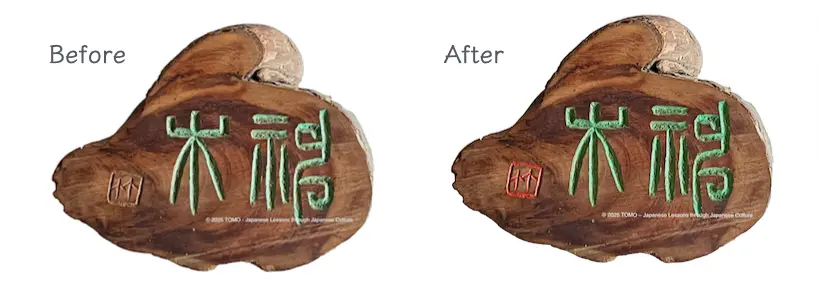
- Before (Pre-restoration)
- Over many years, the wood and seal marks became muted in color.
This is not deterioration.
Marks of time can be felt from the artwork.
- Over many years, the wood and seal marks became muted in color.
- After (Post-digital restoration)
- I recreated the original colors from my imagination.
Careful additions brought back the lost tones. - Rokushō is a pigment that fades easily.
Green from this pigment was added to the characters. - No color remained on the seal area.
So, I tried applying shu.
- I recreated the original colors from my imagination.
Knowing the true colors is impossible.
However, the current appearance gave me a chance to imagine the past form.
Warmth of the Artwork
A tree stump is used for this artwork.
Therefore, the wood’s natural texture remains.
I feel my ancestor’s personality and passion for craftsmanship in it.
People look at shapes and colors when viewing art.
However, the creator’s thoughts and daily life also exist behind it.
Japanese language is the same.
Words have meanings.
Furthermore, knowing the background culture deepens understanding.
My goal as a Japanese teacher is to convey such charm.
Conclusion
Through this artwork, I felt the past colors and the creator’s thoughts.
Digital restoration is a small attempt to imagine that appearance.
Moving forward, I want to continue conveying the charm of Japanese culture.
I sincerely hope you can feel the warmth of Japan.
Please also read this article regarding Japan’s vermilion culture.
[Why Is Vermilion (朱) Important in Japan?]
Explore more about Japanese seal art in the Japanese Seal Art category.
Related Posts
作品を通して伝える日本文化
「木福(もくふく)」。
木がもたらす幸福や恵みを表す、縁起のよい言葉です。
この篆刻作品は、私の先祖が木の切り株に刻んだものです。
長い年月を経た今も、自宅に残されています
おそらく練習のために作られた作品でした。
しかし、その素朴な表現には不思議な温かさがあります。
そこから感じられるのは、木とともに暮らす喜びです。
そして、身近なものの中に福を見いだそうとする心でもあります。
日本には、願いや祈りを言葉に託す文化があります。
「木福」という二文字にも、そんな考え方が表れているように感じます。
最初に心を動かされたのは、技術ではなく温かさでした。
時を経た作品とデジタル復元への挑戦
長い年月を経て、木肌や印影の色は少しずつ落ち着いていきました。
それは単なる劣化ではありません。
時間が生み出した味わいでもありました。
私は、この作品を見ながら考えました。
子孫として何ができるだろうか、と。
以前、私は絵画の複製に関わる仕事をしていました。
色調整や大判プリンタによる出力も担当していました。
その経験を活かし、制作当初の色の再現に挑戦しました。
色彩の知識をもとに、デジタルで復元を試みました。
もちろん、本当の色を知ることはできません。
それでも、作品が生まれた頃の姿に少しでも近づけたいと思いました。
保存や修復は専門機関の役割です。
私が目指したのは、作品の魅力を多くの人に伝えることでした。
日本語教師として伝えたいこと
私は日本語教師として、日本語と日本文化を学ぶ方々と関わってきました。
この作品には、一人の職人が残した手仕事の跡があります。
そして、その奥には日々の暮らしやものづくりへの思いも感じられます。
作品として見える部分だけではありません。
そこには、記録に残らない時間や人の思いもあります。
私は、その両方を伝えたいと思っています。
このデジタル復元も、そのための小さな試みの一つです。
色と時間が語る篆刻の魅力
作品に残る色から、当時の姿をたどってみます。
顔料から見る当時の表現
制作当時の詳しい記録は残されていません。
そのため、実際にどのような色だったのかを正確に知ることはできません。
今回は、作品の状態や当時使われていた材料をもとに考えてみました。
当時の姿を想像するのも、この作品の楽しみ方の一つです。
文字に使われた緑青(ろくしょう)
作品の文字には、緑青が使われていたと考えられます。
緑青は、銅の酸化によってできる天然顔料です。
深みのある落ち着いた緑色が特徴です。
粒子が粗いほど、色は濃くなります。
神社やお寺の屋根、日本画などにも使われてきました。
文字だけでなく、背景の彩色に用いられることもあります。
印に使われた可能性のある色
印には、朱や弁柄が使われていた可能性があります。
日本では、印鑑に朱色がよく使われます。
書や絵画、看板などにも、作者の印が添えられることがあります。
この作品にも印が刻まれています。
当時は、次のような顔料が使われていたと考えられます。
- 朱(しゅ)
- 朱肉の色として知られる鮮やかな赤色。
- 辰砂と同じ原料から作られる顔料。
- 弁柄(べんがら)
- 酸化鉄を主成分とする顔料。
- 落ち着いた赤褐色が特徴。
- 朱より手に入りやすく、広く使われていた。
色を支えた「にかわ」
顔料だけでは、色はうまく定着しません。
そこで使われたのが「にかわ」です。
にかわは、動物の皮や骨、腱などから作られる天然の接着剤です。
彩色の際には、顔料を定着させる役割を果たします。
日本画や伝統工芸でも使われてきた材料です。
ビフォー・アフター
- ビフォー(修復前)
- 長い年月を経て、木肌や印影は落ち着いた色合いになりました。
それは劣化ではありません。
作品が歩んできた時間を感じさせます。
- 長い年月を経て、木肌や印影は落ち着いた色合いになりました。
- アフター(デジタル復元後)
- 制作当初の色をイメージして、再現しました。
失われた色を丁寧に補いました。 - 緑青は色が抜けやすい顔料です。
文字には緑青の色を加えました。 - 印の部分に色は残っていませんでした。
そこで朱色を加えてみました。
- 制作当初の色をイメージして、再現しました。
本当の色を知ることはできません。
それでも、今見えている姿から当時の姿を想像するきっかけになりました。
作品の温かさ
この作品には木の切り株が使われています。
そのため、木そのものの自然な風合いも残っています。
私は、この作品に先祖の人柄やものづくりへの思いを感じます。
作品を見るとき、私たちは形や色に目を向けます。
しかし、その奥には作り手の思いや暮らしもあります。
日本語も同じです。
言葉には意味があります。
さらに、その背景にある文化を知ることで理解が深まります。
日本語教師として、そうした魅力も伝えていきたいと思っています。
まとめ
この作品を通して、当時の色や作り手の思いに触れることができました。
デジタル復元は、その姿を想像するための小さな試みです。
これからも、日本文化の魅力をお伝えしていきたいと思います。
日本文化の温かさを感じていただければ幸いです。
日本の朱色文化については、こちらの記事もご覧ください。
[Why Is Vermilion (朱) Important in Japan?]
ハンコ文化についてもっと知りたい方は、Japanese Seal Art カテゴリをご覧ください。