

What Kind of Fish Do You Think This Is?
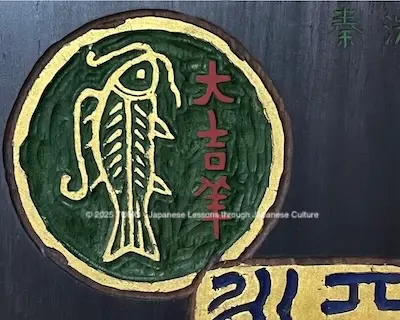
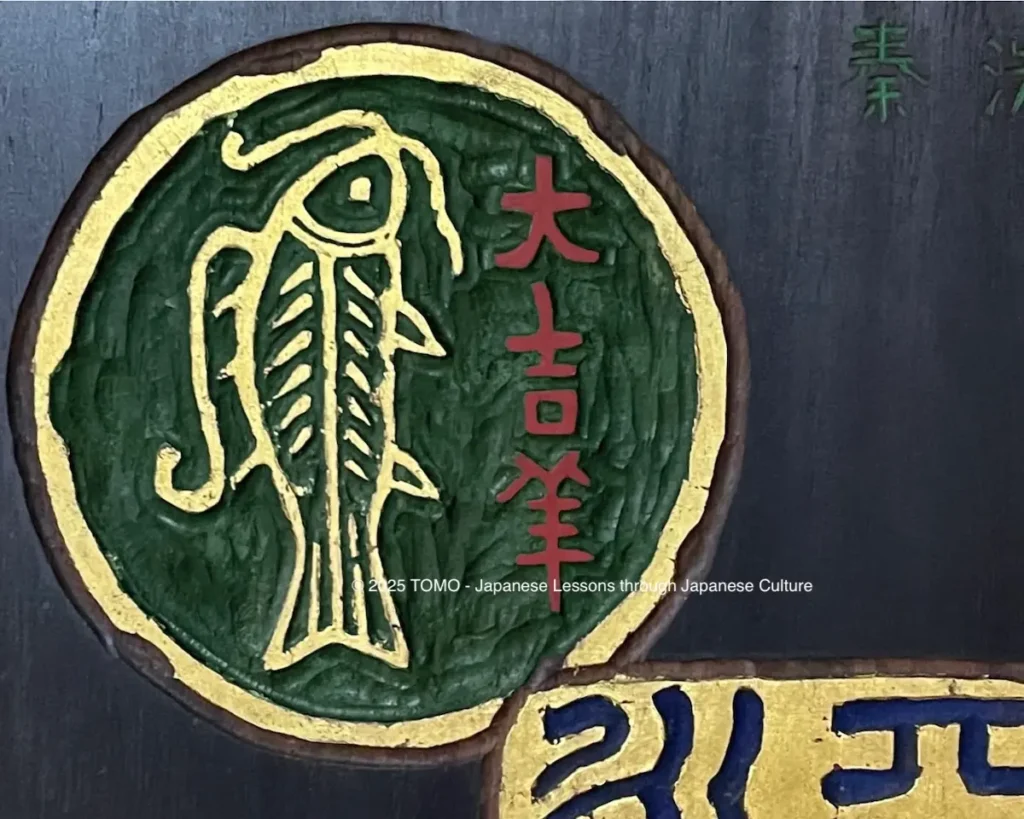
What kind of fish do you see painted here?
You can also find the exact same fish in this website’s header image.
…The correct answer is 鯉 (Koi, carp).
This artwork has been passed down in my family for generations.
It was created by my ancestor, 郊処 (Kōshō).
Originally, it was made for everyday home use.
Because of this, it might not look like a flawless, highly refined piece of fine art.
However, out of all the family heirlooms, this is the one I treasure the most.
The Symbolic Meaning of 鯉(Koi, carp)
The motif of the 鯉 (Koi, carp) originally came from Chinese culture.
In China, there is a famous old story called the Dragon Gate.
A carp swims upstream through rough waters and turns into a dragon.
Because of this story, the carp symbolizes effort and success.
In the Chinese language, the word for fish is 魚(yú).
This word sounds exactly like the word for abundance, 余(yú).
In Chinese, this character means surplus or having more than enough.
Because of this, the carp represents wealth and good fortune.
This cultural belief eventually traveled to Japan.
In Japan, the carp traditionally symbolizes success, health, and growth.
It remains a very popular and auspicious fish today.
Why My Ancestor Painted 鯉(Koi, carp)
My family lives in an area with no sea nearby.
In the past, people rarely had a chance to eat sea fish.
Instead, there was a custom of eating carp.
Because of this, Kōshō, and his brothers liked to paint this familiar fish.
I believe they put their wishes for happiness into this lucky symbol.
The Meaning of 大吉祥 (Daikisshō)
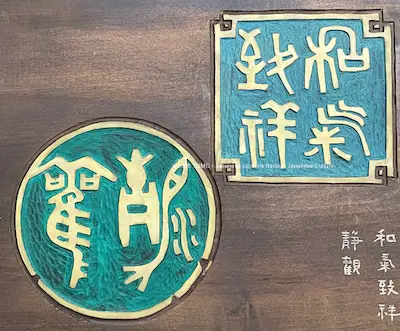
Inside the circle on the left, there are the characters 大吉祥 (Daikisshō).
This phrase is a powerful symbol of good luck.
- 大 (Dai)
It means great or very, which strengthens the meaning of the word. - 吉祥 (Kisshō)
It represents happiness, prosperity, longevity, and a good omen.
Combined, this phrase means ultimate good fortune.
It carries a bright feeling, suggesting that something wonderful is about to happen.
Historically, this phrase has been cherished in calligraphy and seal engraving.
People traditionally used it as a word to welcome happiness.
The Secret Hidden in the Character 祥 (Shō)
The character 祥 (Shō) contains the kanji for sheep, 羊 (Hitsuji).
Since ancient times, sheep have been a symbol of peace and abundance.
This is because sheep were an essential part of daily life.
People believed that a life with sheep meant a prosperous and lucky life.
Even in in this kanji 祥 (Shō), a deep wish for peace and prosperity is hidden.
The Meaning of 右弼弘昌 (Yūhitsu Kōshō)
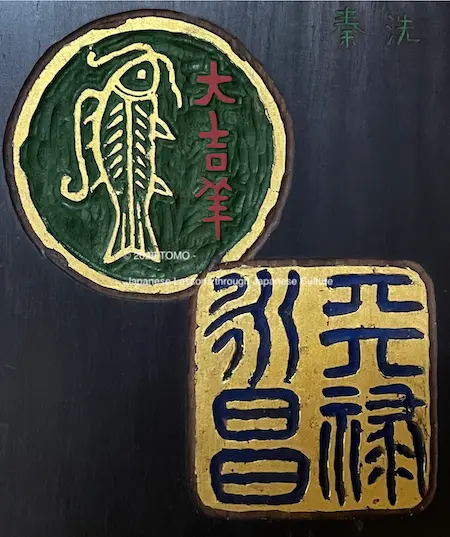
Directly inside the square on the right, there are the characters 右弼弘昌 (Yūhitsu Kōshō).
This phrase is an original expression by my ancestor, Kōshō.
- 右弼 (Yūhitsu)
It refers to an ancient Chinese official position assisting the emperor.
Historically, people considered it a lucky sign bringing fortune and help. - 弘昌 (Kōshō)
It means 弘 (Hiroku, to expand) and 昌 (Sakaeru, to prosper).
This phrase represents great prosperity.
Combined, these characters mean to prosper greatly with good support.
Color Changes: Across Time
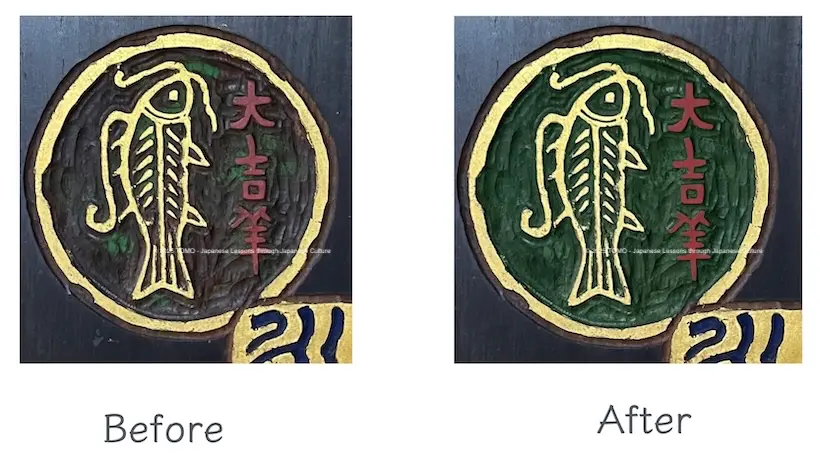
I imagined and recreated the original colors.
The Red of 大吉祥 (Daikisshō)
This time, I adjusted the color of the characters 大吉祥 (Daikisshō) inside the circle.
I also adjusted the surrounding tones.
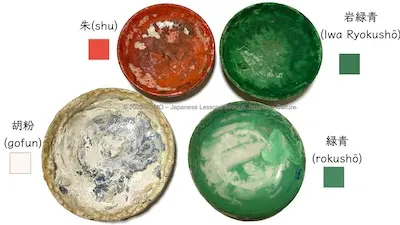
The character color is 弁柄 (Bengara, Red Ochre).
Bengara is an earthy red pigment derived from soil.
It has been used in Japan and around the world since ancient times.
A Touch of Bright Green
A Vivid Green?
Around the characters and the koi, a little vivid green remains.
I used that color to boldly fill the inside of the circle.
This green is likely a pigment called 岩緑青 (Iwa Ryokushō, Malachite Green).
It is one of the pigments from 100 years ago.
I recreated the color by mixing in a tiny bit of 墨 (Sumi, ink Black).
- 岩緑青 (Iwa Ryokushō)
It is a blue-green pigment made from natural copper ore.
Historically, people have used it in Buddhist paintings and decorations. - 墨 (Sumi)
It is a black pigment made from soot.
Traditionally, artists mix it with other colors to create a calm depth.
For a long time, I saw this artwork with almost no color.
So, this vividness is very fresh.
However, I still wonder how much of it is the original color.
The Colors of “Yūhitsu Kōshō”
The Colors of 右弼弘昌 (Yūhitsu Kōshō)
The text 右弼弘昌 (Yūhitsu Kōshō) is a calm, deep color.
It is a mix of 群青 (Gunjō, ultramarine) and 墨 (Sumi, black ink).
You can feel dignity and elegance from this tone.
I kept it exactly as it is because the color remains clear.
Conclusion
Both 大吉祥 (Daikisshō) and 右弼弘昌 (Yūhitsu Kōshō) are lucky words.
- 大吉祥 (Daikisshō): It means ultimate good fortune.
- 右弼弘昌 (Yūhitsu Kōshō): It means to prosper greatly with good support.
Exploring these words is not just studying kanji.
It helps us understand the wishes of our ancestors.
We can feel their deep hopes for happiness and prosperity.
From these lucky words, you can learn about Japanese language and culture.
I hope great fortune comes to you for reading this article.
The maneki-neko is another beloved symbol of good fortune in Japan.
[What is the Secret of the Maneki Neko?]
Explore more about Japanese seal art in the Japanese Seal Art category.
Related Posts
このモチーフ、何の魚かわかりますか?
ここに描かれているのは何の魚でしょうか?
そして、このサイトのヘッダーにも同じ魚がいます。
……正解は「鯉(こい)」です。
この作品は、我が家に代々伝わるものです。
制作したのは、私の先祖である郊処(こうしょ)です。
家庭用に作られたものなので、美術品のような完成度ではないかもしれません。
ですが、私はこの作品を一番大切にしています。
鯉に込められた願い
鯉のモチーフは、もともと中国の文化に由来します。
中国では、「登竜門」の故事があります。
激流を泳ぎ切り、竜へと姿を変える鯉は、努力と成功の象徴です。
また、中国語では「魚(yú)」と「余(yú)」の発音が同じです。
「余」には「あまる」「ゆとりがある」という意味があります。
そのため、鯉は「豊かさ」や「幸運」を運ぶ魚として大切にされてきました。
日本でも鯉は、立身出世や健康、成長を願う魚として大切にされています。
皆に親しまれる、とても縁起の良い魚です。
先祖が鯉を描いた背景
私の住んでいる地域には海がありません。
昔は海の魚を食べる機会がなく、代わりに鯉を食べる風習がありました。
そのため、先祖の郊処や兄弟たちは、身近な鯉を好んで描きました。
縁起の良いこの魚に、幸福への願いを込めたのだと思います。
「大吉祥(だいきっしょう)」の意味
左の円の中には「大吉祥」の文字があります。
これはとても縁起の良い言葉です。
- 大
「とても」「大きな」という意味です。
言葉の力を強めます。 - 吉祥
幸福、繁栄、長寿、吉兆を意味します。
合わせると「この上なく縁起が良い」という意味になります。
何か素晴らしいことが起こる予感を伝えてくれる、明るい言葉です。
古くから書道や篆刻の世界でも、幸福を招く言葉として大切にされてきました。
「祥」という字に隠された秘密
「祥」という字には「羊」という漢字が含まれています。
昔から羊は、平和や豊かさの象徴でした。
羊は生活に欠かせない大切な存在だったからです。
「羊がいる暮らし=豊かで幸運な暮らし」と考えられていました。
「祥」という一文字にも、平和と繁栄への深い願いが隠されているのです。
右弼弘昌(ゆうひつこうしょう)の想い
右の四角の中にある「右弼弘昌(うひつこうしょう)」という文字があります。
これは、先祖郊処が考案した独自の言葉です。
- 右弼(ゆうひつ)
古代中国で皇帝を補佐する官職を指します。
古くから幸運や助けをもたらす吉兆とされました。 - 弘昌(こうしょう)
「弘(ひろ)く」「昌(さか)える」という意味です。
大きく繁栄することを表します。
これらを合わせると、「良き支援に恵まれ、大きく繁栄する」という意味になります。
色の変遷:時を超えて
当時の色合いを想像して、再現してみました。
大吉祥の赤
今回は、円の中にある「大吉祥」の文字と、周囲の色を調整しました。
文字の色は弁柄という赤色です。
弁柄とは赤みのある土由来の顔料です。
古くから日本や世界で使われてきました。
鮮やかな緑色?
文字や鯉の周りには、少しだけ鮮やかな緑色が残っています。
その色を使って、思いきって円の内側全体に色を入れました。
この緑色は、おそらく岩緑青(いわりょくしょう)という顔料です。
100年前の顔料のひとつです。
そこに墨(黒色)をほんの少し混ぜた色で再現しました。
- 岩緑青(いわろくしょう)
天然の銅鉱石から作られた青緑の顔料です。
古くから仏画や装飾にも使われています。 - 墨(すみ)
煤(すす)から作られる黒の顔料です。
落ち着いた深みを出すため、伝統的に他の色と混ぜて使われます。
昔から、この作品をほとんど色のない状態をみていました。
そのため、この鮮やかさは新鮮でもありす。
しかし、どこまでが本来の色なのか、今でも少し迷っています。
「右弼弘昌」の色合い
「右弼弘昌」の文字の色は群青に墨を混ぜた落ち着いた深い色です。
この色合いから、文字の厳かさや品の良さが感じられます。
こちらは色がしっかり残っているので、そのままの色にしました。
まとめ
「大吉祥」と「右弼弘昌」は、どちらも縁起のいい言葉です。
- 大吉祥(だいきっしょう):「この上なく縁起が良い」
- 右弼弘昌(うひつこうしょう):「良き支援に恵まれ、大きく繁栄する」
こうした言葉の意味をひもとくことは、漢字の勉強だけではありません。
そこから先人たちの願いを読み解くことができます。
幸せや繁栄を願う大切な気持ちに触れることができます。
こうした吉語を通して、日本語日本文化にも学んでいただけます。
作品をご覧いただいた方に、たくさんの幸運が訪れますように。
招き猫も、日本で親しまれている縁起物の一つです。
[What is the Secret of the Maneki Neko?]
ハンコ文化についてもっと知りたい方は、Japanese Seal Art カテゴリをご覧ください。