

The Japanese Spirit Found in Traditional Tools
Every object has two values.
One is the visible form, and the other is invisible time.
Recently, I organized some old tools.
They had been stored away for a long time.
My ancestor, a traditional Japanese seal carver, left them behind.
The supplies were used from the Meiji period to the early Showa period.
The Beauty of “Utsuroi” and Changes Over Time
Over about 100 years, the colors changed little by little.
This is not deterioration, but a new charm created by the passage of time.
In Japanese, this gradual transition is called “移ろい (Utsuroi, gradual transition)”.
It expresses a slow and natural change over time.
Historically, Japanese people have found unique value in things that change.
Such cultural perspectives live within the language.
Through my ancestor’s tools, let me introduce this flow of time.
Recreating the Colors of the Time
I digitally recreated the original colors from the faded pigments.
This project captures the colors of that time from 100 years ago.
- Artwork 1: “木福:Mokufuku”
- Artwork 2: “年製紀祥 (Nensei Kishō)”
- Artwork 3: “Daikisshō(大吉祥)”
The Beauty of Aging in Everyday Tools
I found several small dishes inside an old toolbox.
At first glance, they look like ordinary tableware.
However, paint clearly remained on the surface.
These dried layers reveal the creative process of that time.
The Beauty of Aging in Everyday Tools
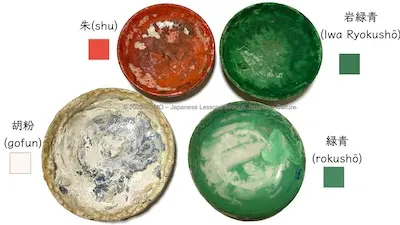
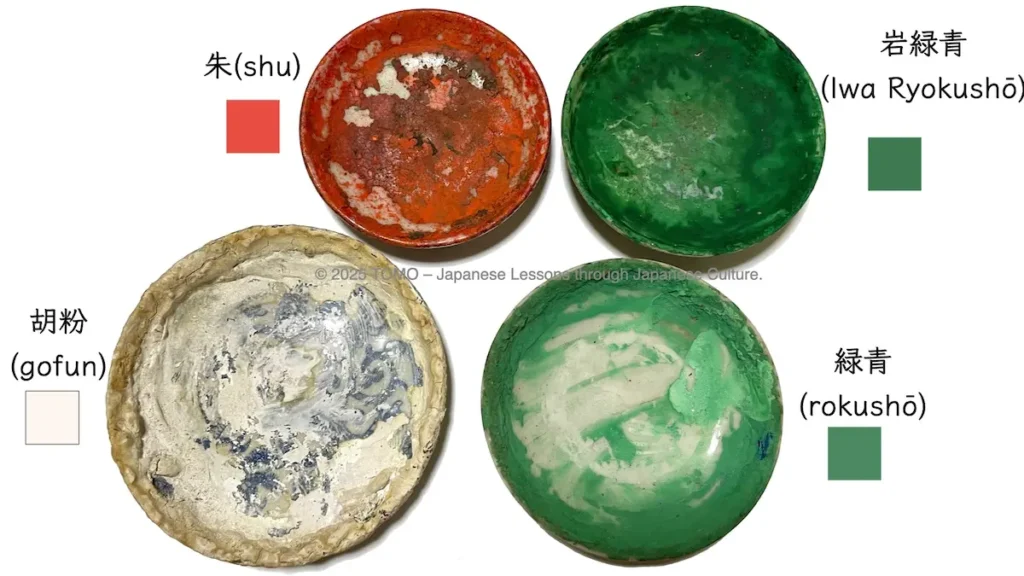
In total, I found four dishes.
Inside the dishes, four colors still remained.
They were shu, iwa-rokushō, rokushō, and gofun.
Red and green tones stay bright even today.
Meanwhile, white gofun has slightly yellowed.
Visible signs of aging appear right here.
Looking at this slight color change, I feel the layers of 100 years.
Artisan Handiwork and Fluid Time
Inside these dishes, only powdered pigments remained.
Painters used to mix them with glue and water to create paint.
Adjusting the amount of 膠 (nikawa, animal glue) or water was key.
This enabled them to control the color density and texture.
Colors also shifted depending on the daily humidity and the state of the glue.
Craftsmanship ensured that each result differed.
Such variation occurred even when using the same pigment.
Every drop of paint was truly a handmade creation.
These mixtures produce natural shadows and depth on wood or paper.
Traces of the Hand Told by “Kaojo” (花王錠) Sumi Ink
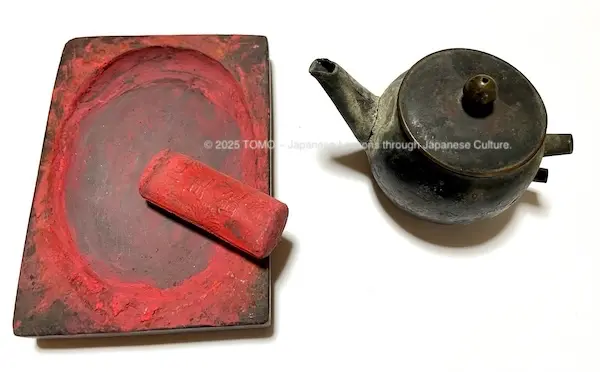
Near the dishes, I found a reddish-brown stick of 朱墨 (shu sumi, vermilion ink).
Engraved on its surface is the name “花王錠 (Kaojo)”.
Products with the same name still exist today.
Bengara (iron oxide) serves as the main ingredient for this ink.
Painters grind it on an inkstone while adding water during use.
Varying the amount of water or the pressure changes the tone.
Such tasks required the experience and intuition of an artisan.
Alongside the ink, a tiny water dropper was stored.
Perhaps they used this to add water little by little while grinding.
Looking at it, I can sense their meticulous approach.
They adjusted the color to create their desired shade.
Differences Between Traditional Pigments and Modern Paints
Modern tube paints are ready to use right out of the container.
Convenience and ease of handling define them.
Our ancestors prepared their own paint.
They kneaded powdered pigments with animal glue and water.
Dedication to this time-consuming process creates a unique beauty.
| Traditional Paints (Pigment + Glue) | Modern Tube Paints | |
|---|---|---|
| How to Use | Made by kneading pigments | Ready to use from the tube |
| Color Expression | Coarse particles create natural shadows and reflections | Even and stable in color |
| Texture | Changes depending on kneading and amount of water | Almost consistent |
| Flexibility | Can be finely adjusted by the artisan’s sense | Little variation |
Modern, convenient tools help us save time.
In contrast, paint from that era required significant effort to prepare.
This process requires time and effort.
Nonetheless, it brings out the unique depth and softness found in nature.
Conclusion
One hundred years of time flows through these ancestral tools.
Traces of handiwork and shifting colors are records left by the passage of time.
These hold an invisible “beauty of time.”
It also reflects the cultural background behind the Japanese language.
Explore more about Japanese seal art in the Japanese Seal Art category.
Related Posts
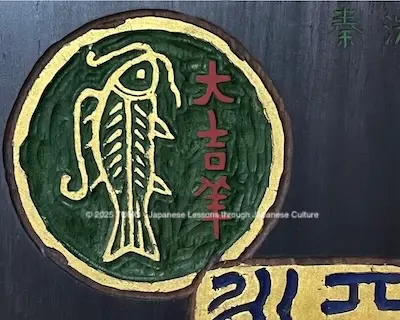 Daikisshō (大吉祥): More Than a Lucky Seal
 Why Is Vermilion (朱) Important in Japan?
古い道具が教えてくれた日本の心
モノには、二つの価値があります。
目に見える「形」と、目に見えない「時間」です。
先日、長く眠っていた道具たちを整理しました。
それは、篆刻家であった私の先祖が遺したものです。
明治から昭和初期にかけて使われていた画材や道具です。
時間がもたらす変化と「移ろい」
約100年の時を経て、色は少しずつ変化していました。
劣化ではなく、 時間の経過が作り出した、新しい味わいです。
日本語には、「移ろい」という言葉があります。
ゆっくりとした変化を表します。
日本人は昔から、変わりゆくものに独自の価値を見出してきました。
言葉の背景には、こうした文化や視点が息づいています。
今回は先祖の残した道具から、時間の流れをご紹介します。
当時の色の再現
デジタル技術を使い、色あせた顔料から当時の色を再現してみました。
100年前に先人たちが見ていた「当時の色」に迫る試みです。
- Artwork 1: “木福:Mokufuku”
- Artwork 2: “年製紀祥 (Nensei Kishō)”
- Artwork 3: “Daikisshō(大吉祥)”
暮らしの道具に宿る、経年変化の美
古い道具箱を整理していると、小さなお皿がいくつか見つかりました。
一見すると、普通の食器のようです。
しかし、表面には絵の具がはっきりと残っていました。
乾いた絵の具の層が、当時の制作の様子を伝えてくれます。
暮らしの道具に宿る、経年変化の美
お皿は全部で4枚ありました。
そこには、朱・岩緑青・緑青・胡粉の4つの色が残っています。
朱や緑系の色は、今でも鮮やかを保っています。
一方で、白の胡粉はやや黄みを帯びていました。
そこに、目にみえる経年変化があります。
胡粉のわずかな色の変化に、100年という時間の層を感じます。
職人の手仕事と、ゆらぐ時間
これらのお皿に残っていたのは、すべて粉末の顔料です。
当時は、これらを膠や水で練って絵の具として使っていました。
膠や水の量で、色の濃淡や質感を自在に調整できました。
その日の湿度や、膠の状態によっても発色が異なります。
同じ顔料を使っても、作る人によって仕上がりが変わります。
このようにして作られた絵の具は、手作業によるものでした。
それらは、木や紙の上で自然な陰影や深みを生み出します。
朱墨「花王錠」が語る、手の痕跡
お皿のそばには、赤茶色の棒状の朱墨がありました。
表面には「花王錠」と刻まれています。
現在でも、同じ名前の商品が存在しています。
弁柄を主原料とする朱墨です。
使用するときは、硯で水を加えながら、磨り潰します。
水の量や力加減によって、色味が変わります。
ここには、職人の経験や感覚が重要でした。
小さな水差しも一緒に保管されていました。
朱墨を磨る際、この水差しから水を少しずつ加えてたのでしょう。
細かな調整をしながら色味を作り出していたことがうかがえます。
当時の顔料と現代の絵の具の違い
現代のチューブ入り絵の具は、出してすぐに使えます。
便利で、扱いやすさが特徴です。
祖先が使っていた絵の具は、粉末の顔料を膠や水で練る必要がありました。
手間をかけるからこそ生まれる美しさが感じられます。
| 当時の絵の具(顔料+膠) | 現代のチューブ絵の具 | |
|---|---|---|
| 使い方 | 顔料を練って作る | 出してすぐ使える |
| 色の表情 | 粒子が粗く、自然な陰影と反射がある | 均一で発色が安定 |
| 塗り心地 | 練り方や水分量で変化する | ほぼ一定で扱いやすい |
| 自由度 | 職人の感覚で微調整できる | 変化は少なくて安定している |
現代の便利な道具は、時間を「短縮」してくれます。
一方、当時の絵の具は、扱いに手間がかかりました。
その反面、自然の素材ならではの深みや柔らかさがあります。
まとめ
先祖の道具には、100年という時間が流れています。
手作業の跡や色の変化は、時間が残した記録です。
そこには、目に見えない「時間の美しさ」があります。
その感覚は、日本語という言葉の背景にも重なっていきます。
ハンコ文化についてもっと知りたい方は、Japanese Seal Art カテゴリをご覧ください。