Mastering “Daijobu”: Is it YES or NO?
When living in Japan, there is a word you often hear. It is the word 「大丈夫です」(Daijobu desu).
But, don’t you find this word strange? Sometimes it means “YES.” And other times it means “NO.”
You must often feel confused, not knowing which one it is.
Today, let’s look at how to answer the most common question, 「大丈夫ですか?」(Daijobu desu ka?).
We will organize the different ways to reply. I will explain how to use them for each situation.
“Daijobu” as YES
First is when it is used in the affirmative (YES) sense.
This is a situation where the other person is concerned about you. They are checking on your current “condition.”
- Situation: At work (Checking your health)
Boss: 「かおいろが わるいけど、だいじょうぶ?」
(Kaoiro ga warui kedo, daijobu?)
”You look pale. Are you okay?””You look pale.”
You: 「はい、だいじょうぶです」
(Hai, daijobu desu.)
”Yes, I’m fine.” - Situation: When you fall down (Checking for injury)
Friend: 「いまの ころびかた、いたそう!だいじょうぶ?」
(Ima no korobikata, itaso! Daijobu?)
“That fall looked painful! Are you okay?”
You: 「うん、だいじょうぶ」
(Un, daijobu.)
”Yeah, I’m fine.”urt. Please don’t worry.)
What if it’s the opposite? (When you are NOT okay)
If you are not okay, please tell them the truth. Do not push yourself too hard.
- 「すみません、すこし やすんでも いいですか?」
(Sumimasen, sukoshi yasunde mo ii desu ka?)
“I’m sorry, could I rest for a little while?” - 「ちょっと いたいです」
(Chotto itai desu.)
”It hurts a little.”
In this way, if you tell them your “current condition” specifically, the other person will also feel relieved.
“Daijobu” as NO
Next is when it is used to decline something (NO).
This is a situation where someone is offering to do something for you.
- Situation: On a rainy day (Offering to lend an umbrella)
Colleague: かさ、もっていないんですか?かしましょうか?」
(Kasa, motte inai n desu ka? Kashimashou ka?)
“Don’t you have an umbrella? Shall I lend you one?”
You: 「あ、だいじょうぶです。くるまで きているので」
(A, daijobu desu. Kuruma de kite iru node.)
”Oh, I’m fine. I came by car.” - Situation: When carrying heavy luggage (Offering help)
Senior: 「たいへんそうだね。てつだおうか?」
(Taihen so da ne. Tetsudaou ka?)
”That looks tough. Shall I help you?”
You: 「あ、だいじょうぶです。もうすぐ おわりますから」
(A, daijobu desu. Mosugu owarimasu kara.)
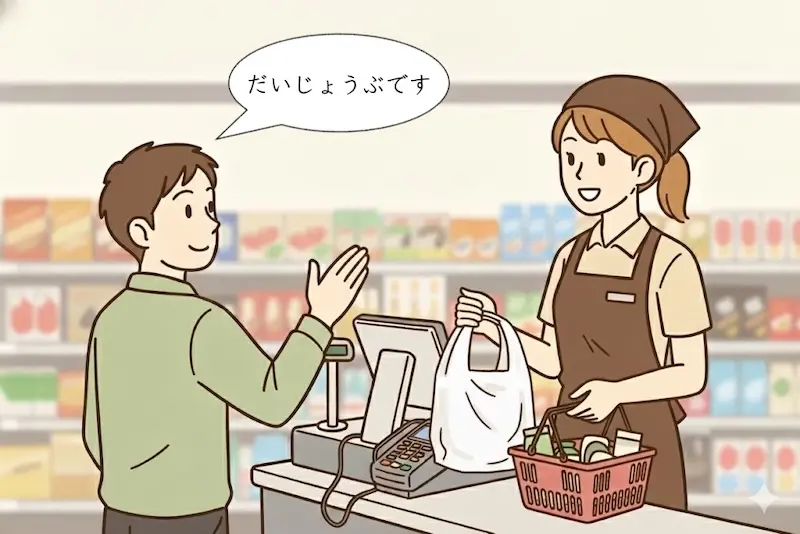
”Oh, I’m fine. I’m almost finished.” - Situation: At a convenience store (Plastic bag offer)
Staff: 「ふくろ いりますか?」
(Fukuro irimasu ka?)
“Do you need a plastic bag?”
You: 「あ、だいじょうぶです」
(A, daijobu desu.)
”Oh, I’m fine (No, thank you).” (= いいえ、いりません。 / No, I don’t need it.)
What if it’s the opposite? (When you are NOT okay)
If you don’t want to decline (you want help), you should not say 「大丈夫です」(Daijobu desu).
- 「ありがとうございます!おねがいします」
(Arigatou gozaimasu! Onegaishimasu.)
”Thank you very much! Please help me.” - 「たすかります。いいですか?」
(Tasukarimasu. Ii desu ka?)
”That would be a great help. Is it really okay?”
In this way, let’s convey “Gratitude + Request” together.
How to tell the difference
Whether “Daijobu desu” means YES or NO is decided by “for what purpose” the other person asked.
- A “Confirmation” question like “Is your current condition okay?” → The “Daijobu” in the answer is YES (I’m fine).
- An “Offer” question like “Shall I do something for you?” → The “Daijobu” in the answer is NO (I don’t need it).
Is the person “worried” about you, or is their question coming from “kindness” to help you?
Just by thinking about that, you can immediately tell which meaning it is.
Why use “Daijobu”?
Why do Japanese people say “Daijobu” instead of saying “I don’t need it”?
It is because they don’t want to reject the other person’s kindness.
“Irimasen” (I don’t need it) has a sound that seems to abruptly cut off the other person’s kindness.
But if you say “Daijobu” (I am satisfied/fine as I am now), you can decline without causing friction.
I feel it is a word full of consideration, which is very typical of Japan.
Summary
When in doubt, the best solution is to add a few more words.
- 「だいじょうぶです。へいきです」
(Daijobu desu. heiki desu.)
“I’m fine, I’m okay.” - 「だいじょうぶです。まに あって います」
(Daijobu desu. mania tte imasu.)
“I’m fine, I already have what I need.” - 「だいじょうぶです。ありがとうございます」
(Daijobu desu. arigatou gozaimasu.)
“I’m fine, thank you.”
Just this will make communication much smoother. Let’s gradually master it according to the situation.
Another versatile word “Sumimasen”:The 3 Meanings of “Sumimasen”(すみません) in Japanese
Japanese of the Day / 今日の日本語
- 助かります (Tasukarimasu) – It helps me / That’s a lifesaver
- Meaning:A way to say “thank you” by letting the person know their help really makes things easier for you.
- Example:助かります。ありがとうございます。 (Tasukarimasu. Arigatou gozaimasu.)
(That’s a great help. Thank you very much.) - Fun Fact:It literally means “I am saved.” It sounds more personal and warmer than a simple “thank you.”
◆ Would you like to practice speaking Japanese? ◆
In my lessons, you can use Japanese a lot and learn to speak naturally with me.
日本で生活していると、よく聞く言葉があります。 それは「大丈夫です」という言葉。
でも、この言葉、不思議に感じませんか?
ある時は「はい(YES)」の意味。 そして、ある時は「いいえ(NO)」の意味。
どちらなのか分からなくて、戸惑うことも多いはずです。
今日は、一番よく聞かれる「大丈夫ですか?」への答え方を、場面ごとに整理します。
YESの「大丈夫」
まずは、肯定(YES)の意味で使うときです。
相手があなたの「状態」を心配して、確認してくれる場面です。
- 場面:職場で(体調の確認)
上司:「顔色が悪いけど、大丈夫ですか?」
自分:「はい、大丈夫です」 (=平気です。仕事は続けられます)
- 場面:転んだとき(ケガの確認)
友人:「今の転び方、痛そう!大丈夫?」
自分:「うん、大丈夫。」 (=痛くないです。安心してください)
【反対の時は?(大丈夫じゃない時)】
もし、平気ではない時は、無理をせずに伝えましょう。
- 「すみません、少し休んでもいいですか?」
- 「ちょっと痛いです」 このように、「今の状態」を具体的に伝えると相手も安心します。
NOの「大丈夫」
次に、お断り(NO)の意味で使うときです。
相手があなたに「何かしてあげましょうか?」と提案してくれている場面です。
- 場面:雨の日に(傘を貸すことを提案)
同僚:「傘、持っていないんですか?貸しましょうか?」
自分:「あ、大丈夫です。車で来ているので」 (=いいえ、いりません。必要ありません) - 場面:重い荷物を持っているとき(手助けの提案)
先輩:「大変そうだね。手伝おうか?」
自分:「あ、大丈夫です。もうすぐ終わりますから」 (=いいえ、自分で運べます。お気遣いありがとうございます) - 場面: コンビニのレジで(レジ袋の提案)
店員: 「袋 いりますか?」
自分: 「あ、大丈夫です」 (= いいえ、いりません。)
【反対の時は?(手伝ってほしい時)】
もし、断りたくない(助けてほしい)時は、「大丈夫です」と言いません。
- 「ありがとうございます!お願いします」
- 「助かります。いいですか?」 このように、「感謝+お願い」を一緒に伝えましょう。
見分けるコツ
「大丈夫です」がYESかNOか。 それは、相手が「何のために」聞いたかで決まります。
- 「今の状態は平気?」という【確認】の質問 → 答えの「大丈夫」は YES(平気です) です。
- 「何かしましょうか?」という【提案】の質問 → 答えの「大丈夫」は NO(いりません) です。
今の場面が「心配」してくれているのか、「親切心」からきているのか。
それを考えるだけで、どっちの意味かすぐに見分けることができます。
なぜ「大丈夫」を使う?
なぜ日本人は「いりません」と言わずに「大丈夫」と言うのでしょうか。
それは、相手の優しさを否定したくないからです。
「いりません」は、相手の親切をパサッと切ってしまうような響きがあります。
でも「大丈夫(私は今、幸せで満たされています)」と言えば、角を立てずに断ることができます。
とても日本らしい、思いやりの詰まった言葉だと感じます。
まとめ
迷ったときは、一言付け加えることが一番の解決策です。
- 「大丈夫です、平気です」
- 「大丈夫です、間に合っています」
- 「大丈夫です、ありがとうございます」
これだけで、コミュニケーションがぐっとスムーズになります。
場面に合わせて、少しずつ使いこなしていきましょう。
もうひとつの万能な言葉「すみません」:The 3 Meanings of “Sumimasen”(すみません) in Japanese