

Anime and Onomatopoeia
In 2025, the new Jujutsu Kaisen (呪術廻戦) movie became a major topic in Japan.
The title is Shibuya Incident Special Edition × Culling Game Preview.
Before watching the movie, there is something you should check out.
Hitsujibungaku’s Ending Song
It is the ending song “more than words” by Hitsujibungaku (羊文学).
This song is from the anime series Jujutsu Kaisen: Shibuya Incident.
It is very popular among fans.
The female vocalist’s husky voice is truly charming.
Also, the unique Japanese expressions in the lyrics caught many people’s attention.
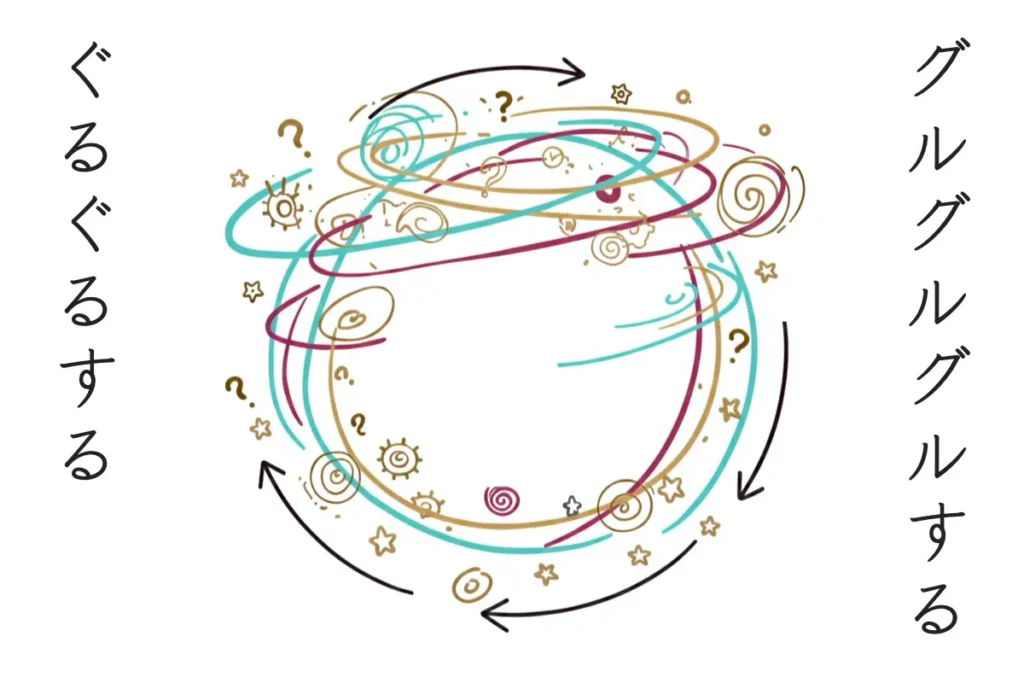
The lyrics include the phrase “グルグルグルする (Guruguru-guru suru).”
The original onomatopoeia is “ぐるぐるする (Guruguru suru)” (to spin around).
Japanese anime and songs often use unique onomatopoeia like this.
You can feel the movement and emotions just by listening to them.
The Meaning of “Guruguru suru”
“ぐるぐるする (Guruguru suru)” describes the movement of something spinning.
This onomatopoeia is used for physical motion.
It also describes a “state of mind” when you are confused.
Examples:
- 頭が ぐるぐるする。
(Atama ga guruguru suru, My head is spinning)
→ Your head feels like it is spinning from dizziness or confusion. - 目が まわる。
(Me ga guruguru mawaru, My eyes are spinning)
→ You feel dizzy and cannot see straight. - 時計の 針が ぐるぐるまわる。
(Tokei no hari ga guruguru mawaru, The clock hands spin around)
→ Time seems to pass very quickly.
This is a very useful expression.
You will often see it in manga and hear it in daily conversations.
The Difference Between “ぐるぐる” and “グルグル”
- ぐるぐる (Guruguru) (Hiragana)
It gives a soft and casual impression.
It is used for natural movements or gentle feelings. - グルグル (Guruguru) (Katakana)
It emphasizes sound and rhythm.
It is used to make the action or emotion stand out.
Songs and manga often use these different styles.
They help express feelings and movements more clearly.
About “グルグルグルする (Guruguru-guru suru)” in the Lyrics
Adding an extra “グル (guru)” to “グルグル (guruguru)” creates a unique rhythm.
By doing this, the sense of movement becomes stronger.
It reaches the listener’s heart more directly.
Japanese onomatopoeia changes its sound.
Adjusting the number of repetitions creates these variations.
This technique helps speakers convey emotions.
It also describes the scale of movement in detail.
Anime and manga often use this feature.
They make lines and lyrics much more expressive.
The Meaning of “グルグルグルする (Guruguru-guru suru)”
The lyrics begin with a question to oneself.
“上手く返事できたか?”
(Umaku henji dekitaka? / Did I answer well?)
(Quoted from “more than words” by 羊文学 / Hitsujibungaku)
The singer feels unsure about her answer.
Her thoughts keep spinning in her head.
She repeats “グルグルグルする♪ (Guruguru-guru suru♪)” three times.
This shows her confusion and hesitation are deeper than the standard “ぐるぐる (guruguru).”
How to Enjoy Japanese Onomatopoeia
Japanese onomatopoeia adds color to language.
These sounds bring rhythm to sentences and conversations.
For example, some describe the state of your head or eyes.
Others show the movement of objects or nature.
“ぐるぐるする (Guruguru suru)” is a useful expression.
It appears not only in daily conversations but also in songs and manga.
When you spot onomatopoeia in lyrics or texts, you can enjoy the fun of expression.
You will feel the unique sense of the Japanese language.
Extra: Why Pronouncing Jujutsu Kaisen Is Difficult
Even for Japanese natives, “Jujutsu Kaisen” is a tongue-twister.
Here is why.
1. Why Is the Pronunciation Hard?
Jujutsu Kaisen (じゅじゅつかいせん) can be a tongue-twister even for Japanese natives if said too fast.
Here are the reasons why it is challenging.
- Consecutive Voiced Sounds
In the “じゅじゅつ (jujutsu)” part, the sound “じゅ (ju)” repeats twice.
These are voiced sounds.
This requires your mouth movements to be quick and busy. - Changing Vowels
In “かいせん (kaisen),” the vowels change from “ai” to “en.”
This makes it hard to pronounce the word smoothly. - Long Words with Many Syllables
“じゅじゅつかいせん (jujutsu-kaisen)” has more than five syllables.
It can be difficult for beginners to catch the right rhythm.
2. Tips for Pronouncing It Correctly
Here are some points to make pronunciation easier:
- Practice in Parts
First, say “じゅじゅつ (jujutsu)” and then “かいせん (kaisen).”
Start slowly.
Once you are comfortable, try saying them together. - Focus on Voiced Sounds
Pronounce “じゅ (ju)” as a single sound, not as “じ (ji) + ゅ (yu).”
Pay attention to the small “ゅ” and keep the sound soft. - Watch the Vowel Changes
In “かい (kai),” blend “か (ka)” and “い (i)” smoothly.
In “せん (sen),” stop clearly between “せ (se)” and “ん (n).” - Learn the Rhythm
Notice the short rhythm: “じゅじゅつ (jujutsu) … かいせん (kaisen).”
Listening to the anime opening or songs and imitating them is also effective.
Please give it a try!
Conclusion
Japanese onomatopoeia is more than just sound.
It expresses delicate emotions and inner conflicts.
By understanding the meaning, you can enjoy anime and songs even more.
Want to learn more? Check out this article.
“Japanese Onomatopoeia in Summer.”
Explore more Japanese expressions in the Japanese Words category.
Related Posts

 Japanese Seals and Vermilion: The Art and Tradition of Shu
アニメとオノマトペ
日本では、2025年に公開された『呪術廻戦』の劇場版 が大きな話題となりました。
タイトルは『渋谷事変 特別編集版』×『死滅回游 先行上映』です。
映画を楽しむ前に、ぜひチェックして欲しいものがあります。
アニメシリーズ『呪術廻戦』「渋谷事変」のエンディング曲です。
曲名「more than words」(羊文学)です。
この曲は、ファンの中でもとても人気があります。
ボーカルの女性のハスキーな歌声が魅力的です。
また、歌詞に含まれるユニークな日本語表現が注目されました。
歌詞には 「グルグルグルする」 というフレーズがあります。
本来のオノマトペは 「ぐるぐるする(回転する)」 です。
日本のアニメや歌には、ユニークなオノマトペが多く使われています。
オノマトペは、聞くだけで動きや気持ちが伝わります。
「ぐるぐるする」の意味
「ぐるぐるする」 は、何かを回る様子を表します。
物理的な動きだけでなく、考えがまとまらない時です。
「頭の中の状態」にもよく使われます。
例:
- 頭が ぐるぐるする
→ 疲れや病気で、視界が回っている感じ。
または、考えすぎて混乱している状態。 - 目が ぐるぐるまわる
→ めまいがして、まっすぐ見られない状態。 - 時計の 針が ぐるぐるまわる
→ 時間がとても速くすぎる様子。
マンガや日常会話でもよく使う、とても便利な表現です。
「ぐるぐる」と「グルグル」のイメージの違い
- ぐるぐる(ひらがな):柔らかく日常的な印象。
自然な動きや軽い感覚を表すときに使う。 - グルグル(カタカナ):音やリズムを強調。
勢いや動きを目立たせたいときに使う。
歌や漫画では、違いを使って感情や動作をよりはっきりと表しています。
歌詞の「グルグルグルする」について
歌詞では 「グルグル」 にに「グル」を加えて、音のリズムを工夫しています。
こうすることで、動きの印象がより強くなり、聞き手の感情に届きます。
オノマトペは、繰り返す回数などで音を変化させることができます。
そうすることで、感情の強さや動作の大きさを細かく表せます。
アニメや漫画では、この特徴が特に自由に使われます。
さらに、文章や歌詞がより生き生きとします。
「more than words」での「グルグルグルする」の意味
歌詞の冒頭に「上手く返事できたか?」という自問自答があります。
(羊文学『more than words』より引用)
自分の答えに自信が持てず、同じ考えが頭の中をずっと回っている……。
「グルグルグルする♪」と3回繰り返しています。
そうすることで、普通の「ぐるぐる」よりも「迷いや混乱」が深いことが伝わってきます。
オノマトペの楽しみ方
日本語のオノマトペは、文章や会話に色やリズムを加えます。
例えば、頭や目の状態を表すものがあります。
また物や自然の動きを表すものなどがあります。
「ぐるぐるする」 は、日常会話だけではありません。
歌や漫画でもよく使われる便利な表現です。
歌詞や文章の中でオノマトペを見つけます。
そうすると、表現の面白さや日本語独特の感覚を楽しめます。
番外編:『呪術廻戦』の発音は難しい?
「じゅじゅつかいせん」は、日本人でも噛みやすい言葉です。
その理由を解説します。
1. なぜ発音が難しいのか?
「呪術廻戦」は、日本人でも一度に言うと噛みやすい言葉です。
難しい理由は次の通りです。
- 濁音が続く
「じゅじゅつ」の部分で「じゅ」が2回続きます。
そのため、口の動きが忙しくなります。 - 連続する母音の変化
「かいせん」の「かい」と「せん」で母音が異なります。
滑らかに発音するのが難しいです。 - 長い単語の連続
「じゅじゅつかいせん」は5音節以上あります。
リズムをつかむのが初心者には難しいです。
2. うまく言うコツ
発音しやすくなるポイントを紹介します:
- 分けて練習する
まず「じゅじゅつ」→「かいせん」と区切る。
最初はゆっくり、慣れたらつなげる。 - 濁音を意識する
「じゅ」は「じ+ゅ」ではなく、一体の音として発音。
小さな「ゅ」を意識して柔らかく。 - 母音の変化に注意
「かい」は「か」と「い」を滑らかに続ける。
「せん」は「せ」と「ん」で止める。 - リズムで覚える
「じゅじゅつ」…「かいせん」と短く区切るリズムを意識。
歌やアニメのオープニングを聴いて真似するのも効果的。
ぜひ、試してみてくださいね。
まとめ
日本語のオノマトペは、音の表現だけではありません。
そこには登場人物の葛藤や、繊細な感情が込められています。
意味を知ることで、アニメや歌の世界がより鮮やかに見えてくるでしょう。
もっとオノマトペを楽しみたい方は、こちらもご覧ください。
“Japanese Onomatopoeia in Summer.”
日本語表現についてもっと知りたい方は、Japanese Words カテゴリをご覧ください。