

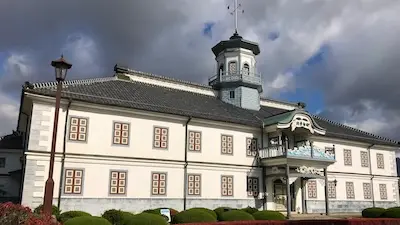
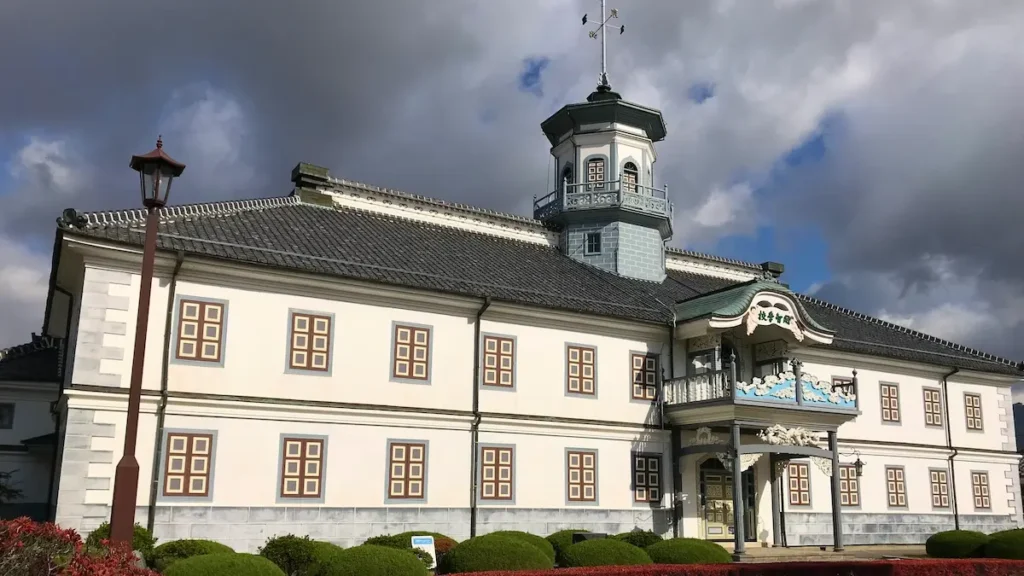
Do you know about the beautiful and nostalgic building in Matsumoto City, Nagano?
It is the 旧開智学校 (Former Kaichi School).
This national treasure is located right near the famous Matsumoto Castle.
A Mix of East and West: “Retro” Architectural Beauty
Step inside, and you will find a world of retro-modern charm.
The building style is called “擬洋風建築 (Giyōfū architecture).”
This means Japanese craftsmen imitated Western styles using their own traditional techniques.
- It features a Japanese-style roof combined with Western-style balconies and windows.
- The walls look like stone.
However, they are actually made of traditional Japanese “漆喰 (shikkui: lime plaster).”
Shikkui is a natural material made from lime. It has been used for walls in Japan for centuries.
This unique design shows how people in the past dreamed of a “new era.”
In 2019, it became the first modern school building designated as a 国宝 (Kokuhō: National Treasure).
The Birthplace of Modern Japanese Education
Long ago, Japanese children studied at “寺子屋 (Terakoya).”
The name includes the word for “寺 (tera: temple).”
However, in the Edo period (1603–1867), townspeople and samurai also became teachers.
They taught children at their own homes.
There, students learned essential skills: reading, writing, and the abacus (soroban).
Later, a new school system started in 1872.
This was during the Meiji era (1868–1912).
The 旧開智学校 (Former Kaichi School) was born based on this new system.
At first, not many children attended school.
However, people slowly realized the importance of education.
By 1902, the enrollment rate exceeded 90%.
The Secret of the Signboard: Reading Right to Left
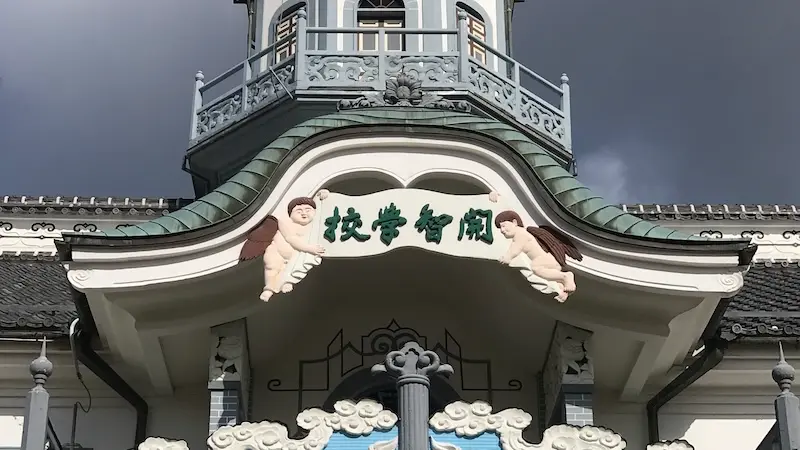
Look closely at the signboard on the front of the building.
The characters for “開智学校 (Kaichi Gakkō: Former Kaichi School)“ are written from right to left.
In Japanese vertical writing, columns move from right to left.
This signboard follows a traditional rule where each column is only one character long.
Therefore, you read it from right to left.
My ancestor was a “篆刻 (Tenkoku)” artist—a specialist in carving stone seals.
Because of this, I am very familiar with these traditional writing rules.
You can often see this style in old signs and calligraphy.
The Meaning Behind the Kanji “智” (Chi)
Please focus on the Kanji “智” in the school’s name. It is pronounced “Chi” or “Tomo.”
This character means “wisdom.”
It also represents “understanding” and a “compassionate heart.”
Actually, my name, TOMO, uses this same Kanji: 智.
My grandfather gave me this name.
He hoped I would have wisdom and a kind heart.
I use this same meaning for my website logo today.
Summary
The 旧開智学校 (Former Kaichi School) is a place where you can feel the passion of the Meiji-era Japanese people.
Its retro look continues to attract many visitors.
People in the past truly valued learning.
I also keep the meaning of “智” (wisdom and compassion) in my heart.
I am here to fully support your learning journey.
By the way, what is the origin or meaning of your name?
Also, is there a retro building in Japan that you would like to visit?
Love retro buildings? Check out this one from “Godzilla Minus One.”:
Historic Japanese Building Featured in Godzilla Minus One
Discover more about Japanese culture in the Japan & Culture category.
Related Posts
長野県松本市にある、美しくてどこか懐かしい建物をご存知ですか?
国宝・松本城のすぐ近くに立つ「旧開智学校(きゅうかいちがっこう)」をご紹介します。
和と洋が混ざり合う「レトロ」な建築美
一歩足を踏み入れれば、そこにはレトロモダンな世界が広がっています。
この建物は「擬洋風建築(ぎようふうけんちく)」と呼ばれています。
これは、当時の日本の職人が西洋のスタイルを真似て作った建築様式です。
- 和風の屋根に、洋風のバルコニーや窓があります。
- 壁は石のように見えます。
しかし、実は日本伝統の「漆喰(しっくい)」で塗られています。
漆喰とは、石灰を原料とした材料です。
日本では古くから塗り壁に使われてきました。
この不思議で独特なデザインは、当時の日本人が「新しい時代」を夢見て作った証拠です。
2019年には、近代の学校建築として初めて国宝に指定されました。
日本の教育の「はじまり」の場所
昔、日本の子供たちは「寺子屋(てらこや)」で勉強していました。
名前には「お寺」という文字が付いています。
しかし、江戸時代にはお坊さんだけではなく、町の人や武士も先生になりました。
先生たちは自分の家などで子供たちに教えていました。
そこでは、生活に欠かせない「読み・書き・そろばん」を習っていました。
その後、1872年に新しい学校制度ができました。
その制度に基づいて、この開智学校が誕生しました。
当時はまだ学校に通う子供が少なかったです。
しかし、次第に教育の大切さが世の中に広まりました。
そして1902年には、就学率が90%を超えました。
右から左へ読む看板のヒミツ
建物の正面にある看板をよく見てください。
「開智学校」の文字が右から左へ書かれています。
日本の縦書きは、右から左へと行が進みます。
この看板は「一文字書いては改行する」というルールで書かれています。
そのため、右から左へ読む形になっています。
私の先祖は「篆刻家(てんこくか)」という、ハンコを彫る専門家でした。
そのため、私はこうした昔の文字のルールに親しみがあります。
古い看板や書の世界では、このような書き方がよく見られます。
「智」という漢字に込めた想い
校名にある「智」という漢字に注目してください。
「チ・とも」と読みます。
この字には「知恵」だけでなく、「理解力」や「思いやりの心」という意味があります。
実は、私の名前「TOMO」の漢字も、この「智」です。
私の祖父が「思いやりのある知恵を持ってほしい」と願って付けてくれました。
このホームページのロゴにも、同じ想いを込めています。
まとめ
旧開智学校は、明治時代の日本人が新しい世界を目指した情熱を感じられる場所です。
和風と洋風が混ざったレトロな姿は、今も多くの人を惹きつけています。
当時の人々は「学ぶこと」をとても大切にしていました。
私も「智」という言葉を胸に、あなたの学びをしっかりとサポートします。
ところで、あなたの名前にはどんな「由来(意味や理由)」がありますか?
また、日本の「レトロな建物」で、あなたが行ってみたい場所はどこですか?
ゴジラ映画のロケ地になった「レトロ建築」もぜひご覧ください。
Historic Japanese Building Featured in Godzilla Minus One
日本文化についてもっと知りたい方は、Japan & Culture カテゴリをご覧ください。