

In Japan, you often see the culture of Japanese wrapping in daily life.
Whether it is a lunchbox or a gift, this tradition is part of our everyday routine.
It shows how much we care about the person receiving it.
But why do Japanese people love to “wrap” things so much?
In this post, I would like to explore the story behind this tradition.
The History of Furoshiki and Its Interesting Name
“Wrapping” is a key part of Japanese culture.
The furoshiki (風呂敷, wrapping cloth) is a perfect example of this.
There is a long history and a lot of daily wisdom hidden behind this simple cloth.
The Versatility of a Single Cloth
Furoshiki is not a bag. It is simply a square piece of cloth.
It is a single piece of cloth that is close to a square.
Because it is square, you can wrap items of all shapes and sizes.
It perfectly fits large boxes, long bottles, and even oddly shaped fruits.
By changing how you tie it, the furoshiki naturally fits anything you carry.
When not in use, you can fold it compactly.
It is a great feature that it fits easily into a small bag.
This versatility is the biggest advantage of a single piece of cloth.
The “Hira-tsutsumi” Used by Nobles
The history of furoshiki dates back to the Nara period.
Back then, it was known as hira-tsutsumi (平包み, flat wrapping).
Originally, it was used by nobles and samurai families.
The purpose was to keep precious treasures and clothing clean.
It was valued as a formal way of wrapping items.
The Origin of the Name “Furoshiki”
The name furoshiki became common during the Edo period.
At that time, sento (銭湯, public bathhouses) became very popular.
These were public bathhouses for townspeople.
However, there were no shelves in the changing rooms to store belongings.
So, people wrapped their clothes in their own cloths.
After bathing, they would spread the cloth on the floor.
Then, they changed their clothes on top of it.
A cloth used to “敷く, shiku” (spread) in the “風呂, furo” (bath).
That is the origin of the word “furoshiki.”
It is an interesting story born from the wisdom of daily life.
Furoshiki in Daily Life
Furoshiki is a simple, convenient, and waste-free tool.
Its value is still very much alive today, especially for wrapping lunchboxes.
In the morning, you wrap your lunchbox in the cloth to protect it.
During your lunch break, you can spread the cloth out.
It serves as a perfect placemat for your meal.
This is a hygienic way to eat.
You do not have to place your lunchbox directly onto a table.
You can enjoy a pleasant meal even when you are on the go.
The Wisdom Behind Furoshiki
With just a single piece of cloth, you can create a dining space anywhere.
Finding creative ways to use limited tools is a joy.
It reflects the wisdom of Japanese daily life.
Recently, more people are choosing furoshiki with traditional patterns.
They make unique and thoughtful souvenirs.
The Meaning Behind Furoshiki Colors
The choice of furoshiki color reflects the Japanese sense of beauty.
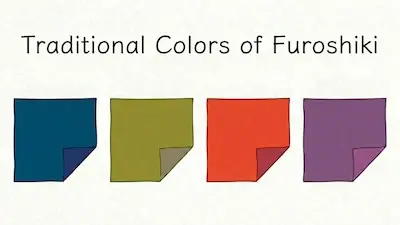
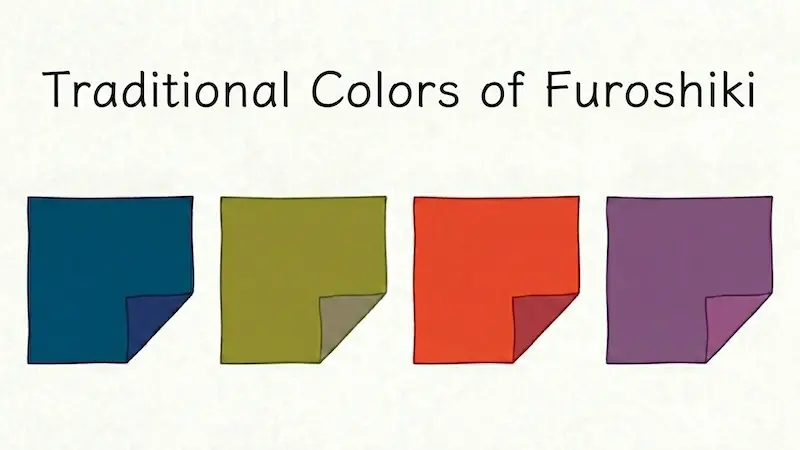
There are four basic color groups: purple, red, blue, and green.
Each color has a different impression and role.
Choose a color that suits the person or the occasion.
This is an important act of thoughtfulness.
Cool and Calm Blue
Blue is a clean and calm color used in daily life.
- 藍色 (ai-iro, indigo)
- 紺色 (kon-iro, navy blue)
- 瑠璃色 (ruri-iro, lapis lazuli blue)
-
Indigo
(Aiiro)Navy blue
(Kon-iro)Lapis lazuli blue
(Ruri-iro)
Dark navy is also sometimes used in formal or solemn situations.
Green Inspired by Nature
This is a calm color that evokes a sense of nature.
- 鶯色 (uguisu-iro, warbler green)
- 利休色 (rikyu-iro, rikyu green)
-
鶯色
(uguisu-iro, warbler green)利休色
(rikyu-iro, rikyu green)
It is often used for wrapping gifts in daily life and for tea ceremony utensils.
Deep green tones are also suitable for formal and solemn occasions.
・Red Expressing Vibrancy
This is a bright and lively color.
It gives a sense of elegance and celebration.
- 朱 (shu-iro, vermilion)
- 紅 (kurenai-iro, crimson)
- 臙脂 (enji-iro, deep red / burgundy)
-
朱色
(shu-iro, vermilion)紅色
(kurenai, crimson)臙脂色
(enji-iro, deep red / burgundy)
It is often used for celebratory occasions.
These include weddings and childbirth.
・Purple with a Sense of Elegance
This is considered the most formal and prestigious color.
- 古代紫 (kodai-murasaki, ancient purple)
- 京紫 (kyo-murasaki, Kyoto purple)
-
古代紫
(kodaimurasaki, ancient purple)京紫
(kyomurasaki, Kyoto purple)
It can be used for both celebratory and solemn occasions.
It is a safe choice when you are unsure which color to choose.
The Meaning of Traditional Japanese Colors
These colors reflect different aspects of Japanese culture.
- 青 (ao, Blue): cleanliness and calmness
- 緑 (midori, Green): nature and harmony
- 赤 (aka, Red): celebration and brightness
- 紫 (murasaki, Purple: elegance and dignity
Choosing colors often reflects care for the other person.
Traditional Japanese colors have a quiet and calm beauty.
The Beauty of the “Wrapping” Aesthetic
Furoshiki expresses our deep respect for the items we handle.
The Meaning of Wrapping Gifts
In Japan, it is customary to carefully wrap souvenirs in beautiful paper.
When you buy a gift at a shop, the staff wraps it neatly.
There is a long-standing tradition behind this.
Japanese people have a habit of not touching items directly with their hands.
They prefer to deliver items to the recipient in a clean, pristine state.
This custom reflects a uniquely Japanese sense of thoughtfulness.
Taking the extra time to wrap a souvenir is a kind gesture.
It shows how much you value the recipient.
By intentionally hiding the contents, you keep the gift a surprise.
This shows your respect for the person receiving the gift.
The Sense of “Wrapping” in Japanese Communication
It seems that Japanese people wrap more than just physical objects.
This concept is deeply connected to their communication.
For example, there is an expression, “to wrap in oblate.”
Oblate is a thin, edible film used to wrap medicine.
Japanese people use this phrase when they need to convey something difficult.
They use it to soften their message.
It is a gentle way to avoid hurting the other person’s feelings.
Softening the Impression of Words
Japanese people often use specific expressions to soften their tone.
These phrases wrap the speaker’s opinion to make it less blunt:
- “~と思います” (I think…)
- “~かもしれません” (It might be…)
These words help to avoid stating an opinion too directly.
In conversation, Japanese people truly value being considerate of others.
You can also use this kind of softening in real Japanese conversations.
For more about traditional Japanese colors, see this article.
[Traditional Japanese Colors: History, Culture, and Modern Influence]
Discover more about Japanese culture in the Japan & Culture category.
Related Posts
日本では、物を「包む」場面をよく見かけます。
お弁当を包んだり、贈り物を包んだり。
そこには、相手を大切に思う気持ちが込められています。
なぜ日本人は「包む」のでしょうか。
今回は、その背景を探りたいと思います。
風呂敷の歴史と、面白い名前の由来
包むという所作の代表的なものといえば、風呂敷です。
その背景には、長い歴史と暮らしの知恵が隠されています。
一枚の布が持つ自由さ
風呂敷は、袋ではありません。
正方形に近い、一枚の布です。
四角い布だからこそ、さまざまな形の物を包むことができます。
大きな箱や長い瓶、形がいびつな果物にも合わせられます。
結び方を変えるだけで、どんな形にも自然にフィットします。
使わない時は、小さく畳めます。
小さなバッグに入れて持ち歩けるのも魅力です。
この自由自在さは、一枚の布だからこそ生まれる大きな利点です。
公家が大切にした「平包み」
風呂敷の歴史は古く、奈良時代まで遡ります。
当時は「平包み(ひらつつみ)」と呼ばれていました。
もともとは、公家や武家の間で使われていたものです。
その目的は、大切な宝物や衣類を、清浄に保つことです。
格式高い包みとして重宝されていました。
風呂敷という名前の由来
現在の呼び名になったのは、江戸時代のことです。
当時、町の人々の間で銭湯が大流行しました。
しかし、脱衣所には荷物を置く棚がありませんでした。
そこで人々は、脱いだ服を自分の布で包みました。
湯上がりには、その布を床に敷きます。
そして、その上で着替えをしました。
「お風呂」の場所で「敷く」布。
これが、風呂敷の由来です。
暮らしの中から知恵から生まれた、興味深いエピソードです。
暮らしの中の風呂敷
風呂敷は、無駄のない便利な道具です。
その良さは、現代のお弁当包みにも生きています。
朝、お弁当箱を布で包みます。
この時は、中身を優しく守るカバーになります。
お昼休みにその布を広げます。
すると、そのまま敷物として使うことができます。
机の上に直接お弁当を置かずに済むため、衛生的です。
外出先でも、気持ちよく食事ができます。
布が一枚あるだけで、どこでも自分の食卓を作れます。
限られた道具を工夫して使いこなす。
そこには、日本人らしい暮らしの知恵が感じられます。
最近では、日本らしい柄のお土産として選ぶ人も増えています。
風呂敷の色に込められた意味
風呂敷の色の選択にも、日本の美意識が表れます。
基本の色は、紫、赤、青、緑の4系統です。
色には、それぞれ異なる印象や役割があります。
相手や場面に合わせて色を選ぶことも、大切な心づかいです。
・落ち着きを感じる青
青は清潔感があり、日常でも使いやすい色です。
- 藍色
- 紺色
- 瑠璃色
落ち着いた紺色は、お悔やみの場面でも使われます。
・自然を感じる緑
自然を感じさせる、落ち着いた色です。
- 鶯色
- 利休色
普段の贈り物や、お茶席の道具を包む時によく使われます。
深みのある緑は、お悔やみの場面にも使われます。
・華やかさを表す赤
華やかで、明るい印象の色です。
- 朱色
- 紅色
- 臙脂色
結婚や出産など、お祝いの場面によく使われます。
・上品さを感じる紫
最も格式が高いとされる色です。
- 古代紫
- 京紫
お祝い事にも、お悔やみ事にも使えます。
色選びに迷った時にも安心できる色です。
日本の伝統色の意味
これらの色は、それぞれ日本の文化の異なる側面を表しています。
- 青:清潔・静けさ
- 緑:自然・調和
- 赤:祝い・華やかさ
- 紫:格式・品格
色を選ぶ時間には、相手を思う気持ちが込められています。
日本の伝統色には、静かで落ち着いた美しさがあります。
「包む」所作に表れる美しさ
風呂敷には、物を大切に扱う気持ちが表れています。
贈り物を包む意味
日本では、お土産を美しい紙で丁寧に包みます。
お店で贈り物を買うと、きれいにラッピングをしてくれます。
これには、古くからの理由があります。
品物に直接手で触れないための配慮です。
清潔な状態のまま相手に届けます。
この習慣には、日本らしい心づかいが感じられます。
また、包むひと手間には、相手を大切に想う気持ちも表れます。
中身をあえて隠します。
それによって、相手への敬意を示しています。
日本語にも残る「包む」の感覚
日本人が包むのは、物だけではないようです。
日本語のコミュニケーションにも、この感覚が深く関係しています。
たとえば、「オブラートに包む」という表現があります。
言いにくいことを、やわらかく伝える時に使う言葉です。
相手を傷つけないための、優しい工夫でもあります。
「~と思います」や「~かもしれません」も似ています。
自分の意見を、ストレートに言い切るのを避ける表現です。
言葉の印象をやわらかく包んでいます。
日本人は、会話のなかでも相手への配慮を大切にしています。
日本の伝統色については、こちらもご覧ください。
[Traditional Japanese Colors: History, Culture, and Modern Influence]
日本文化についてもっと知りたい方は、Japan & Culture カテゴリをご覧ください。