

Only a 16-year era greatly changed Japanese culture.
That is the Taisho era.
It continued from 1912 to 1926, and is one of the shortest eras in Japan.
Western culture spread quickly.
At the same time, traditional Japanese culture was passed down.
Two cultures harmonized, and a new style was born.
That is “大正ロマン (Taisho Roman).”
What is “Roman”?
“ロマン (Roman)” is a word that expresses dreams and admiration.
In Japan, it does not mean only romantic love.
It can also express admiration for past eras or an ideal world.
“Taisho Roman” expresses admiration for the new culture of the Taisho period.
While cherishing tradition, people also enjoyed new things.
The feelings of the people of that era are put into this word.
Life in the Taisho Period
During the Taisho period, life changed greatly, mainly in urban areas.
Trains and streetcars developed.
Getting around became convenient.
Department stores and coffee shops also gained popularity.
More people began wearing Western clothes.
A new lifestyle spread.
Western food tailored to Japanese tastes also spread.
Japanese-style Western dishes also became popular.
Omelet rice and curry rice are two famous examples.
On the other hand, many people still lived wearing kimono.
Traditional lifestyles were also cherished.
It was an era where new culture and tradition coexisted.
That is a major characteristic of the Taisho period.
Learn how Japan blended Western culture and tradition in the Meiji era.
[How Did Japan Blend Western Culture and Tradition?]
New Culture Created by Taisho Roman
In this era, a new culture influenced by Western culture spread.
It spread mainly among the young generation in urban areas.
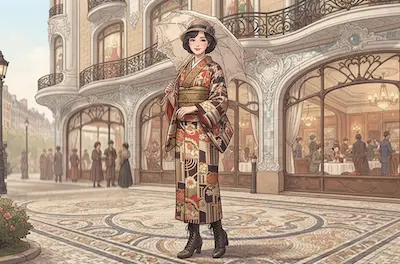
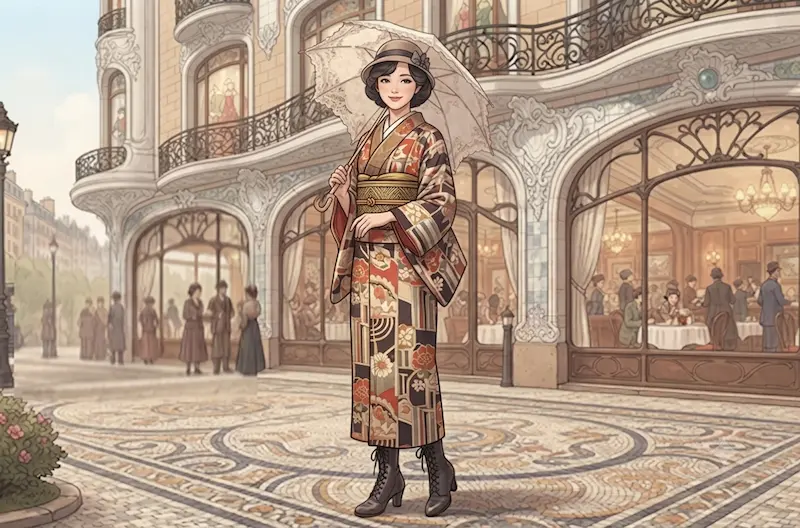
Fashion of Taisho Roman
Patterns such as floral prints and geometric designs became popular.
They were used on kimonos and Western clothes.
In fashion, designs influenced by the West became popular.
They added Western elements to traditional kimonos.
At the same time, they kept the Japanese style.
Here too, people protected the good qualities of the old days.
While doing so, they incorporated new senses.
Modern Girl (“Moga”) and the New Image of Women
During the Taisho era, women called “modern girls“ appeared.
They were also called “moga” for short.
Modern girls adopted new styles.
Women of this era wore Western clothes and had short hair.
Such figures also appeared in magazines and movies.
These appearances attracted the attention of many people.
Moga were an existence that symbolized the changing era.
Meanwhile, they expressed an admiration for a new life and a free way of living.
New Expression in the Taisho Era
In the Taisho era new expressions spread in literature and art as well.
An Era When Spoken-Style Writing Spread
In the Meiji era, spoken-style writing was born.
Until then, written and spoken languages were very different.
The spoken style is close to everyday speech.
In the Taisho era, many authors adopted this style.
Such easy-to-read writing became beloved by many.
与謝野晶子 (Akiko Yosano), a prominent poet and author, represents this era.
Her fresh works deeply influenced many readers.
An Era When New Art Spread
In the Taisho era, new art expressions spread.
While influenced by Western culture, uniquely Japanese works were also born.
竹久夢二 (Takehisa Yumeji) represents this era as a prominent painter.
He created many paintings of women and daily scenes.
Gentle colors and a soft atmosphere drove his popularity.
Women in his artwork captured the admiration of many.
He also designed numerous magazine covers and illustrations.
Today, his pieces remain beloved symbols of Taisho Roman.
Differences in Architecture Between the Meiji and Taisho Eras
In the Meiji era, Western-style architecture spread in Japan.
Brick buildings and Western-style houses symbolized modernization.
Such structures served mainly for stations, banks, and government offices.
Architecture became even more diverse in the Taisho era.
The influence of Art Nouveau also began to appear.
Decorations featuring curves and geometric patterns gained popularity.
Buildings also expanded into everyday life.
Department stores, theaters, and apartments went up one after another.
Urban scenery changed dramatically.
Traditional tatami rooms were incorporated into Western-style houses.
Such architecture remains one of the defining features of Taisho Roman.
Conclusion
The Taisho era lasted only sixteen years.
Within this short time, a wealth of new culture was born.
Its charm still remains across Japan.
You can see it in retro architecture, art, and fashion.
Taisho Roman continues to captivate many people today.
Discover more about Japanese culture in the Japan & Culture category.
Related Posts
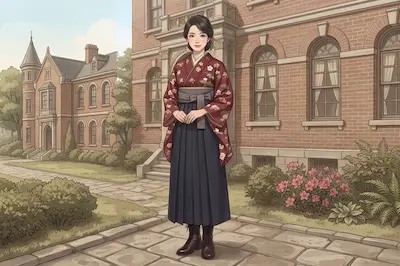 How Did Japan Blend Western Culture and Tradition?
 What Is “Iki”? A Japanese Aesthetic
わずか16年の時代が、日本の文化を大きく変えました。
それが大正時代です。
1912年から1926年まで続いた、日本で最も短い時代の一つです。
西洋文化が広がる一方で、日本の伝統も受け継がれていました。
二つの文化が調和し、新しいスタイルが生まれました。
それが「大正ロマン」です。
「ロマン」とは?
「ロマン」は、夢や憧れを表す言葉です。
日本では、恋愛だけを意味する言葉ではありません。
昔の時代への憧れや、理想の世界を表すこともあります。
「大正ロマン」は、大正時代の新しい文化への憧れを表しています。
伝統を大切にしながら、新しいものも楽しむ。
その時代の人々の気持ちが、この言葉に込められています。
大正時代の暮らし
大正時代には、都市部を中心に暮らしが大きく変わりました。
電車や路面電車が発達し、移動が便利になりました。
百貨店や喫茶店も人気を集めました。
洋服を着る人も増え、新しい生活スタイルが広がりました。
日本人の好みに合わせた洋食も広まりました。
オムライスやライスカレーなど、日本独自の洋食も生まれました。
一方で、多くの人はまだ着物を着て生活していました。
昔ながらの暮らしも大切にされていました。
新しい文化と伝統が共存した時代でした。
それが大正時代の大きな特徴です。
明治時代、日本は伝統を守りながら西洋文化を取り入れました。
[How Did Japan Blend Western Culture and Tradition?]
大正ロマンが生んだ新しい文化
この時代、西洋文化の影響を受けた新しい文化が広がりました。
新しい文化は、主に都市部の若い世代から広まりました。
大正ロマンのファッション
着物や洋服に、花柄や幾何学模様などの模様が人気となりました。
ファッションでは、西洋の影響を受けたデザインが人気になりました。
伝統的な着物に西洋の要素を加えながら、日本らしさも残していました。
ここでも、昔からの良さを守りながら、新しい感覚を取り入れています。
モダンガール(モガ)と新しい女性像
大正時代には、「モダンガール」と呼ばれる女性が登場しました。
略して「モガ」とも呼ばれました。
洋服やショートヘアなど、新しいスタイルを取り入れました。
雑誌や映画にも登場し、多くの人の注目を集めました。
モガは、変化する時代を象徴する存在でした。
また、新しい生活や自由な生き方への憧れを表していました。
大正時代の新しい表現
大正時代には、文学や美術にも新しい表現が広がりました。
口語体の文章が広がった時代
明治時代、口語体の文章が生まれました。
それまでは、書き言葉と話し言葉が大きく異なっていました。
口語体とは、話し言葉に近い文章のことです。
大正時代には、多くの作家が口語体を取り入れました。
読みやすい文章は、多くの人に親しまれました。
歌人・作家の与謝野晶子も、この時代を代表する人物です。
新しい感覚の作品は、多くの読者に影響を与えました。
新しい美術が広がった時代
大正時代には、美術にも新しい表現が広がりました。
西洋文化の影響を受けながら、日本らしい作品も生まれました。
画家の竹久夢二は、この時代を代表する人物の一人です。
女性や日常の風景を数多く描きました。
優しい色使いと、やわらかな雰囲気も人気の理由でした。
夢二が描く女性は、多くの人の憧れの存在でした。
また、雑誌の表紙や挿絵も多く手がけました。
現在でも、大正ロマンを代表する作品として親しまれています。
明治と大正の建築の違い
明治時代、日本では西洋風の建築が広がりました。
レンガ造りの建物や洋館は、近代化の象徴でした。
主に駅や銀行、官公庁などに使われました。
大正時代になると、建築はさらに多様になりました。
アール・ヌーヴォーの影響も見られるようになりました。
曲線や幾何学模様を取り入れた装飾も人気になりました。
また、建物は人々の暮らしにも広がりました。
百貨店や劇場、アパートなどが次々と建てられました。
都市の景色も大きく変わっていきました。
洋館にも和室が取り入れられました。
このような建築も、大正ロマンを感じるものの一つです。
まとめ
わずか16年の大正時代。
その中で、新しい文化が数多く生まれました。
その魅力は、今も日本各地に残っています。
レトロ建築や美術、ファッションなどに見ることができます。
大正ロマンは、今も多くの人を魅了し続けています。
日本文化についてもっと知りたい方は、Japan & Culture カテゴリをご覧ください。