

- The Blend of Japanese Tradition and Western Culture
- The Spread of Western Clothes Through Bunmei Kaika
- Wayō Setchū Fashion Spread During the Taisho Era
- Changes in Colors Seen in Fashion
- Wayō Setchū Culture Still Exists in Modern Japan
- Conclusion
- 日本の伝統と西洋文化が出会った「和洋折衷」
- 文明開化と洋服の広がり
- 大正時代に広がった和洋折衷のファッション
- ファッションに表れた色彩の変化
- 和洋折衷の文化は現代でも残っている
- まとめ
The Blend of Japanese Tradition and Western Culture
When did Japanese people start wearing Western clothes?
During the Meiji and Taisho era, new culture arrived from overseas.
People’s lifestyles, values, and clothing changed greatly.
Japan adopted Western culture while preserving its traditions.
From this, a unique Japanese style, 和洋折衷 (Wayō Setchū), emerged.
The Spread of Western Clothes Through Bunmei Kaika
In the Meiji era, new cultures and technologies came to Japan from overseas.
Clothing also changed under this influence.
Western Clothing Spread During the Meiji Era
In 1868, the Meiji era began.
The Japanese government opened the country to the world.
It actively adopted Western technology and culture.
This period is known as 文明開化 (Bunmei Kaika, Civilization and Enlightenment).”
New systems, such as railroads and public schools, were introduced.
Clothing also began to change.
Western-style uniforms and suits appeared in Japan.
Soldiers and government officials were among the first to wear Western clothes.
Western clothing became a symbol of modernization and a new era.
Western Clothing Was Limited to Certain People
In the Meiji era, Western clothing spread mainly among people with new jobs.
They included government officials, teachers, and office workers.
These people had more opportunities to experience Western culture.
Western clothing gradually spread among them.
Women also began wearing Western-style fashion among a limited group of people.
It was accepted by women who attended girls’ schools.
Hakama and Boots as a Wayō Setchū Style
From the late Meiji era, women’s education gradually spread in urban areas.
More women began attending girls’ schools.
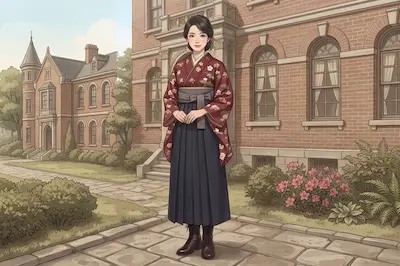
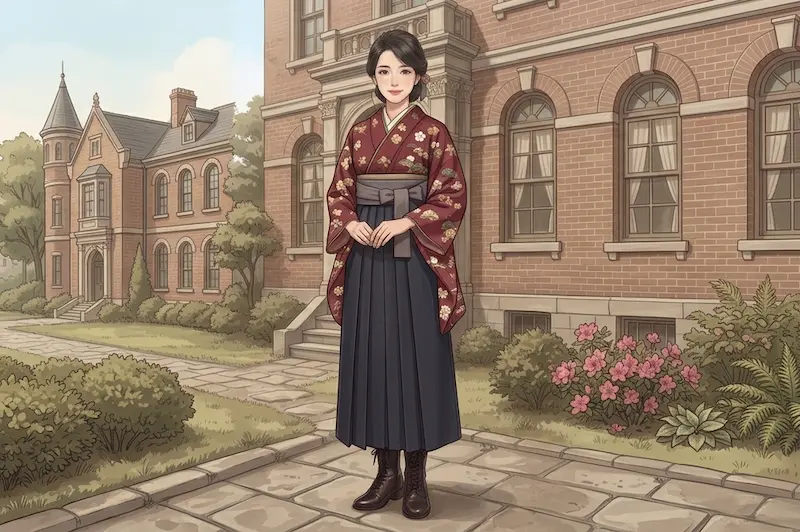
Among these students, hakama became a popular style of clothing.
袴 (Hakama, traditional Japanese trousers) was easier to move in than kimono.
It was suitable for school life.
At first, hakama was usually worn with 草履 (zori, Japanese sandals) or 下駄 (geta, wooden sandals).
A Combination of Hakama and Western Boots
Later, it was influenced by Western culture.
Styles combining leather shoes and boots appeared.
Hakama was a traditional Japanese garment.
On the other hand, boots were a new item introduced from the West.
This was a Wayō Setchū.
It combined Japanese tradition with Western culture.
The style became popular at that time.
The hakama style became a symbol of female students.
It represented intelligence and independence.
The Tobi Coat as a Symbol of Wayō Setchū for Men
Like women, men also adopted new fashions.
One popular example was the トンビコート (tonbi coat, Western-style overcoat).
It was a coat worn over a kimono.
Some men also wore the 山高帽 (yamataka bō, bowler hat).
Traditional Japanese clothing was combined with practical Western items.
The combination created a 粋 (iki, stylish) look with Japanese and Western elements.
Its popularity began during the Meiji era.
It became even more popular during the Taisho era.
Kimono Life Continued Even After Western Clothing Appeared
Western clothing appeared in Japan.
However, many Japanese people’s lives did not change immediately.
Kimono remained the main type of everyday clothing at that time.
Kimono was deeply connected to people’s daily lives.
The fabric could be changed depending on the season.
People could also adjust the temperature by wearing multiple layers.
Therefore, kimono remained part of people’s lives even after Western clothing appeared.
During the Meiji era, kimono and Western clothing existed at the same time in Japan.
Western Culture Spread into Daily Life and Cityscapes
Western culture also influenced people’s lives and cityscapes.
Buildings with Western-style designs were created.
At the same time, Japanese techniques and materials were still valued.
For example, some buildings had Western-style exteriors and tatami rooms inside.
These buildings were called Wayō Setchū architecture.
This combination represented Japan’s modernization.
Japanese people did not simply accept Western culture as it was.
They adapted it to Japanese climate and lifestyles.
Over time, they developed it into a new form of culture.
Wayō Setchū Fashion Spread During the Taisho Era
The influence of Western culture began during the Meiji era.
During the Taisho era, it spread further, especially in urban areas.
New Fashion Culture in Cities
The Taisho era began in 1912.
Wayō Setchū culture continued to spread, especially in urban areas.
In large cities such as Tokyo and Osaka, new fashions became popular.
Magazines and newspapers helped spread these trends.
More people began to wear items such as hats, Western-style umbrellas, and shoes.
Kimono designs also changed.
Patterns and colors influenced by Western culture were added.
However, fashionable clothing was expensive.
Therefore, only a limited number of people could enjoy these new fashions.
Most were from middle-class and upper-class families in urban areas.
Changes in Colors Seen in Fashion
During the Meiji and Taisho eras, the expression of colors also changed.
Traditional Japanese Colors Inspired by Nature
Japan has many beautiful colors inspired by nature.
Here are some examples.
- 藍色 (aiiro, indigo blue)
- 桜色 (sakurairo, cherry blossom pink)
- 紅葉色 (moegiiro, fresh green)
- 藤色 (fujiiro, wisteria purple)
These colors were created through a connection with the seasons and nature.
Until the Edo era, natural materials were widely used for dyeing in Japan.
People created various colors from plants and minerals.
藍染 (Aizome, indigo dyeing) is one of Japan’s representative dyeing techniques.
紅花染め (Benibana-zome, safflower dyeing) is another traditional technique.
Changes in Color Expression Through Synthetic Dyes.
Changes in Color Expression Through Synthetic Dyes
During the Meiji era, synthetic dyes were introduced to Japan from the West.
These dyes made it possible to create colors that had been difficult to produce before.
Brighter colors and more stable colors could be created.
This change also influenced clothing designs.
New color combinations also became popular.
Traditional ideas about colors remained important.
At the same time, new expressions were added.
Prussian blue, used in ukiyo-e, was also a color introduced from the West.
[Why Did Ukiyo-e Fascinate the World’s Greatest Artists?]
Wayō Setchū Culture Still Exists in Modern Japan
The style spread during the Meiji and Taisho eras.
It can still be seen in Japan today.
Wayō Setchū Fashion in Modern Japan
Wayō Setchū fashion can still be seen in Japan today.
One example is hakama worn at graduation ceremonies.
As mentioned earlier, hakama became popular as a uniform for female students.
It was practical because it allowed them to move easily.
The style was also suitable for school life.
Hakama became connected with the image of educated women.
For this reason, hakama became a formal outfit for graduation ceremonies.
Female students still wear it today.
Today, some female students still wear hakama with boots.
Styles that combine kimono with modern accessories are also popular.
These styles do not simply recreate the past.
Female students enjoy creating their own styles with modern trends.
Modern Retro Styles Inspired by Tonbi Coat
Tonbi coat was worn by men during the Meiji and Taisho eras.
It is now popular among young men.
Anime such as Demon Slayer and Bungo Stray Dogs have influenced this trend.
The style and atmosphere of the Meiji and Taisho eras have become familiar again.
Many people enjoy this style today.
Today, it is not only worn on special occasions.
More young men wear it as a casual outer layer.
It is a unique and sophisticated fashion item.
A style from the past is now enjoyed as a new and stylish look.
Conclusion
Meiji and Taisho eras were times of great change in Japan.
Many new cultures entered Japan after the country opened to the world.
However, Japanese people did not simply accept these cultures.
They adapted them to Japanese life and aesthetics, creating a new culture.
Wayō Setchū is a unique Japanese style.
It continues to be seen in Japan today.
Discover more about Japanese culture in the Japan & Culture category.
Related Posts
 The Beauty of Real Ukiyo-e at the Japan Ukiyo-e Museum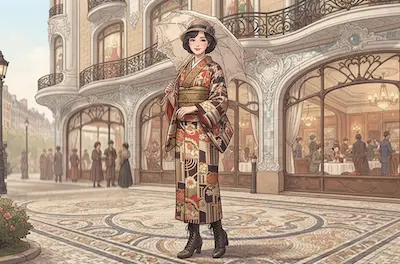
日本の伝統と西洋文化が出会った「和洋折衷」
日本人は、いつから洋服を着るようになったのでしょうか。
明治・大正時代、海外から新しい文化が入ってきました。
人々の暮らしや価値観とともに服装も大きく変化しました。
日本は伝統を大切にしながら西洋の文化を取り入れました。
そこから、日本独自の「和洋折衷」というスタイルが生まれました。
文明開化と洋服の広がり
明治時代になると、日本には海外から新しい文化や技術などが入ってきました。
服装も、その影響を受けて変化していきます。
文明開化とともに広まった洋服
1868年、明治時代が始まりました。
日本政府は、開国をし、海外の技術や文化を積極的に取り入れました。
これを「文明開化」と呼びます。
鉄道や学校制度など、新しい仕組みが作られました。
服装にも、変化が起こります。
西洋式の制服やスーツが、日本社会に登場しました。
特に軍人や政府関係者は、洋服を早くから取り入れました。
洋服は、近代化や新しい時代を象徴する存在でした。
洋服を着たのは限られた人々だった
明治時代に、洋服は主に新しい仕事に就く人々の間で広がりました。
官僚、教師、会社員などです。
海外の文化に触れる機会が多い人々から、少しずつ洋服が広がりました。
また、女性の場合も、同じように限られた人々から始まりました。
女学校へ通う女性の間で、洋風ファッションが受け入れられました。
和洋折衷を象徴する袴にブーツ
明治時代後半から、女性の教育が少しずつ広がりました。
都市部では、女学校へ通う女性も見られるようになりました。
その中で、女学生の服装として広まったのが袴です。
袴は、着物よりも動きやすく、学校生活に適した服装でした。
当初は、草履や下駄などと合わせることが一般的でした。
その後、西洋文化の影響を受けました。
そして、革靴やブーツを合わせるスタイルが登場しました。
袴は、日本の伝統的な衣服です。
一方、ブーツは西洋から伝わった新しいアイテムでした。
日本の伝統と西洋文化を組み合わせた和洋折衷スタイルでした。
このスタイルが、当時の新しいファッションの一つでした。
袴姿は知的で自立した「女学生のステイタス」として憧れの的でした。
男性の和洋折衷を象徴するトンビコート
女性と同じように、男性にも新しいファッションが流行しました。
代表的なものは「トンビコート」です。
着物の上に、西洋のコートを羽織るスタイルです。
頭には「山高帽」という帽子を被る人もいました。
日本の着物に、西洋の便利なアイテムを合わせたのです。
それは、とても粋(いき)な装いでした。
このスタイルは明治時代から見られました。
そして、大正時代にはさらに広く親しまれるようになっていきました。
洋服が登場しても続いた着物の暮らし
洋服が登場しても、多くの日本人の暮らしは、すぐには変わりませんでした。
当時の日常の服装は、着物が中心でした。
着物は人々の生活に深く結びついた衣服でした。
季節に合わせて生地を変えることができます。
重ね着によって温度を調整することもできました。
そのため、洋服が登場した後も、着物は人々の生活に残りました。
明治時代の日本では、着物と洋服が同時に存在していました。
暮らしや街にも広がった西洋文化
人々の暮らしや街の景色にも影響を与えました。
洋風のデザインを取り入れた建物が作られました。
一方で、日本の技術や素材も大切にされました。
例えば、外観は洋風でも、内部には畳の部屋がある建物もありました。
このような建築を、「和洋折衷建築」と呼ばれてます。
このような融合は、日本の近代化を象徴しています。
日本人は海外文化をそのまま取り入れるのではありませんでした。
日本の気候や生活に合わせて工夫し、新しい文化として発展させました。
大正時代に広がった和洋折衷のファッション
西洋文化の影響は明治時代に始まりました。
そして、大正時代になると都市部を中心に、さらに広がりました。
都市で生まれた新しいファッション文化
1912年、大正時代が始まりました。
和洋折衷の文化は、都市部を中心にさらに広がっていきます。
東京や大阪などの大都市では、新しいファッションが話題になりました。
雑誌や新聞がそれを広めました。
帽子や洋傘、洋風の靴などを取り入れる人も増えていきます。
また、着物のデザインにも変化がありました。
西洋の影響を受けた模様や色彩が取り入れられるようになりました。
しかし、流行の衣服は高価でした。
そのため、新しいファッションを楽しめた人は限られていました。
主に、都市部の中流以上の人々です。
ファッションに表れた色彩の変化
明治・大正時代には、色の表現にも変化が生まれました。
自然から生まれた日本の色
日本には、自然から生まれた豊かな色があります。
藍色、桜色、萌黄色、藤色などです。
これらの色は、季節や自然との関わりの中で生まれました。
江戸時代まで、日本の染色では自然素材が多く使われていました。
植物や鉱物などから、さまざまな色を作り出していました。
また、藍染めや紅花染めなどは、日本を代表する染色技術です。
化学染料による色彩表現の変化
明治時代、日本に西洋から化学染料が入ってきました。
化学染料によって、これまで表現が難しかった色も作れるようになりました。
より鮮やかな色や、安定した色に染めることが可能になりました。
その変化は、衣服のデザインにも影響を与えました。
また、新しい色の組み合わせも楽しまれるようになりました。
伝統的な色の感覚を大切にしながら、新しい表現が加わっていきました。
浮世絵の「ベロ藍」も、西洋から伝わった色の一つです。
[Why Did Ukiyo-e Fascinate the World’s Greatest Artists?]
和洋折衷の文化は現代でも残っている
明治・大正時代に広がった和洋折衷は、現在の日本にも見ることができます。
現代にも広がる和洋折衷のファッション
現在でも、和洋折衷のファッションを見ることができます。
その一つが、卒業式で着る袴です。
先に書いたように、袴は女学生の制服として普及しました。
動きやすく、学校生活に適した実用的な服装でした。
そして、袴は学ぶ女性の姿と結びつくようになりました。
そのため、人生の節目である卒業式に、正装として受け継がれています。
最近でも、ブーツを合わせるスタイルが見られます。
着物に現代的な小物を組み合わせるスタイルも人気があります。
昔の形をそのまま再現しているだけではありません。
今の流行を取り入れながら、自分らしい着こなしを楽しんでいます。
トンビコートから広がる現代のレトロスタイル
当時の男性が着ていた「トンビコート」は、いま現代の若者にも人気です。
『鬼滅の刃』や『文豪ストレイドッグス』などのアニメが影響しています。
明治・大正時代の世界観が、とても身近になりました。
今では、特別な日だけではありません。
普段着のアウターとして羽織る若者が増えています。
個性的で、洗練されたアイテムです。
昔の流行が、いま新しいおしゃれとして粋に楽しまれています。
まとめ
明治・大正時代は、日本が大きく変化した時代でした。
日本は開国をしたことで、海外から多くの文化が入ってきました。
しかし、日本人はそれをそのまま受け入れたわけではありません。
日本の生活や美意識に合わせながら、新しい文化へ変化させました。
和洋折衷は、日本独自のスタイルです。
それらは、現在の日本に受け継がれています。
日本文化についてもっと知りたい方は、Japan & Culture カテゴリをご覧ください。