

I had seen 浮世絵 (ukiyo-e) many times in books and photos.
The real prints had a beauty that photos simply cannot capture.
Recently, I visited the Japan Ukiyo-e Museum in Matsumoto City, Nagano Prefecture.
I first learned about this museum and decided to visit it.
It is surrounded by peaceful countryside.
In this quiet place, a world-class collection of ukiyo-e is on display.
The Sakai family collected these works over five generations.
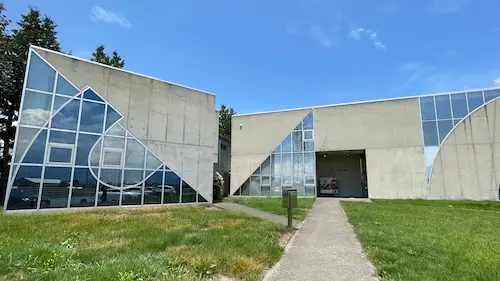
The exhibitions change throughout the year.
However, you can always see authentic Edo-period ukiyo-e in person.
The Beauty of Ukiyo-e That Photos Cannot Capture
You can see ukiyo-e in books and on the Internet.
However, seeing the real prints changed my impression completely.
The Natural Color of the Paper
The first thing that caught my attention was the color of the paper.
It was not pure white like modern printed paper.
Instead, it had a soft, warm tone.
Edo-period ukiyo-e was printed on 和紙 (washi paper).
At that time, washi was made from natural materials.
The paper was not pure white and had its own natural texture and character.
Of course, the paper has also changed over the years.
However, I felt that its natural color is one of the charms of ukiyo-e.
The Beauty of Prussian Blue
On the other hand, the colors were surprisingly vivid.
I was especially impressed by the beauty of ベロ藍 (Bero-ai, Prussian blue).
Bero-ai, became widely used in ukiyo-e during the late Edo period.
Its deep blue color has remained vivid even after many years.
The deep blue and the aged color of the paper.
Together, they made me feel the long history of the artwork.
Fine Details and the Size of the Prints
Seeing the real prints, I noticed the fine lines.
I was also amazed by the patterns on the kimonos.
In photos, you can simply enjoy them as beautiful pictures.
However, each print was made with great skill.
It was created using woodblock printing.
The Size of Ukiyo-e Prints
The size of the prints also caught my attention.
Most of the ukiyo-e on display were about 35 cm tall and 25 cm wide.
They felt quite small as works of art.
Unlike modern paintings, they were not made in various sizes.
This shows that printed works in the Edo period followed a standard size.
The Tools Behind Ukiyo-e
The exhibition also displayed 版木 (hangi, woodblocks).
It also displayed 馬連 (baren, hand printing pads).
These tools were used to make ukiyo-e.
A baren is used to press the paper onto the woodblock.
It transfers the ink to the paper.
It looked similar to the printmaking tools I used in elementary school.
Because of that, I felt a little closer to the ukiyo-e printing process of the Edo period.
The Skills of the Craftsmen
Ukiyo-e was not created by a single artist.
An 絵師 (eshi, designer) created the original design.
A 彫師 (horishi, block carver) carved the woodblocks.
A 摺師 (surishi, printer) printed the image.
Each person had a different role.
Together, their skills created a single work of art.
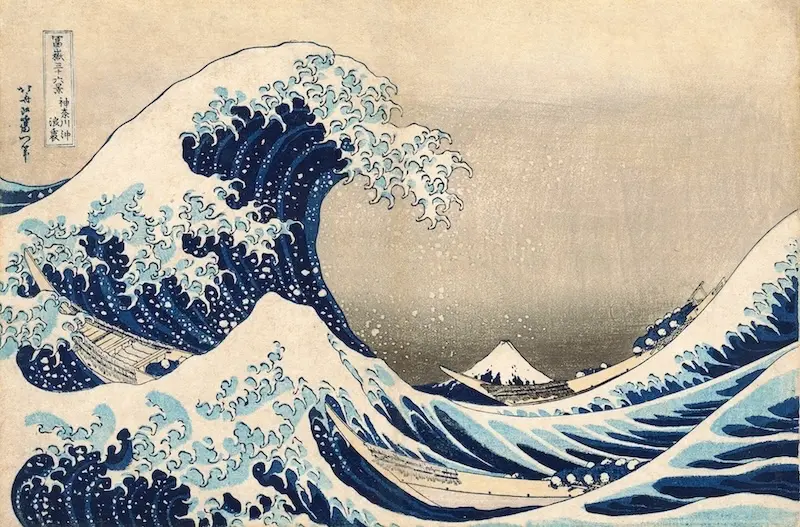
Learn how ukiyo-e influenced artists around the world.
[Why Did Ukiyo-e Fascinate the World’s Greatest Artists?]
The Ukiyo-e That Left the Strongest Impression
The work that impressed me the most was by Katsushika Hokusai.
Bushū Tamagawa (Fugaku Sanjūrokkei)
富嶽三十六景 武州玉川
Fugaku Sanjūrokkei: Bushū Tamagawa
Thirty-six Views of Mount Fuji: Bushū Tamagawa
This work beautifully depicts 富士山 (Fujisan).
It also portrays the surrounding landscape with great care.
The river, nearby scenery, and people are shown in great detail.
One of its most striking features is the use of Bero-ai.
I felt that Hokusai painted more than Fujisan.
He also painted the lives of the people who looked at it.
Kōshū Misaka Suimen (Fugaku Sanjūrokkei)
富嶽三十六景 甲州三坂水面
Fugaku Sanjūrokkei: Kōshū Misaka Suimen
Thirty-six Views of Mount Fuji: Reflection in Lake Misaka, Kai Province
The reflection of Fujisan on the water is impressive.
Its soft colors create a calm atmosphere.
Although it is the same Fujisan, it looks different from every viewpoint.
This work shows Hokusai‘s keen observation and artistic skill.
歌川広重「東都御茶の水」
東都御茶の水
Tōto Ochanomizu
Ochanomizu in the Eastern Capital
One work by Utagawa Hiroshige also left a strong impression on me.
His prints show everyday life in Edo.
They also capture the city’s streets and scenery.
Ukiyo-e depicts not only landscapes but also the lives and culture of the people.
This print is in a vertical format.
Try Ukiyo-e Printing
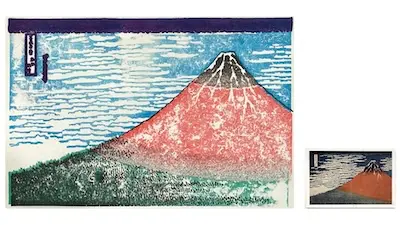
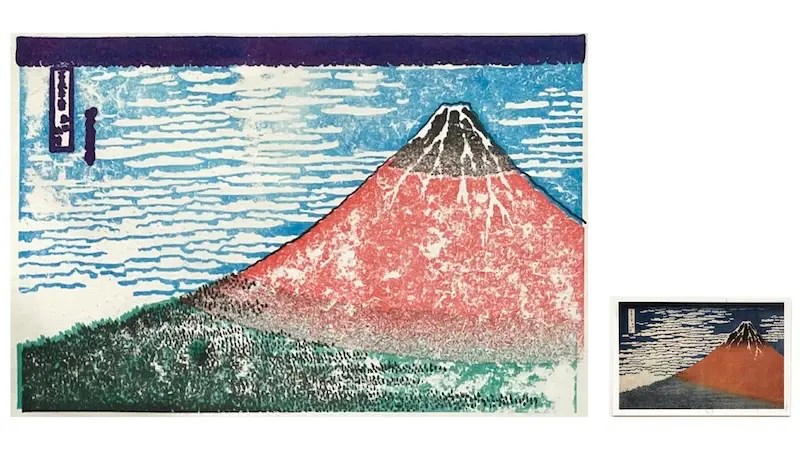
At the museum, visitors could try a ukiyo-e stamp activity.
There were two stamps: “Red Fuji” and “The Great Wave off Kanagawa.”
My main image shows the “Red Fuji” stamp.
Ukiyo-e is created by layering multiple woodblocks.
The stamp is also completed by adding colors step by step.
Trying it yourself helps you understand the skills behind ukiyo-e.
Ukiyo-e Across Time and Borders
When I visited, a family from overseas was enjoying the activity.
The parents and their teenage son looked like they were having a great time.
It reminded me that ukiyo-e began in the Edo period.
People around the world still enjoy it today.
Japanese Culture That Lives On Through Time
The Japan Ukiyo-e Museum has English signs and brochures.
Visitors from overseas can enjoy the museum with ease.
Ukiyo-e is more than beautiful pictures.
It reflects the paper, colors, and the skills of many craftsmen.
The prints also reflect the aesthetic sense of the Edo period.
Seeing the real prints gave me a new appreciation for ukiyo-e.
From Everyday Prints to Works of Art
During the Edo period, ordinary people enjoyed ukiyo-e.
It is said that one print cost about the same as a bowl of soba.
Today, ukiyo-e reprints are treated as works of art.
The reprints in the museum shop cost around 10,000 yen.
Over time, the role of ukiyo-e has changed.
In the Edo period, it was part of everyday life.
Today, it is a valuable way to share Japanese culture.
Discover how ukiyo-e inspired Europe and created Japonism.
[What Is Japonism?: How Ukiyo-e Captivated Europe]
Conclusion
Visiting the Japan Ukiyo-e Museum reminded me of the beauty of ukiyo-e.
Real prints have a beauty that photos cannot capture.
Natural paper textures.
Vivid colors.
Fine craftsmanship.
Each print contains the skills of many craftsmen.
Created over 200 years ago, ukiyo-e still fascinates people worldwide.
Discover more about Japanese culture in the Japan & Culture category.
Related Posts
 Why Did Ukiyo-e Fascinate the World’s Greatest Artists?
写真や本で何度も見た浮世絵。
しかし、実物を見ると、画面では伝わらない魅力がありました。
先日、長野県松本市にある日本浮世絵博物館を訪れました。
私は今回、初めてこの博物館を知りました。
周囲には田園風景が広がり、とてものどかな場所でした。
そんなところに、世界的にも貴重な浮世絵のコレクションが展示されています。
このコレクションは、酒井家が5代にわたって収集してきたものです。
展示内容は時期によって入れ替わります。
しかし、いつでも江戸時代の浮世絵を実際に見ることができます。
写真では伝わらない浮世絵の魅力
浮世絵は、本やインターネットでも見ることができます。
しかし、実物を見ると印象が大きく変わりました。
紙が持つ自然な色
最初に目に入ったのは、紙の色でした。
現代の印刷物のような真っ白な紙ではなく、少し温かみのある白でした。
江戸時代の浮世絵には和紙が使われています。
当時の和紙は自然素材から作られていました。
そのため、均一な白ではなく、紙そのものが持つ風合いがあります。
もちろん、長い年月による変化もあります。
しかし、当時の紙が持つ自然な色も、浮世絵の魅力の一つだと感じました。
一方で、色は驚くほど鮮やかに残っていました。
特にベロ藍の美しさが印象的でした。
ベロ藍は江戸時代後期に浮世絵で多く使われるようになった青色です。
深みのある青は、長い年月を経ても鮮やかに残っていました。
深みのある青と、時間を重ねた紙の色。
その組み合わせから、作品の長い歴史を感じました。
細かな技術と作品の大きさ
実物を見ると、細かな線や着物の模様にも驚かされます。
写真では美しい絵として見ることができます。
しかし、実際には高度な木版技術によって作られています。
また、作品の大きさにも特徴がありました。
展示されていた浮世絵の多くは、縦約35cm、横約25cmほどでした。
絵画としては小さいという印象です。
現在の絵画のように自由な大きさではありません。
当時の印刷物として、一定の規格があったことが分かります。
浮世絵を支えた職人の技術
展示室には、浮世絵制作に使われた版木や馬連もありました。
馬連は、版木に乗せた紙を押さえ、色を紙に写すための道具です。
私が小学生の頃に使った版画の道具と似ていました。
そのため、江戸時代の浮世絵制作を少し身近に感じました。
浮世絵は、一人の画家だけで完成するものではありません。
絵師、彫師、摺師。
それぞれの技術によって、一枚の作品が作られています。
浮世絵が世界の芸術家に与えた影響について紹介しています。
[Why Did Ukiyo-e Fascinate the World’s Greatest Artists?]
印象に残った浮世絵
今回、特に印象に残ったのは葛飾北斎の「富嶽三十六景」でした。
「富嶽三十六景 武州玉川」
「武州玉川」では、富士山と自然の風景が美しく描かれています。
富士山だけではなく、川や周囲の景色、人々の姿も丁寧に表現されています。
ベロ藍がとても印象的な作品です。
北斎は、富士山だけではなく、富士を見る人々の生活も描いていたのだと感じました。
「富嶽三十六景 甲州三坂水面」
「甲州三坂水面」では、水面に映る富士山が印象的でした。
全体的に淡い色合いの作品です。
同じ富士山でも、場所や視点によって違う表情を見ることができます。
北斎の観察力と表現力を感じる作品でした。
歌川広重「東都御茶の水」
歌川広重の「東都御茶の水」も心に残りました。
広重の作品からは、江戸の町や人々の日常を感じることができます。
浮世絵には、江戸の景色、人々の暮らしや文化も描かれています。
こちらは縦長の作品です。
浮世絵を体験できるスタンプ
博物館には、浮世絵を体験できるスタンプがありました。
冨嶽三十六景の「凱風快晴」と「神奈川沖浪裏」の2つです。
メイン画像は「凱風快晴」のものです。
浮世絵は、複数の版を重ねて一つの作品になります。
スタンプも同じように、何度も重ねることで完成します。
実際に体験すると、多くの職人の技術によって浮世絵が作られていたことを実感できます。
私が訪れた時には、海外から来たご家族もスタンプを楽しんでいました。
ご両親と10代後半くらいの息子さんが、楽しそうに体験している姿が印象的でした。
江戸時代に生まれた浮世絵が、現在も国を越えて楽しまれていることを感じました。
時代を越えて残る日本文化
日本浮世絵博物館には、英語の案内やパンフレットもあります。
海外からの訪問者も楽しめる環境が整っています。
浮世絵には、紙や色、職人の技術があります。
そしてそこには、江戸時代の美意識が込められています。
実物を見ることで、写真では伝わらない魅力を感じることができました。
浮世絵がヨーロッパに与えた影響と、ジャポニズムについて紹介しています。
[What Is Japonism?: How Ukiyo-e Captivated Europe]
身近な印刷物から美術品へ
江戸時代の浮世絵は、庶民の間で楽しまれていました。
当時、浮世絵はそば一杯ほどの価格だったと言われています。
一方、現在の復刻版は、美術品として扱われています。
館内ショップで見た復刻版は、約1万円でした。
同じ浮世絵でも、時代によって役割は変わりました。
江戸時代には、多くの人が楽しむ身近な存在でした。
現在では、日本文化を伝える貴重な作品になっています。
まとめ
日本浮世絵博物館を訪れ、浮世絵の魅力を改めて感じました。
実物には、写真では伝わらない美しさがあります。
紙の風合い。
鮮やかに残る色。
細かな職人の技術。
一枚の作品に、多くの人の技が込められています。
200年以上前の浮世絵が、今も世界中の人を魅了しています。
日本文化についてもっと知りたい方は、Japan & Culture カテゴリをご覧ください。