

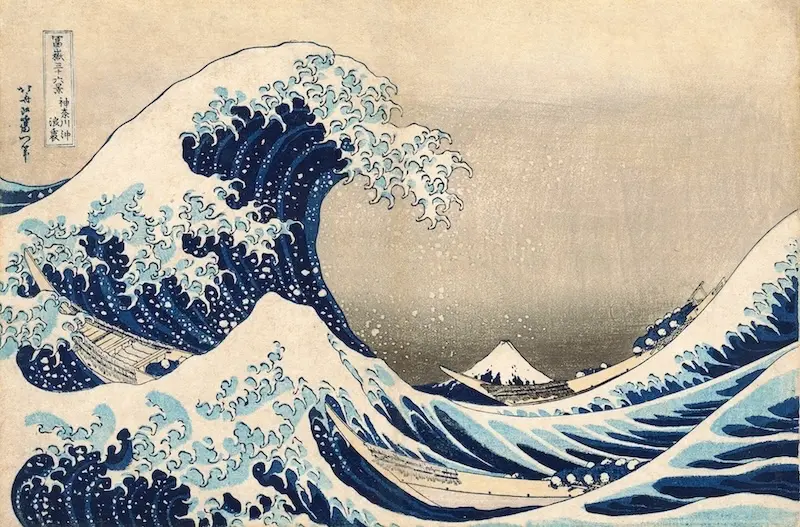
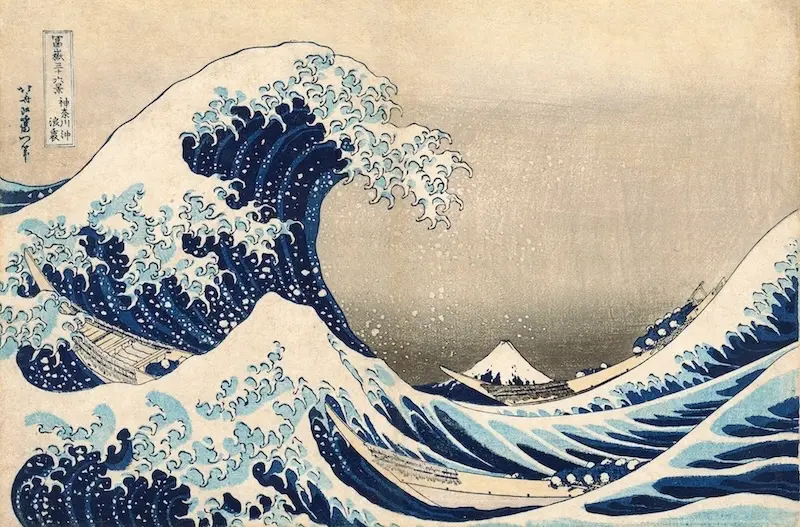
葛飾北斎《冨嶽三十六景 神奈川沖浪裏》東京富士美術館蔵 「東京富士美術館収蔵品データベース」収録
Why did a single woodblock print captivate artists worldwide?
In my last post, I explored ジャポニズム (Japonisme).
A color called “ベロ藍 (Bero-ai, Prussian blue)” sparked a Japan boom across Europe.
This striking blue transformed Japanese 浮世絵 (Ukiyo-e).
It then crossed the ocean to inspire Western painters.
Today, I will introduce Ukiyo-e masterpieces created with Bero-ai.
Ukiyo-e: Art Born from Townspeople Culture
Ukiyo-e originated from the merchants and artisans of Edo.
It reflects a vibrant townspeople culture.
Affordable Art: The Price of a Bowl of Soba
Ukiyo-e prints are traditional Japanese woodblock art.
Once a woodblock is carved, the same image can be printed many times.
This mass production made the art highly affordable.
In fact, one print cost about the same as a single bowl of soba noodles.
Ukiyo-e: Visual Media Before Photography
The Edo period had no photos or TV.
People discovered Kabuki actors and famous landmarks through Ukiyo-e.
It also showed them the latest trends.
Landscape prints let people enjoy beautiful sights without traveling.
Prints of popular actors were like today’s celebrity posters.
Ukiyo-e was beautiful art.
It was also a powerful information medium.
From Hishikawa Moronobu to Nishiki-e
Woodblock printing techniques were essential for Ukiyo-e to evolve.
菱川師宣 (Hishikawa Moronobu) was active in the late 17th century.
He laid the foundation of Ukiyo-e.
At that time, most works were printed only in black ink.
As the prints grew popular, townspeople wanted color.
Later, artists developed a technique to layer multiple carved woodblocks.
This created vibrant, multi-colored prints called 錦絵 (Nishiki-e).
It comes from the Japanese phrase “錦のように美しい絵 (Nishiki no yoni utsukushii e).”
This means “pictures as beautiful as brocade.”
With these bright colors, Ukiyo-e captivated even more people.
Hokusai’s Blue and His Masterpieces
This is 葛飾北斎 (Katsushika Hokusai).
His masterpiece is “富嶽三十六景 (Fugaku Sanjūrokkei,
Thirty-Six Views of Mount Fuji)”.
Hokusai and “Fugaku Sanjurokkei”
This series depicts 富士山 (Fujisan, Mount Fuji) from various locations.
Hokusai had a reason for drawing Fujisan so often.
Fujisan has long been loved as Japan’s highest mountain.
It was also an object of worship, making it special to many people.
Hokusai painted Fujisan from many different viewpoints.
He captured its beauty in a single series.
Among these prints, “神奈川沖浪裏 (Kanagawa Oki Nami Ura,
The Great Wave off Kanagawa)” is famous worldwide.
A giant wave fills the picture.
Fujisan looks tiny in the distance.
This bold composition surprised many people.
Landscapes Painted with Bero-ai
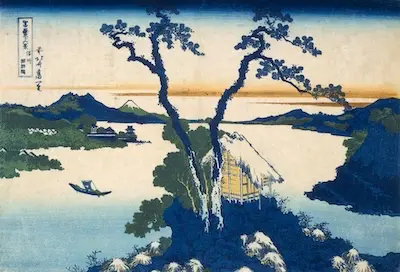
葛飾北斎《冨嶽三十六景 信州諏訪湖》東京富士美術館蔵 「東京富士美術館収蔵品データベース」収録
This series includes many beautiful landscapes.
One of them is “信州諏訪湖 (Shinshu Suwako, Lake Suwa in Shinshu)”.
The foreground depicts Benten Island, which no longer exists today.
In the back left, you can see Takashima Castle.
Behind it, a tiny Fujisan appears.
The blue of Bero-ai fills the entire picture.
While the foreground island is a dark indigo, the lake surface is a lighter blue.
Then, a beautiful gradient spreads up into the sky.
Bero-ai was a vivid pigment.
It did not fade easily.
This bright blue enhanced the beauty of the sky and the lake.
The Beauty Created by Shades of Blue
Hokusai depicted a peaceful lake using shades of blue.
The sky and the lake blend naturally, which gives the artwork a sense of depth.
You can almost feel the crisp, cold air.
Through his use of color, Hokusai captured the very atmosphere of the scene.
For more on Lake Suwa, featured in “Your Name.”, please see this post.
Lake Suwa & “Your Name.” — Landscapes and Language
Hiroshige and the Art of Lines
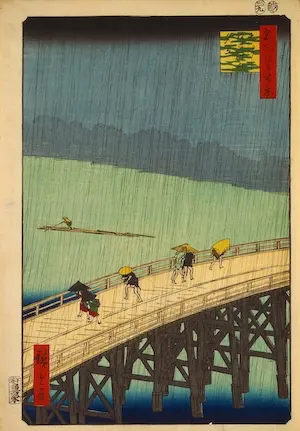
歌川広重《名所江戸百景 大はしあたけの夕立》東京富士美術館蔵 「東京富士美術館収蔵品データベース」収録
On the other hand, 歌川広重 (Utagawa Hiroshige) focuses on the use of lines.
His masterpiece is “大はしあたけの夕立 (Ohashi Atake no Yudachi,
Sudden Shower over Shin-Ohashi Bridge and Atake)”.
Sharp, straight lines depict the intense rain.
These lines capture the sudden shower perfectly.
Viewers can almost hear the sound of the rain, feeling a true sense of realism.
Expressions That Challenged Western Conventions
At that time, European paintings mainly focused on three-dimensionality.
Perspective and shading were emphasized.
On the other hand, Ukiyo-e features flat colors and bold compositions.
Compositions that boldly crop the scene are also often seen.
Clear outlines were also rarely seen in Western painting.
These expressions gave many painters new ideas.
What Van Gogh and Monet Learned
Van Gogh collected Ukiyo-e.
He is also known for copying Hiroshige‘s works.
The vivid blue also strongly attracted him.
Japanese art and Ukiyo-e profoundly influenced him.
Evidence of this impact appears in his own works.
On the other hand, Monet was also a painter who loved Ukiyo-e.
He displayed many Ukiyo-e prints in his home.
What attracted both of them was not just Japanese-style patterns.
Free compositions also captivated them.
They were also drawn to the clear outlines and flat colors.
These expressions were fresh in the West.
Ukiyo-e became a hint for new forms of painting.
The Values Behind the Word “Ukiyo”
To understand Ukiyo-e, it is essential to look at the word “Ukiyo.”
From “Uki-yo” to “Ukiyo”
“浮世 (Ukiyo)” was originally written as “憂き世 (Uki-yo)“.
In Buddhism, this term described the reality of life as full of suffering.
However, the meaning shifted during the Edo period.
It evolved to mean “modern,” “stylish,” or “of the current age.”
Eventually, it came to signify “enjoying the present moment.”
It began to be used in this positive sense as well.
This perspective may be unique to the flourishing townspeople culture.
What Ukiyo-e Conveyed
This mindset is reflected in Ukiyo-e.
All the subjects were familiar to the people of that time.
Edo residents found beauty in their everyday lives.
Ukiyo-e captured these values in a single woodblock print.
They also serve as a clue to understanding the culture and life of the Edo period.
“Enjoying the present moment” was also a key attraction of Edo culture.
Perhaps that was one of its attractions.
Conclusion
Ukiyo-e is more than just beautiful art.
It preserves the daily lives and values of the people of Edo.
This is the very reason it continues to captivate so many people.
It transcends both time and borders.
Discover more about Japanese culture in the Japan & Culture category.
Related Posts

 What Is Japonism?: How Ukiyo-e Captivated Europe
なぜ、一枚の木版画が世界中の画家を魅了したのでしょうか。
前回の記事では、「ジャポニズム」についてご紹介しました。
ヨーロッパで日本ブームが起こるきっかけが「ベロ藍」でした。
その青は、日本の浮世絵を大きく変えます。
そして、海を渡り、西洋の画家たちにも影響を与えました。
今回は、ベロ藍で描かれた「浮世絵」をご紹介します。
浮世絵は町人文化が育てた芸術
浮世絵は、江戸の商人や職人から生まれました。
活気あふれる町民の文化です。
蕎麦一杯で買えるアート
浮世絵は木版画で作られました。
一度版木を作れば、同じ絵を何枚も刷ることができます。
そのため、多くの人が手頃な価格で楽しめる芸術になりました。
値段は、蕎麦一杯ほどだったと言われています。
浮世絵は写真のない時代のメディア
江戸時代には、写真もテレビもありませんでした。
人々は浮世絵を通して、歌舞伎役者や名所、新しい流行を知りました。
旅に行けない人は、風景画を見て名所を楽しみました。
人気役者の浮世絵は、現代のアイドル写真のような存在だったともいわれています。
浮世絵は、美術品であると同時に、情報を伝えるメディアでもありました。
菱川師宣から錦絵へ
浮世絵の発展には、木版印刷の技術が欠かせませんでした。
17世紀後半、菱川師宣が浮世絵の基礎を築きます。
当時は、墨一色で描かれた作品が中心でした。
人気が出るにつれて「色をつけたい!」という町民の欲求が高まりました。
その後、何色もの版木を重ねて刷る技術が発展します。
鮮やかな色彩を表現できる「錦絵」が誕生しました。
「錦絵」とは錦のように美しい絵という意味です。
浮世絵は、さらに人々を惹きつける存在になりました。
北斎の青と名作の数々
葛飾北斎の代表作は『富嶽三十六景』です。
北斎と『富嶽三十六景』
『富嶽三十六景』には、各地から見た富士山が描かれています。
北斎が富士山を何度も描いたのには理由があります。
富士山は、日本一高い山として古くから親しまれてきました。
また、信仰の対象でもあり、多くの人にとって特別な存在でした。
北斎は、さまざまな場所から見える富士山を描きました。
そして、その魅力を一つのシリーズにまとめました。
その中でも『神奈川沖浪裏』は世界的に知られています。
画面いっぱいに広がる大波。
その奥に小さく見える富士山。
大胆な構図は、多くの人を驚かせました。
ベロ藍で描かれた風景
このシリーズには、美しい風景が数多く収められています。
その中の一枚に、『信州諏訪湖』という作品があります。
手前には、現在は存在しない弁天島が描かれています。
左奥には高島城、さらにその奥には小さな富士山が見えます。
画面を包み込むのは、「ベロ藍」の青です。
手前の島は濃い藍色、湖面は少し明るい青。
そして空へと、きれいなグラデーションが広がります。
ベロ藍は発色が美しく、色あせしにくい顔料でした。
この鮮やかな青が、空や湖の美しさを引き立てました。
青の濃淡が生み出す美しさ
北斎は青の濃淡で、静かな湖を表現しました。
空と湖が自然につながり、作品に奥行きを感じさせます。
どことなく、冷たい空気まで伝わってくる気がします。
北斎は色の使い方で、その場の空気まで表現しました。
『君の名は。』にも出てくる諏訪湖についてはこちらをご覧ください。
Lake Suwa & “Your Name.” — Landscapes and Language
広重の雨と『大はしあたけの夕立』
一方、線に注目したいのが歌川広重です。
彼の名作『名所江戸百景 大はしあたけの夕立』です。
激しい夕立の雨が、鋭い直線だけで描かれています。
雨粒を一本一本の線で表現する大胆な手法が特徴です。
それは、当時としてはとても斬新でした。
見る人は、雨音まで聞こえてきそうな臨場感を感じます。
西洋の常識を覆した表現
当時のヨーロッパでは、立体感を表現する絵画が主流でした。
遠近法や陰影が重視されていました。
一方、浮世絵は平面的な色使いや大胆な構図が特徴です。
画面を大胆に切り取るような構図も、多く見られます。
はっきりとした輪郭線も、西洋絵画ではあまり見られませんでした。
こうした表現は、多くの画家に新しい発想を与えました。
ゴッホやモネが学んだもの
ゴッホは浮世絵を集めました。
広重の作品を模写したことでも知られています。
また、鮮やかな青にも強く惹かれました。
浮世絵や日本美術から受けた影響は、自身の作品にも見られます。
一方、モネも浮世絵を愛した画家でした。
自宅には多くの浮世絵を飾っていました。
二人が惹かれたのは、日本らしい模様だけではなく、自由な構図です。
また、はっきりとした輪郭線や平面的な色彩です。
こうした表現は、西洋では新鮮でした。
浮世絵は、新しい絵画表現のヒントになりました。
「浮世」という言葉に込められた価値観
浮世絵を理解するためには、「浮世」という言葉も欠かせません。
「憂き世」から「浮世」へ
「浮世」は、もともと「憂き世」と書きました。
仏教では、苦しみの多い現実世界を表す言葉です。
しかし、江戸時代になると意味が変わります。
「いまどきの」といった流行の最先端を指す言葉として使われるようになりました。
そこから、「今、この瞬間を楽しむ。」
そのような前向きな意味でも使われるようになりました。
町人文化が発展した時代だからこその価値観だったかもしれません。
浮世絵が伝えたもの
こうした考え方は、浮世絵にも表れています。
どれも、当時の人々に身近な題材でした。
江戸の人々は、日常の暮らしの中に美しさを見つけていました。
浮世絵は、その価値観を一枚の木版画に残しています。
江戸時代の文化や暮らしを知る手がかりにもなっています。
そして、「今を楽しむ」という江戸の人々の価値観。
それが魅力の一つだったのかもしれません。
まとめ
浮世絵は、美しい版画というだけではありません。
そこには、江戸の人々の暮らしや価値観が今も残されています。
だからこそ、時代や国を超えて、多くの人を魅了し続けているのでしょう。
日本文化についてもっと知りたい方は、Japan & Culture カテゴリをご覧ください。