

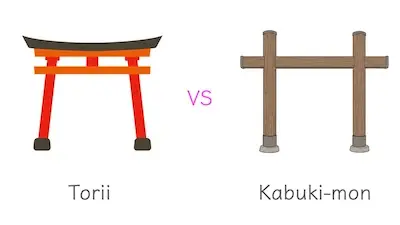
When you visit Japanese shrines, you will see 鳥居 (Torii, Torii gates).
At Japanese temples and samurai houses, you might see a similar gate.
It is called 冠木門 (Kabukimon, Kabukimon gates).
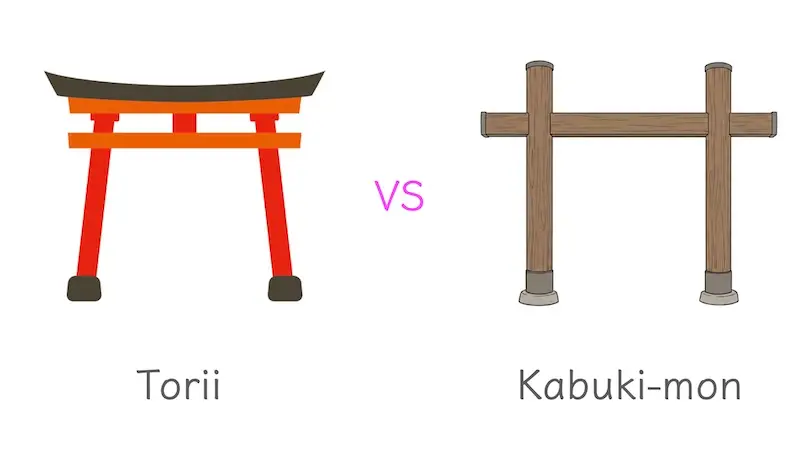
Both are made of two pillars and a crossbar.
They look very similar.
However, their roles and meanings are very different.
In this article, we will explain the differences between Torii and Kabukimon.
I will also explore the traditional Japanese mindset behind them.
Different Number of Crossbars?
Torii and Kabukimon are both made of pillars and crossbars.
However, their structures and roles are very different.
1. Torii (Entrance to the World of Gods)
A Torii is a little different from a regular gate.
In 神道 (Shinto), it is considered a boundary.
It separates the human world from the world of the gods.
Therefore, Torii gates do not have doors.
They are not gates for people to just walk through.
Instead, they mark the entrance to a sacred space.
Another feature is the top crossbar.
It is very long and sticks out on both sides.
This is a common shape for most Torii gates.
Shinto has a unique worldview.
It is said that this mindset is reflected in the shape of the Torii.
2. Kabukimon (Boundary for Human Spaces)
On the other hand, a Kabukimon is a gate for people to pass through.
It does not have a long crossbar like a Torii.
Instead, the pillars stick out slightly above the crossbar.
This is the main feature of a Kabukimon.
Some of these gates also have doors.
Why do the pillars stick out at the top?
To build a Kabukimon, holes are made in the pillars.
The crossbar passes through these holes.
If you make a hole too close to the top of the pillar, it becomes weak.
Therefore, the top of the pillar is left a little longer.
This structure focuses on durability and strength.
Fun Facts from Kanji and Japanese Mythology
The kanji used for their names also show their unique features.
Kabukimon (冠木門)
Kabukimon is written with the kanji for “冠木門.”
“冠木” refers to the crossbar placed on top of the pillars.
The name comes from its shape, which looks like a crown.
It sounds exactly the same as the traditional performing art, 歌舞伎 (Kabuki).
However, they use completely different kanji characters.
Torii (鳥居)
There are various theories about the origin of the word 鳥居 (Torii).
One famous theory is that it means “鳥が居る場所”
(Tori ga iru basho, a place where birds are).
There is a well-known story in Japanese mythology.
It is a story about the sun goddess hiding herself.
To bring her back out, birds were made to sing.
The bird perch used at that time is said to be the origin of the Torii.
Kabukimon at Temples
Kabukimon are not only found at samurai houses.
You can also see them at temples.
Temples have a main gate called a 山門 (Sanmon).
However, other gates are also used on the large temple grounds.
One of them is the Kabukimon.
For example, you can see them at the entrance to a garden or in front of a hall.
They are also used at the entrance to the monks’ living spaces.
A Kabukimon has the role of dividing space.
It is a gate that signals, “A different space begins here.”
Why Are Torii Found Only at Shrines?
Torii are widely known as the symbol of Shinto shrines.
Shrines and Temples Have Different Roots
Japan has both shrines and temples.
Shrines are places of worship for Shinto.
Shinto is the ancient, native belief system of Japan.
On the other hand, temples are places of worship for Buddhism.
Buddhism originated in India.
It later came to Japan through China and the Korean Peninsula.
Shinto and Buddhism have completely different roots.
Therefore, each developed its own unique architecture and culture.
Learn more about Shinto shrines and Buddhist temples here.
[Shinto Shrines and Buddhist Temples]
Shinto and Buddhism Coexisted for a Long Time
Today, shrines and temples are recognized as separate places.
However, they shared a very close relationship in ancient Japan.
In the past, temples were often built within shrine grounds.
It was also common to find shrines located near temples.
We can still see traces of this history today.
Thus, Shinto and Buddhism were deeply connected.
Each belief system has its own unique architecture.
A Torii is a structure that symbolizes Shinto.
Meanwhile, Kabukimon were used for temples and daily living spaces.
This is why Torii are seen at shrines, and Kabukimon are found at temples and estates.
The Boundaries Cherished by Japanese People
Torii and Kabukimon differ in both shape and origin.
However, they share a common role.
That role is to mark a boundary.
To Japanese people, they mean, “A different space begins here.”
In Japan, people have long distinguished between “inside” and “outside.”
These concepts are called Uchi (内) and Soto (外).
Switching the Mindset
For example, people take off their shoes when entering a home.
At shrines, many people bow before a Torii.
These customs share a common purpose.
By crossing a boundary, people switch their mindset.
Under a Torii, they show respect to the gods.
At a temple’s Kabukimon, they focus on the quiet space.
Inside an estate, they value the etiquette of that place.
Torii and Kabukimon are landmarks that show the meaning of a space.
They also help people prepare and calm their minds.
These simple structures show the traditional Japanese mindset.
Conclusion
Torii and Kabukimon have different roles.
Understanding this will make shrines and temples feel closer to you.
Japanese culture is full of fascinating discoveries like this.
Please enjoy exploring Japanese culture along with the language.
Discover more about Japanese culture in the Japan & Culture category.
Related Posts
 Kōhaku in Japan: Why Red and White Mean Good Luck
 What is the Secret of the Maneki Neko?
日本の神社を訪れると、「鳥居」を目にします。
一方、お寺や武家屋敷では、鳥居によく似た「冠木門」を見ることがあります。
どちらも二本の柱と横木でできています。
見た目はよく似ています。
しかし、役割や意味は大きく異なります。
この記事では、鳥居と冠木門の違いをご紹介します。
そして、そこから見えてくる日本人の考え方についても見ていきましょう。
横木の数が違う?
鳥居と冠木門は、どちらも「柱と横木」でできています。
しかし、構造や役割には大きな違いがあります。
1. 鳥居(神様の世界への入り口)
鳥居は一般的な門とは少し異なります。
神道では、神様と人間の世界を分ける「境界線」と考えられています。
そのため、鳥居には扉がありません。
鳥居は、人が出入りするための門ではありません。
神聖な空間への入り口を示す目印です。
また、一番上の横木が左右に長く突き出しているのも特徴です。
この形は、多くの鳥居に共通して見られます。
神道には独特の世界観があります。
そうした考え方が、鳥居の形にも表れていると言われています。
2. 冠木門(人間の空間の区切り)
一方、冠木門は人が出入りするための門です。
鳥居のような長い横木はありません。
横木の上に柱が少し突き出ています。
これが冠木門の特徴です。
扉が付いているものもあります。
なぜ柱が上に突き出ているのでしょうか。
冠木門は、柱に穴を開けます。
そこへ横木を通します。
柱の上端近くに穴を開けると、強度が弱くなります。
そのため、柱を少し長く残しています。
丈夫さを重視した構造です。
漢字と神話が教える豆知識
名前の漢字にも、それぞれの特徴が表れています。
冠木門
冠木門は、「冠木門」と書きます。
「冠木」とは、柱の上に渡す横木のことです。
その形が冠のように見えることから、この名前が付いたと言われています。
伝統芸能の「歌舞伎(かぶき)」と同じ読み方です。
しかし、漢字は異なります。
鳥居
鳥居の語源には、さまざまな説があります。
その一つが、「鳥が居る場所」という説です。
日本神話には有名な物語があります。
太陽の神様が姿を隠してしまったという話です。
その神様を外へ呼び出すために、鳥を鳴かせたと伝えられています。
その時の鳥の止まり木が、鳥居のルーツの一つだとも言われています。
お寺にも「冠木門」
冠木門は、武家屋敷だけにあるものではありません。
お寺でも見ることができます。
お寺には正門である山門があります。
しかし、広い境内では別の門も使われます。
その一つが冠木門です。
例えば、庭園への入り口やお堂の前などに見られます。
僧侶の生活空間への入り口に使われることもあります。
冠木門は、空間を区切る役割を持っています。
「ここから先は別の空間です」と知らせるための門です。
なぜ鳥居は神社だけにある?
鳥居は神社のシンボルとして知られています。
神社とお寺はルーツが違う
日本には神社とお寺があります。
神社は神道の信仰の場です。
神道は日本古来の信仰です。
一方、お寺は仏教の信仰の場です。
仏教はインドで生まれました。
その後、中国や朝鮮半島を経由して日本へ伝わりました。
神道と仏教はルーツが異なります。
そのため、それぞれ独自の建物や文化が発展しました。
神社とお寺の違いは、こちらの記事で紹介しています。
[Shinto Shrines and Buddhist Temples]
神道と仏教は長く共存してきた
現在では、神社とお寺はそれぞれ独立した存在として知られています。
しかし、昔の日本では両者の結び付きがとても強いものでした。
神社の境内にお寺が建てられることもありました。
また、お寺の近くに神社があることも珍しくありませんでした。
現在でも、その名残を見ることができます。
このように、神道と仏教は深く結び付いていました。
それぞれの信仰には独自の建造物があります。
鳥居は神道を象徴する建造物です。
一方、冠木門は、お寺や人々の生活空間で使われてきました。
そのため、鳥居は神社で、冠木門はお寺や屋敷で見られます。
日本人が大切にしてきた境界線
鳥居と冠木門は、形も由来も異なります。
しかし、共通する役割があります。
それは、境界を示すことです。
「ここから先は別の空間です」と伝えています。
日本では昔から、「内」と「外」を区別してきました。
家に入る時は靴を脱ぎます。
神社では鳥居の前で一礼する人もいます。
こうした習慣には共通点があります。
境界を越えることで、気持ちを切り替えます。
神社の鳥居をくぐる時は、神様への敬意を意識します。
お寺の冠木門をくぐる時は、静かな空間に心を向けます。
屋敷の門をくぐる時は、その場所の礼儀を大切にします。
鳥居や冠木門は、場所の意味を示す目印です。
そして、人の心を整える役割も持っています。
シンプルな形の中に、日本人のものの考え方が表れています。
まとめ
鳥居と冠木門には、それぞれ違う役割があります。
その違いを知ると、神社やお寺がもっと身近に感じられるでしょう。
日本文化には、このような面白い発見がたくさんあります。
日本語と一緒に、日本文化も楽しんでみてください。
日本文化についてもっと知りたい方は、Japan & Culture カテゴリをご覧ください。