

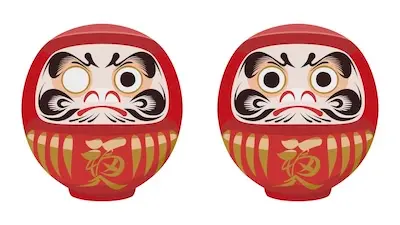
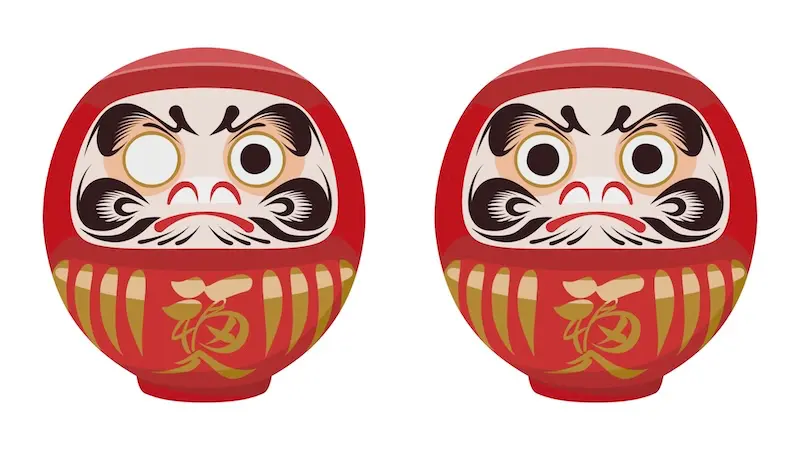
Have you ever seen a round, red doll at a Japanese shrine or temple?
Sometimes, it only has one eye drawn in.
In Japan, we call this a だるま (Daruma doll).
This article explains the meaning and history of Daruma dolls.
It also covers their connection to Japanese shrines.
What is a Daruma Doll?
A Daruma is a lucky charm for making wishes and achieving goals.
It is also popular among foreigners as a goal-setting tool.
Origin: Daruma Daishi (Bodhidharma)
Daruma is modeled after 達磨大師 (Daruma Daishi, Bodhidharma).
Daruma Daishi is the founder of Zen Buddhism.
禅 (Zen) is one type of Buddhism.
Therefore, Daruma’s roots are in Buddhism.
There is a legend that Daruma Daishi practiced 坐禅 (Zazen) for a long time.
It is said that Daruma’s round shape comes from this legend.
七転び八起き (Nanakorobi Yaoki)
Daruma gets back up even if it falls.
This is called “七転び八起き (Nanakorobi Yaoki).”
It means to stand up again no matter how many times you fail.
Daruma holds the wish to keep moving forward despite difficulties.
What Is Daruma Made Of?
Traditional Daruma are made of paper.
Many layers of paper are pasted onto a wooden mold.
After drying, they are removed from the mold and finished.
This technique is called “張り子 (Hariko).”
Because they are made of paper, it is very light.
The Meaning of Daruma’s Eyes
Daruma has no eyes drawn on it.
Why Do You Paint One Eye First?
First, you paint one eye.
Traditionally, people start with the Daruma‘s left eye.
This is to clearly be aware of your goal.
Every time you look at Daruma, you can remember your goal.
Then, you paint the other eye when you achieve your goal.
When Is It Used?
Daruma is used for various wishes.
Companies sometimes display it to wish for business prosperity and success.
In elections, it is used to pray for victory.
Individuals sometimes wish to pass school or certification exams.
Shrines and Daruma
Daruma is a lucky charm originating from Buddhism.
However, it is also often seen at shrines.
Some people may wonder about this.
Why Is It Also Offered at Shrines?
In Japan, Shinto and Buddhism have influenced each other for a long time.
Therefore, Daruma originating from Buddhism is sometimes offered at shrines.
Through such history, Daruma became widely popular.
Even now, it is offered not only at temples but also at shrines.
Especially during 初詣 (Hatsumode), you can see Daruma at many shrines and temples.
Some people welcome a new Daruma during New Year’s.
There is also a custom to return Daruma that finished their role to shrines or temples.
Want to learn more about Japanese New Year traditions?
[Hatsumode in Japan: New Year Traditions at Shrines and Temples]
The Color of Daruma
Daruma is known for its red color.
However, there are Daruma in various colors now.
The Meaning of Red
Red has the meaning of 魔除け (Mayoke, warding off evil).
In old Japan, it was believed that red had the power to keep disasters away.
Red is also used for shrine 鳥居 (Torii, gates) and お守り (Omamori, amulets).
Therefore, red became the basic color for Daruma too.
Even now, red is the most common color.
Modern Daruma
Currently, there are also white, gold, black, and pink Daruma.
Each color holds a different wish.
Also, small Daruma and stylish Daruma are popular.
Some people buy them as souvenirs.
Some people display them as interior decor.
Daruma continues to live in modern life.
Conclusion
Daruma is a Japanese lucky charm originating from Daruma Daishi.
The custom of painting the eyes means to not forget your wish.
It also means to continue making efforts.
Wondering about the difference between shrines and temples?
[Shinto Shrines and Buddhist Temples]
Discover more about Japanese culture in the Japan & Culture category.
Related Posts
神社やお寺で、赤くて丸い人形を見たことはありますか。
片方だけ目が入っていることもあります。
日本では、この人形を「だるま」と呼びます。
この記事では、だるまの由来や意味、神社との関係について紹介します。
だるまとは?
だるまは、願いごとや目標達成を願う縁起物です。
外国人の間では、目標達成のツールとしても人気があります
達磨大師が由来
だるまのモデルになったのは、達磨大師です。
達磨大師は、禅宗の祖とされる人物です。
禅宗は、仏教の一つです。
そのため、だるまのルーツは仏教にあります。
達磨大師には、長い間座禅を続けたという伝説があります。
現在のだるまの丸い形は、その伝説が由来だと言われています。
七転び八起き
だるまは、倒れても起き上がります。
この姿は、「七転び八起き」といいます。
何度失敗しても、再び立ち上がるという意味です。
だるまには、困難に負けず前に進むという願いが込められています。
何でできているの?
伝統的なだるまは、紙で作られています。
木型に紙を何枚も貼り重ねます。
乾燥させた後、型から外して仕上げます。
この技法は「張り子」と呼ばれます。
紙で作られているため、とても軽いのが特徴です。
だるまの目の意味
だるまには、目が描かれていません。
なぜ片目から入れるの?
まず片目を入れます。
一般的には、だるまの左目から描きます。
これは、自分の目標をはっきり意識するためです。
だるまを見るたびに、目標を思い出すことができます。
そして、目標を達成したときにもう片方の目を入れます。
どんな時に使うの?
だるまは、さまざまな願いごとに使われます。
企業では、商売繁盛や事業の成功を願って飾ることがあります。
選挙では、当選祈願として使われます。
個人では、受験や資格試験の合格を願うこともあります。
神社とだるま
だるまは仏教に由来する縁起物です。
しかし、神社でもよく見かけます。
不思議に思う人もいるでしょう。
なぜ神社でも授与されるの?
日本では、神道と仏教が長い間影響し合ってきました。
そのため、仏教由来のだるまが神社で授与されることもあります。
そのような歴史の中で、だるまは広く親しまれるようになりました。
現在でも、お寺だけでなく神社でも授与されています。
特に初詣の時期には、多くの神社やお寺でだるまを見ることができます。
お正月に新しいだるまを迎える人もいます。
また、役目を終えただるまを神社やお寺に納める習慣もあります。
日本のお正月について知りたい方はこちらもご覧ください。
[Hatsumode in Japan: New Year Traditions at Shrines and Temples]
だるまの色
だるまといえば赤色です。
しかし、現在ではさまざまな色のだるまがあります。
赤色の意味
赤色には魔除けの意味があります。
昔の日本では、赤色には災いを遠ざける力があると考えられていました。
神社の鳥居やお守りにも赤色が使われています。
そのため、だるまも赤色が基本になりました。
現在でも、赤色は最も一般的な色です。
現代のだるま
現在では、白や金、黒、ピンクなどのだるまもあります。
色ごとに異なる願いが込められています。
また、小さなだるまやデザイン性の高いだるまも人気です。
お土産として購入する人もいます。
インテリアとして飾る人もいます。
だるまは、現代の暮らしの中にも生き続けています。
まとめ
だるまは、達磨大師に由来する日本の縁起物です。
目を入れる習慣には、願いを忘れず努力を続けるという意味があります。
神社とお寺の違いに興味がある方は次の記事をご覧ください。
[Shinto Shrines and Buddhist Temples]
日本文化についてもっと知りたい方は、Japan & Culture カテゴリをご覧ください。