

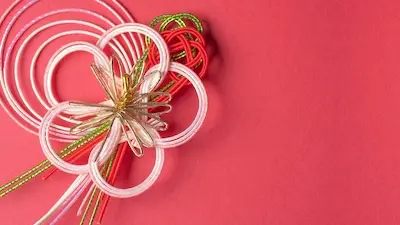

Japanese people often tie colorful, beautiful cords on gifts.
Did you know there are hidden meanings behind these decorations?
They are called 水引 (Mizuhiki), traditional Japanese decorative cords.
Previously, I introduced the Japanese culture of “結ぶ (musubu, tying).”
Mizuhiki is a special tradition born from that exact culture.
The History of Mizuhiki
I will introduce its history era by era.
The Asuka Period: The First Cords
The origin of Mizuhiki dates back to the Asuka period (飛鳥時代).
A Japanese envoy returned from China.
He brought back special gifts.
Red and white hemp cords were tied around the gift boxes.
It served as a charm for a safe voyage.
Knots also proved that the boxes were unopened.
Japanese people at that time were deeply moved by this beautiful custom.
They began tying similar red and white cords on gifts to the imperial court.
The Heian to Muromachi Periods: Evolution to Paper
As time passed, the materials changed greatly.
They changed from the previous hemp cords to special 和紙 (Washi) cords.
It is a technique of applying glue to the paper and drying it to make cords.
This method led to the phrase 水を引く (Mizu o hiku, “pulling water”).
It is said that the name Mizuhiki was born from this.
Also, around this time, the etiquette for tying knots began to be created.
Rules were gradually established among samurai warriors.
The Edo Period: Spread and Etiquette
During the Edo period, the production of Washi increased.
Thanks to this, Mizuhiki became a familiar material for ordinary people.
People began using Mizuhiki for weddings and important gifts.
Around the same time, Japanese commerce developed rapidly.
Merchants began exchanging mid-year and year-end gifts.
Also, at 寺子屋 (Terakoya, temple schools), children were taught how to tie Mizuhiki.
During this era, detailed rules for colors and tying methods were completed.
The etiquette for celebratory and mourning occasions was established.
Even Though It Is Paper, Why Is It So Strong?
The material of Mizuhiki is 和紙 (Washi, Japanese paper).
However, it feels as strong as a metal wire when you touch it.
Why is it so strong even though it is paper?
Artisans have an amazing technique for this.
First, finely cut Washi is twisted into a cord shape.
This paper cord is called こより (Koyori, paper cord).
Next, they harden the koyori with 糊 (Nori, glue).
By doing this, it becomes unbelievably strong for paper.
Finally, gold and silver threads are wrapped around the surface.
In this way, Mizuhiki as beautiful as a jewel is completed.
When Is It Used?
Mizuhiki is essential for important scenes and events in life.
It is broadly divided into two groups based on meaning and purpose.
Celebrations and Mourning Occasions
Weddings and funerals are typical examples.
Two wishes are included in the Mizuhiki for these events.
One is the wish that “it will not be repeated.”
The other is the wish that “it ends with just this one time.”
Therefore, people use a knot that is not easily untied once tied.
- お祝い事 (Oiwai-goto, Celebrations)
Gorgeous gold and silver or red and white cords are used. - お悔やみ事 (Okuyami-goto, Mourning occasions)
Black and white or silver cords are used.
Annual Events
Mizuhiki is sometimes used for decorations.
It is often seen in お正月飾り (Oshogatsu kazari, New Year’s decorations).
Originally, it meant “something pure and clean.”
Now, it contains the wish to “tie people together, and tie people to gods.”
Modern Mizuhiki: Stylish Accessories!
In modern Japan, Mizuhiki has been newly reborn.
The cords are highly popular as “stylish fashion items.”
Earrings and hair accessories, in particular, are attracting a lot of attention.
A major feature is their “surprisingly light” weight.
This lightness comes from the use of Washi.
Even with large designs, they are not uncomfortable to wear for a long time.
You can enjoy items that blend tradition and modern styles in your daily life.
In this way, Mizuhiki still remains in people’s lives today.
Useful Japanese Words for Gift-Giving
Here are some Japanese words that appeared in this article.
お祝い (Oiwai, Celebration)
This refers to happy events like birthdays or weddings.
It also refers to the gift itself.
ご祝儀 (Goshugi, Wedding Gift Money)
This refers to money given as a celebration gift.
のし袋 (Noshibukuro, Ceremonial Envelope)
This is a special envelope for giving money as a gift.
It is decorated with beautiful Mizuhiki.
お悔やみ (Okuyami, Condolences)
This refers to sad events like a funeral.
It also expresses sympathy for the other person.
お正月飾り (Oshogatsu kazari, New Year’s Decorations)
These are decorations to welcome the gods for the new year.
People display them at their entrance during the holiday season.
Conclusion
水引 (Mizuhiki) represents the spirit of connecting people.
It remains a vital part of Japanese gifts and decorations.
This culture truly reflects the Japanese heart of “kindness and consideration.”
Japanese has many expressions that value “tying” and “connection.”
Learning the language with its culture makes it feel more natural.
Discover more about Japanese culture in the Japan & Culture category.
Related Posts

日本人が贈り物に結ぶ、色鮮やかな美しい紐。
あの飾りには、大切な意味や願いが隠されているのをご存知ですか?
それが、日本の伝統的な飾り紐「水引」です。
以前、「結ぶ」文化についてご紹介しました。
水引は、その「結ぶ」文化から生まれた、日本ならではの伝統です。
水引の歴史
その歴史の流れを、時代ごとにご紹介します。
飛鳥時代:始まりの紅白紐
始まりは飛鳥時代に遡ります。
日本の使者(遣隋使)が、中国から帰国しました。
彼が日本へ持ち帰った品物は、中国からの贈り物でした。
その箱には、紅白の麻紐が結ばれていました。
これは航海の無事を願うお守りです。
また、「未開封である」という証明でもありました。
当時の日本人は、この美しい習慣に深く感動しました。
そして、宮中への贈り物にも、同じように紅白の紐を結び始めました。
平安〜室町時代:紙への進化
時代が進むと、素材が大きく変わります。
これまでの麻紐から、特別な「和紙」の紐になりました。
和紙にのりを引き、乾燥させて紐を作る技術です。
この製法から「水を引く」という言葉に繋がりました。
ここから「水引」という名前が生まれたとされています。
また、この頃から結び方の作法も作られ始めました。
武士たちの間で、徐々にルールが整えられていきました。
江戸時代:広がりとマナーの完成
江戸時代になると、和紙の生産が増えました。
そのおかげで、水引は一般の庶民にとって身近な素材になりました。
人々は結婚式や大切な贈り物に、水引を使い始めました。
同じ頃、日本の商業も盛んに発展しました。
商人たちの間で、お中元やお歳暮を贈り合う習慣が生まれます。
また、寺子屋でも、子供たちに水引の結び方が教えられました。
この時代に、細かい色や結び方のルールが完成します。
お祝い事やお悔やみ事のマナーが確立されました。
紙なのに、なぜこんなに強いの?
水引の素材は和紙です。
しかし、触ってみると金属のワイヤーのように丈夫です。
なぜ紙なのに、これほど強いのでしょうか。
そこには、職人の素晴らしい技術があります。
まず、細く切った和紙をねじって紐状にします。
この紙の紐を「こより」と呼びます。
次に、このこよりを糊(のり)で固めます。
こうすることで、紙とは思えないほど強くなります。
最後に、表面に金糸や銀糸を巻きつけます。
こうして、宝石のように美しい水引ができあがります。
どんな時に使うの?
水引は、人生の大切な場面や行事で欠かせません。
意味や目的によって、大きく2つのグループに分かれます。
お祝い事とお悔やみ事
結婚式とお葬式が代表例です。
この時の水引には2つの願いが込められています。
一つは、「繰り返すことのないように」という願いです。
もう一つは、「今回一度で終わるように」という願いです。
そのため、一度むずんだら簡単にはほどけない結び方をします。
- お祝い事: 金銀や紅白の華やかな紐を使います。
- お悔やみ事: 白黒や銀色の紐を使います。
年中行事
お正月飾りなどにも水引が使われることがあります。
元々は、「無垢で清潔なもの」を意味しました。
今は、「人と人、人と神を結ぶ」という願いが込められています。
他にも、行事の飾りや、縁起物として使われることもあります。
現代の水引:おしゃれなアクセサリー!
現代の日本では、水引が新しく生まれ変わっています。
「おしゃれなファッションアイテム」として大人気です。
特にピアスやヘアアクセサリーとして注目されています。
最大の特徴は「驚くほど軽い」ことです。
素材が和紙だからです。
大ぶりなデザインでも、長時間つけていて苦になりません。
伝統とモダンが融合したアイテムを、日常の中で楽しむことができます。
このように、水引は今も人々の生活の中に残っています。
覚えておきたい!贈答の日本語
この記事に出てきた、日本語をいくつかご紹介します。
- お祝い
誕生日や結婚などのおめでたいイベントです。
その贈り物のことも指します。 - ご祝儀
お祝いとして贈る「お金」のことです。 - のし袋
お祝いのお金を入れる特別な封筒です。
美しい水引がついています。 - お悔やみ
お葬式などの悲しい出来事です。
相手を思いやる気持ちも表します。 - お正月飾り
新しい年の神様を迎えるための飾りです。
行事の時に家の玄関に飾ります。
まとめ
水引は、人と人を結ぶ気持ちを表わしています。
今でも、贈り物や飾りの中に残っています。
日本らしい「思いやり」が見える文化の一つです。
日本語には、「結ぶ」や「つながり」を大切にする表現があります。
日本文化についてもっと知りたい方は、Japan & Culture カテゴリをご覧ください。